

How to Hike Cotopaxi Volcano
and visit the National Park
Cotopaxi, an active volcano located near Quito, is a beacon of natural beauty and one of Ecuador’s most iconic landmarks. Its distinguished conical shape, crowned with a glistening glacier, can be seen from miles around. No wonder, it is the second main attraction in Ecuador (after the Galapagos) and one of the best day trip from Quito.
As you approach Cotopaxi, the landscape unfolds into a dramatic panorama of rugged terrain, wild vegetation, and the sky-touching peak of the volcano itself. But this majestic volcano isn’t just a sight to behold; it’s a call to adventure! Near its summit lie the Cotopaxi refuge and the glacier, both of which are accessible to those determined enough to make the journey.
Many choose to explore Cotopaxi through organized tours from Quito or Baños, enjoying the convenience and information that these guided trips provide. However, for those with a spirit of adventure and independence, there are several ways to experience Cotopaxi’s wonders without a guide.
Embarking on a journey to hike Cotopaxi Volcano and visit the national Park is unforgettable and a must-do while in Ecuador. In this guide, we are sharing all the information you need to get to the Cotopaxi national park, Hike to the Refuge or organise for other fun activities like mountaineering or biking! Let’s get to it…
How to get to Cotopaxi National Park
The Cotopaxi National Park is situated about 1 hour south of Quito and 30 minutes north of Latacunga. It hosts one of the most active and highest volcanos in the world, Cotopaxi.
This Stratovolcano last erupted for 6 months in 2015 which meant it was closed to the public until October 2017. Fortunately, the volcano is since accessible and is an exceptional site to visit for a
There are different way for you to visit the park depending on what you want to do there.
Local transport
There aren’t public buses that enter the Cotopaxi National Park itself. However, whether you come from Quito, Latacunga or Baños, you can ask to be let off on the Panamerica (E35) at the Cotopaxi junction where you will need to make your way, either by hitch-hiking or hiring a local guide.
For this, you will need to ask the bus driver to drop you off at the turn to Cotopaxi National Park (in spanish tell the driver: “A la Ingressa del Parque Nacional Cotopaxi“). Map Cost is usually from $1 to $2 per person depending on where you come from.
Hitch-hike
Hitch-hiking to the park, especially on weekends, is a popular option due to the higher volume of local traffic. It’s common to see hitch-hikers heading towards the lagoon or the closer car park of the Cotopaxi refuge. If hitch-hiking from the Latacunga village seems daunting, consider taking a taxi to the park’s entrance, where you might have better luck finding a ride
This is how we visited Cotopaxi. At the end of this article we are sharing more of our experience hitch-hiking and hiking Cotopaxi! It was for sure an adventure, but one we absolutely loved.
Rent a car
Renting a car offers the flexibility and convenience of exploring Cotopaxi National Park at your own pace. Car rentals are available in Quito, Latacunga, and other major cities.
When renting, ensure that the vehicle is suitable for high-altitude and potentially rough terrain. It’s advisable to have a 4WD for a more comfortable and safer journey. Make sure to carry a valid driver’s license, understand the local driving laws, and have a good map or GPS.

BEST ONLINE CAR RENTAL COMPARATOR – DISCOVER CARS
When booking a rental car in Ecuador online, we recommend using Discover Cars because they offer Full coverage for less than €7. It is one of the best rental car comparators out there!
Take a guided tour
For those who prefer a more structured experience, local guides can be taken from the main cities in Ecuador.
Alternatively, some guided tour are often found near the bus drop-off point at the entrance of the park, offering transport to the refuge and back, typically starting at $30 per person. They will also give you the option to do cycle back down the volcano for an extra $10. However, it is hard to say if you will find any of those during your visit, so if you aren’t ready to gamble it, you can book a tour from Quito instead.
If you want to take a tour to Cotopaxi Volcano, here is a list of recommended guided trips:
- From Quito: Cotopaxi National Park Full-Day Tour with Hike
- Full-Day Tour Cotopaxi National Park – All included from Quito
- Cotopaxi Tour from Quito with Hike to Refuge
- Quito-Cotopaxi-Quilotoa: Full-Day Adventure
Psst! Despite the claim of included entrance fees, remember that there is no admission charge to Cotopaxi National Park, though carrying your passport is necessary. See our paragraph about all the important things you need to know before visiting Cotopaxi.
Take a Taxi
If hitch-hiking or renting a car isn’t an option, hiring a taxi is a viable alternative. Taxis can be arranged to take you from the junction directly to the park entrance or even further to specific destinations within the park. Discuss and agree upon the fare beforehand to avoid any confusion later. While this option might be costlier, it provides a direct and comfortable journey to the park.

Hiking Cotopaxi Volcano without a guide (to refuge)
The most popular activities is hiking from the car park (4,500 meters) to the Refuge Jose Rivas at 4,800 meters, and then onwards to the edge of the Cotopaxi Glacier. While 300 m elevation doesn’t seem much, above 4,000 it can be quite a challenge even for the fitter.
1. Drive to the Refuge Jose Rivas Car Park
First, make your way to the Cotopaxi Volcano Car Park. It is about 15km (9 miles) from the National Park entrance. The route follows a main dirt road, known as the “Cotopaxi Park Road,” which leads directly to the car park area. This road is generally well-marked with signs pointing towards the parking area and the refuge, but it is not for the faint of heart. Make sure to visit with good weather as rain and wind can be quite dangerous.
From the visitor Center, drive about 6km on the main road, passing the Laguna De Limpiopungo on your left. There is a right turn about 2km after the laguna that winds up to the Cotopaxi Car Park. This 8km road leading to the refuge is notably steep, with certain sections reaching a whooping 14%. Throughout this stretch, there is an elevation gain of more than 700 meters on lose rock. At this altitude, the atmosphere is so thin that it can affect the car’s power (read our experience with an old Volkswagen Beetle here!).

2. Hike to the Refuge Jose Rivas and Cotopaxi Glacier
Once at the car park, there are two ways to hike up, the “zig-zag” trail and the “straight forward” route. Of course, we would recommend taking the zig-zag trail which is easier to climb as the straightforward route is very steep and has a lot of loose rocks.
To hike from the car park at 4,500 m to the refuge at 4,800 m, it should take between 1.5 to 2 hours, depending on how fit, prepared and acclimatized you are. Then, you can take an additional 40-minute walk to the edge of the Cotopaxi Glacier to have a better view over the national park and see the glacier from up close.
At this altitude
Earth’s closest place to the moon
Once at the Refuge Jose Ribas, you can ask the owner to stamp your passport for $1. We thought that was pretty cool as Cotopaxi is also one of the only places on Earth where you may end up being the further away from the Earth’s centre, or if you prefer, the closest to outer space (and the moon!). That definitely deserved a stamp!
Did your brain just freeze? haha yeah, let’s do math! Mount Everest is the highest peak in the world if we count the elevation from sea level. However, Chimborazo (the highest peak in Ecuador) and Cotopaxi (the second) are so close to the Equator line that it makes them the highest mountains above the Earth’s Centre and therefore the closest to the moon, space, sun, etc!

Other Things To Do In Cotopaxi National Park
Climbing Cotopaxi Volcano (with a guide)
Climbing the Cotopaxi Volcano is a sought-after challenge for many adventurers. Standing at 5,897 meters (19,347 ft), it is one of the highest active volcanoes in the world. Due to its high altitude and technical paths, climbing Cotopaxi requires a certified guide, proper gear, and acclimatization to the altitude.
Climbing Cotopaxi is strenuous and requires excellent physical condition. You will to spend a few days at high altitude locations in Ecuador to acclimatize your body prior to climbing to the summit. Hiring a certified and experienced guide is mandatory. They ensure your safety and provide necessary climbing equipment which is necessary.
The climb usually begins at the José Rivas Refuge, near the car park, and typically involves a midnight start to reach the summit for sunrise. The route is strenuous, involving glacier travel and steep slopes, and can take anywhere from 6 to 8 hours for a round trip. Climbers need to be equipped with insulated boots, ice axes, crampons, helmets, and appropriate clothing for sub-zero temperatures.
Cotopaxi Volcano Biking
Mountain biking down the slopes of Cotopaxi Volcano provides an adrenaline rush unlike any other. This fun activity usually starts from the parking lot nearby the José Rivas Refuge. The descent is fast and requires a good handle on the bike due to the loose gravel and sharp turns, making previous mountain biking experience beneficial.
The entire ride down takes about 2-3 hours, offering not just an exciting physical challenge but also a unique experience of the surrounding park. Many local tour operators offer bike rentals from Quito:
Horse Riding around Cotopaxi National Park
For a more relaxed yet equally enriching experience, horse riding through the vast highlands of Cotopaxi National Park is a fantastic option. Local operators offer horseback tours that cater to all skill levels, from beginners to experienced riders.
These tours take you through open fields, pine forests, and along the slopes of Cotopaxi and other nearby volcanoes. As you ride, keep an eye out for the park’s wildlife, including wild horses, Andean foxes, and various bird species.
Some tours also include cultural aspects, such as visits to local communities or historical haciendas, providing insight into the local way of life. While horse riding is less strenuous than climbing or biking, the high altitude still requires visitors to stay hydrated and take regular breaks. Dressing in comfortable, warm clothing and sturdy boots is also advised due to the rapidly changing weather.
Here are some Horse Riding in Cotopaxi National Park you can book online:

Important information to visit Cotopaxi National Park
Entering Cotopaxi National Park is relatively straightforward, but there are a few important details you should be aware of to ensure a smooth visit. Here’s what you need to know about permits, fees, and regulations.
There are No Entrance Fee
Cotopaxi National Park does not charge an entrance fee. Visitors are free to explore the vast beauty of the park without worrying about admission costs. However, always carry your passport or a copy of it, as you may need to show identification at the park entrance or checkpoints.
Registration at the Entrance
Upon arrival, you will be required to register at the entrance or at a nearby control point. This process is usually quick, involving providing your name and passport or ID number. It’s a safety measure that helps park authorities keep track of visitors in case of emergencies.
Guide Requirements for Summiting
If you plan to summit the Cotopaxi Volcano, it’s mandatory to hire a qualified guide. This regulation ensures the safety of all climbers, as the conditions can be challenging and require technical mountaineering skills. Guides can be arranged through local tour operators or at the mountain guide association in the area.
This is not valid if you only plan to hike around the national park or to the Refuge Jose Ribas. Pass the Refuge, you must have a guide.
Environmental Regulations
Cotopaxi National Park is a protected area, and visitors are expected to follow strict environmental regulations to preserve its natural beauty:
- No Littering: Carry all trash and waste out of the park.
- Stick to Trails: To prevent erosion and protect plant life, always stick to marked trails.
- Wildlife: Do not disturb or feed the wildlife. Maintain a respectful distance.
- No Collecting: Taking rocks, plants, or other natural elements from the park is prohibited.
Weather and Clothing
The weather in Cotopaxi can be unpredictable and change rapidly. You should come prepared with warm, waterproof clothing, and appropriate footwear.
Altitude of Cotopaxi, be prepared
The high altitude can also affect individuals differently, so take precautions to avoid altitude sickness, including proper acclimatization.

Where to stay in and around Cotopaxi
We went to Cotopaxi after our 3-day hike to the Quilotoa Crater Lake. After the hike, we spent the night in Latacunga and took an early bus that passed by
Hostel Sendero de Volcanes: this is where we stayed after our hike. The hostel is quiet, clean with a kitchen and a rooftop bar. The price was very affordable: $17 for a double room with a shared bathroom or $10 for a dorm. Not sure if breakfast was included as we had to leave very early in the morning to hike the Cotopaxi volcano on our own.
We liked the fact it was lively and that most people were getting prepared for the different hikes in the area. A great thing if you are looking for travel buddies.
Hotel Endemo:
Here are a couple more places you might be interested in chekcing out:
- Hotel Huasicama: A peaceful place in Latacunga with breakfast, free tea, and a beautiful terrace offering views of Cotopaxi. ($13/night)
- Rondador Cotopaxi: Situated in Chasqui, it offers an amazing view of the volcano, professional service, and tour arrangements. ($24/night)
- Hosteria Tambopaxi Lodge: Hosteria Tambopaxi Lodge is a notable accommodation within Cotopaxi National Park, offering spectacular views of Cotopaxi Volcano and various amenities. The lodge provides garden views, a shared lounge, free WiFi, and private parking
- Hotel Casa Sakiwa: Located in Machachi, it provides a cozy stay with amenities like unlimited tea and thermal bed sheets. ($42/night)
- Hacienda El Rejo: offers a panoramic mountain view and various amenities including a restaurant, bar, garden, and playground. Guests enjoy free WiFi, parking, and access to a sun terrace.
- REEC Latacunga by Oro Verde Hotels: This boutique hotel in Latacunga boasts modern amenities, impeccable service, and a variety of breakfast options.($85/night)

Hitch-Hiking to the refuge, our experience
We started to hitch-hike near the Panamerica where the bus from Latacunga dropped us off. We walked a bit through the little village Chasqui, before being picked up by an Ecuadorian family. The drive took about 15 minutes to the entrance of the National Park through a steady steep road.
After the formality of registering with the park rangers, the family drove up through a dense forest until we reached a vast plain at the feet of the Cotopaxi volcano. Here, there is not much vegetation, the landscape is dry, almost arid with no more than a couple of bushes. As the family turned left towards the laguna Limpiopungu, we set off to walk along the gravel road looking for our next ride.
We didn’t mind walking. The views of the surrounding
In the national park, there aren’t many roads and any car passing by is more than likely going to the refuge. However, it took us about 40 minutes more until we got picked up again. During that time a couple of cars passed us, but they were already full. The car which picked us up was probably our best ride ever.
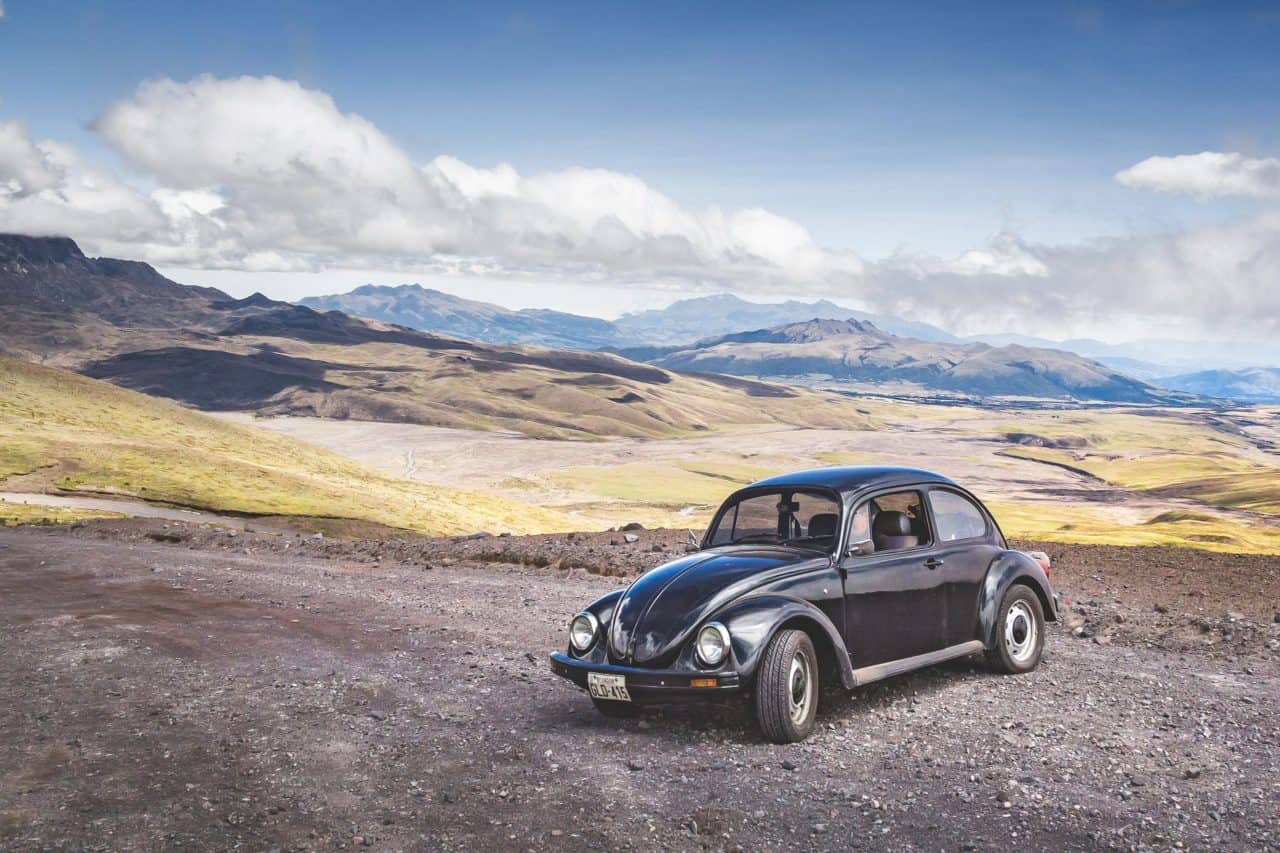
We were being picked up at 4,000 metres above sea level by an old Volkswagen Beetle! At this altitude, the thin atmosphere can affect the car’s engine and decrease the acceleration or climbing power. So imagine 4 people plus a lot of luggage trying to drive a 10% incline gravel road… We seriously didn’t think we were going to make it to the top. And we didn’t. About 600 m away from the car park, the car stopped with big difficulty to start again.
The owner didn’t seem to be worried and stopped a car for us so we could continue our way to the refuge. At that time, his son managed to get the car going again and followed us in our 3rd ride, a huge
We cut short our time at the refuge due to Jenny feeling a bit dizzy and nauseous and decided to hike all the way down and hitch-hike back to the Panamerica later. We just wanted to spend more time in the park, appreciating this gorgeous day at the Cotopaxi. It took us about 2 hours to walk down to the plains, where a car brought us on a bumpy ride to the national park museum before dropping us off at our bus stop to Quito.
In total, we took 4 cars, but you might as well end up with people who will drive you around with them for the day. Hitch-hiking is full of surprises and you never know on which adventure you are going to end up. This is also the beauty of hitch-hiking, meeting people, changing plans and seeing another part of the place.

What to pack to hike Cotopaxi volcano
You don’t need much for this day trip to the Cotopaxi volcano. Just make sure to bring a few layers for any and all types of weather. At this altitude, the weather changes very fast and it can really be chilly even with a strong sun shining down.
We would recommend wearing a good pair of shoes because the hike to the refuge is on gravel and loose rocks. You will need to correctly protect your ankles.
Another important piece of gear that not many travellers carry is hiking poles. We can assure you these are absolutely necessary when you plan on trekking or hiking at high altitudes. We see 3 main reasons: it helps with balance, it saves your knees from pain and injury (in the long term) and reduces your effort. When hiking at high altitudes, having hiking poles is a must to spend less energy and find a good rhythm.
Bring enough water. At altitude, your body works twice as much with less oxygen. Headaches are often due to dehydration. 2 litres per person would be a minimum. Here is a good water bladder for any type of exercise and a bag.
FAQ about Cotopaxi National Park

ARE YOU ON PINTEREST?
What about saving this post to your Pinterest board? Click on the photo to save this blog post for later.
We are also on the platform and we love pinning great travel tips. Follow Tales From The Lens’ boards to see our latest pins.
Don’t be shy, come say hi!
Please note │ This blog post may also include affiliate links to hostels or products we recommend, which means if you buy something following a link on this page, we’ll get a small commission. This will be of no extra cost to you but will help us continue running this blog. Thank you for your support.

About the Author
Jen is the Funder, Author & Photographer behind Talesfromthelens.comJen has lived for the past 15 years across Oceania and Ireland while also travelling in Latin America, North America, and Europe. She has visited more than 65 countries and set foot on every continent in the world! She is a coffee nerd, passionate about photography, wildlife, and outdoor activities.
For more info, check out the About page.
Can you hike up to the refuge and glacier in one day?
what’s the timeline on this hike? I’m wondering if I can take the bus back to quito after the hike
Hi Joy, Yes you can!! the hike from the car park to the refuge and glacier take only a couple of hours. It is the transport from the main road to the car park that can take time if you decide to hitch-hike. In this case, I would recommend you to take the earliest bus to the junction from wherever you are staying the night before (Latacunga would be best), then hire a taxi from the junction to drive you to the car park and back. You will have enough time to get back to Quito after. A lot of people do this hike on a day trip. Let me know how it goes!
Hello Jenny,
Thanks for posting your experience hiking Cotopaxi.
I’d like to do the 2-hike to the summit (make it to base camp the first day and then hike to the summit beginning early the next morning). Do you know anything about hiring a guide to do that instead of just making it to the glacier below? I’ve read that it can be done but don’t know many details. Any information that you have on that I’d greatly appreciate.
Thanks again.
Todd
Hi Todd, as far as I know, you can take a tour from Quito or if you go to a hiking shop near Foch square, you can ask them as they have guides’ contact. Though, I think it is probably best to find people who have done the hike before and can recommend a guide. Have you tried Facebook groups? You might be able to find fellow travellers with good contacts.
Unfortunately, I don’t have this and don’t know anyone who went (the summit was closed for a few months because of the volcano activity). I hope you find a guide and don’t hesitate to share your experience with me so I can relay the info to other readers 😉