

Easter Island | The Best Budget Self-Guided Itinerary
Travelling to Easter Island is a big deal and making sure to have the best time visiting all the amazing and mysterious archaeological sites should be your main concern.
For those who decide to not take a tour to visit the different sites on the island, it is easy to rent a car and drive around, but for those on a budget, it can be a bit more complex. Well, we got you covered! In this article, we are sharing our best 5-day budget self-guided itinerary. Explore Easter island by car, bike and on foot for just above €600 per person, flights included. Dare to learn how to do that? Keep reading!
As you land on Easter Island you definitely reach another level of “the middle of nowhere”… This tiny dot in the Pacific Ocean is the most remote piece of inhabited land on earth. For years the mysteries of the island have intrigued us, so we made it a must-see while travelling South America.
It is simple, to get to this Chilean island, it is required to cross at least 3,500 km of sea from either the South American continent, Polynesia or New Zealand. No wonder the island is renowned for its mysterious culture and history that involves a collapsed civilisation, many toppled head statues and bird-man stories.
Easter Island | The Best Budget Self-Guided Itinerary
About Easter Island
Easter Island was named by the Dutch navigator Jacob Roggeveen, who was the first to set eyes on the island on Easter Sunday, 1722. The island’s name in Polynesian is “Rapa Nui” which means Big Rapa for its resemblance to the island of Rapa, in South Polynesia.
Since the internet has reached the island and with daily flights from/to Santiago de Chile and Tahiti, Easter Island has only a taste of remoteness through its location. However, if the only village on the island doesn’t feel remote, you are immediately called back to what the island used to be as you start exploring it.
The landscape has been shaped by successive eruptions from three volcanoes and centuries of not-so-Pacific waves… When the first inhabitants, “Hotu Matua” believed to come from Polynesia, arrived between 400 and 700 CE, the island was covered with a native Palm tree. Now extinct, it is thought the trees were cut down in favour of crops and never regenerated…
Easter Island is mostly known for its famous Moai statues that can only be found on the island.

Getting to Easter Island on a budget
There are only two airports with Easter Island as a destination: Santiago de Chile (LAN airline) and Papeete (Air Tahiti airline). We booked our flights from Santiago de Chile three months in advance. We set up a Google flight alert and received an email regarding a drop in price. Instead of a normal €700 return plane ticket with LAN, we got it for €350 each. A bargain if you are already in Chile or are planning to be.
During the low season, the cheapest you can get from Chile will be €320. From Tahiti, if you book in advance you can expect about €430 return.

Budget Accommodation on Easter Island
Staying on Easter island isn’t cheap. If you are on a budget there are two solutions to keep the spending under control: camping and hostelling or not booking anything!
While the first option is definitely the cheapest, you’ll need to make sure to book the only camping/hostel on the island well in advance. For the second option, be aware that it is risky and that once at the airport you will need to ask around for a room or go to the centre and do the same.
As for us, we decided to take the risk and did not book anywhere to stay. We hoped the hostel would still have beds but that wasn’t the case. For a little while, we thought we were stuck… But once outside the airport, while hosts are awaiting their guests with flower necklaces in hand, others are offering rooms. We met a lady who offered us a cabana for CLP30,000 (€40) per night only.
We thought it was a very good price as we were used to paying between CLP 10,000 – 15,000 per person in Patagonia. Therefore, we agreed and hopped in the car with our new host. Our cabana consisted of 2 bedrooms, a double and a dorm, plus a kitchen, a living room and a deck. All just for us! We were a bit outside of the centre of Hanga Roa but nothing that couldn’t be done on foot or by taxi. Sometimes taking risks pays off, but we were lucky. Depending on the season, it is wiser to book ahead anyway.
Best places to stay on Easter Island
- $ – Campsite and hostel Mihinoa – min. 3 nights – tent €18 per person / €25 shared dorm / €53 double
- $ – Camping Moehiva – €13 for a tent
- $$ – Cabañas Uka Vaikava – 1 bedroom house €68 – 2 rooms €75
- $$ – Cabañas Vaiora – €70 for a double / €80 for a bungalow
- $$$ – Taha Tai – €152 for a double
- $$$ – Inaki Uhi Hotel – €160 for a double
- $$$$ – Hotel Hangaroa Eco Village & Spa – €750 for a double
Top 8 Things to do on Easter Island
1. SUNRISE AT AHU TONGARIKI

This is probably the most meticulously restored Ahu on the island. Here, you can see 15 standing Moai. Only one, however, wears its Pukao! 220 metres long, Ahu Tongariki is the largest ceremonial platform in Polynesia. Watching the sunrise was probably our favourite moment on Easter Island. What a chance to be standing in front of the Pacific Ocean with these giants overlooking us while the sun poked out of the low clouds behind them. A must-do.
Tip #1: Take off early from town so you can stargaze before entering the site.
2. SWIM AT ANAKENA BEACH
This white sand beach is dotted by tall palm trees and hosts an Ahu of 7 standing Moai. Behind them, the clear blue water of the Pacific Ocean is undoubtedly calling you for a swim. The water is shallow and as the sun’s rays break through the clouds, you know you are the luckiest person on earth.
Tip: Try to visit in the morning to avoid the crowds. Many organised tours have lunch here.

3. SPEND THE AFTERNOON AT RANO RARAKU

This is the birthplace of the Moai. It also offers one of the most beautiful views of Ahu Tongariki and the Pacific Ocean. We loved walking around the paths, bringing us from one Moai to another. All of them are now stuck for eternity at a different stage of carving. You can spot half-buried statues and a couple still attached to the volcanic rock.
Tip: hike up to the crater for a relaxing time alone by the lake.
4. WATCH THE SUNSET AT AHU TAHAI
Ahu Tahai is such a beautiful place. We watched the sunset here 3 times out of our 4 nights on the island! It is the closest Ahu to Honga Roa town and there is a very large area to sit down, read a book and relax while waiting for the sunset. Bring something to drink and snack on!
Tip: Do not seat on the forbidden sections, a ranger will shout and whistle at you. Bring drinks and food and relax after a long day.

5. LEARN ABOUT BIRD-MAN AT ORONGO
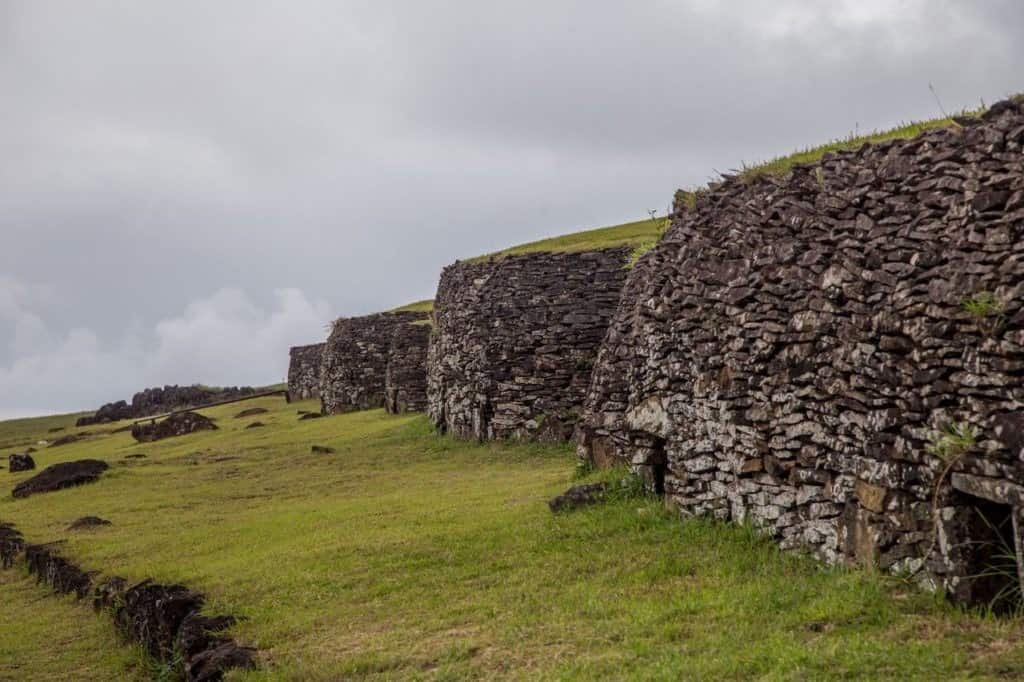
Close to town, on the edge of the volcano Rario Kau, you can visit the Orongo village that once was used for the Bird-man ceremony. There, you can see the stone houses that were restored. What we thought was the most amazing part are the stories regarding the annual egg collection competition and the Bird-man cult.
Tip: There is a nice walk on the saddle of the crater. The views over the rest of the island and the ocean are spectacular.
6. VISIT THE CAVES ON THE WEST COAST
The rocky path that leads northwest from Honga Roa is only accessible to bikers and hikers. The road follows very rough cliffs where you can find incredible caves. These caves were once used by the islanders to hide from the rival tribes or to prepare the young man to participate in the egg collection competition.
Tip: Finding the entrances are not easy. When you find one cave, walk until you find the other exit!

7. THE ONLY MOAI’S FACING THE SEA AT AHU AKIVI

Ahu Akivi is another site that has been restored by archaeologists. This site is very special as the Maoi are facing the ocean instead of looking inland. They are thought to have been erected this way to help outsiders find the island. This is the only Ahu on the island built like this. This is also a very good place to watch the sunset if you have a car.
Tip: The Ahu is also known to be a celestial observatory as the stars align with the platform during the spring and autumn equinoxes.
8. HIKE TO THE 1KM LARGE CRATER LAKE
The southern volcano of the island Rario Kau is easily accessible by a short hike from the town of Hanga Roa. This spectacular natural amphitheatre hosts one of the only three freshwater sources on the island. From the edge of the crater, you can see the damage caused by the ocean, which step by step erodes one of the crater’s sides. From there the views of the Pacific Ocean, Motu Nui (Birdman’s island) and most of the island are incredible.
Tip: The most suitable time to visit the Rano Kau crater is in the morning as the sun will reflect on the lake.


Our budget Self-guided tour of EASTER island
1. A 5-day itinerary ¦ Map
- Day 1: Land at the airport, buy your entrance ticket, settle down and rent a car for the next day;
- Day 2: Early start to Ahu Tongariki, visit Anakena Beach and Rano Ranaku;
- Day 3: Visit the museum of Hanga Roa, hike to Orongo, go to a Polynesian dance show;
- Day 4: Rent a bike and cycle to seaside caves, Ana Te Pahu, Ahu Aviki and Ahu Vinapu. Watch the sunset at Ahu Tahai;
- Day 5: Go for a swim or snorkelling with turtles, get your passport stamped at the post office and prepare for your flight.

2. drive to the northern sites – Day 2
Ahu Tongariki
We rented a car for 24 hours in order to be able to visit “Ahu Tongariki” at sunrise. We set off around 4 am and drove for 25 minutes before reaching our destination. We were the first tourist on site and had to wait for the “doors” to open while stargazing. We entered the site 20 min before sunrise.
Many other cars and tours arrived after us but everyone magically disappeared around 10 am. At that time we were the only visitors on site which was absolutely incredible.
The sunrise at Ahu Tongariki was a blessing. Probably one of the most impressive we have had the chance to see on this trip. We all stood in front of the ocean, the Moai looking at us, while the sun poked out from behind the statues, touching the clouds with a purple than orange hue.

Anakena beach & the Ahu Nau Nau
To avoid the crowds that had now moved to the next site: Rano Ranaku, we drove north towards Ahu Nau Nau. As we arrived on-site, at Anakena beach, we could immediately distinguish the beauty of the postcard-white sand beach surrounded by tall palm trees. There, we found the 7 beautiful Moai (some without heads) turning their backs to crystal clear blue water.
We couldn’t resist and obviously enjoyed the view of the Ahu Nau Nau from the water.

Rano Ranaku
Later on, as the tours arrived one by one to settle for lunch at Anakena, we packed our picnic and drove back south toward Rano Ranaku, the birthplace of the Moai. From this mountain quarry, we really enjoyed the different points of view of the Ahu Tongariki and witness how the Moai were carved.
It is easy to spend hours wandering around the quarry. There are many heads poking out of the ground. These heads are actually complete Moai, partially buried.
Another amazing part of the walk is seeing the different stages of carving. What struck us the most, was that a couple of statues were not even cut out of the rock. Just as if they were left by their sculptors for an eternal sleep attached to their bedrock.

3. Hike the volcano Rario Kau – Day 3
Orongo & the “birdman cult”
After visiting the local museum in the morning, set off after lunch along the coast towards the start of the hike.
Make sure to always carry your National Park Ticket Entrance. It can be asked anywhere within the park, even in town.
The hike took us up through a steep one-hour walk, on the side of the volcano. As we arrived at the top we continued our walk on the ridge, overlooking the crater’s lake.
The views of Hanga Roa and the Pacific Ocean are stunning from there. We even had the chance to see the daily plane to Tahiti taking off and disappearing behind the clouds.
Once in Orongo, the trail leads into the middle of the stone houses that were used by the different tribes during the annual egg-collection competition. Here we could hear the diverse stories about the Birdman cult and even see the two islands that were used for the competition.
The Birdman Cult
As the chief of Easter Island started losing his power during famine and war, a new cult came to replace the Moai era. The Birdman cult appeared as a rebirth for the island, extolling freedom and wisdom.
In Rapa Nui mythology, Make-Make is the God of Fertility and the creator of humanity. He is represented as a man with a bird head and can be found on many petroglyphs on Easter Island.
Each year, until the missionary forbade it, a competition was held in tribute to the Birdman. First, a prophet would declare the name of the contestants. Those men, the tribes’ chief, would then elect a person who would compete for them, if not going themselves.
The aim was to swim to the island Moto Nui and be the first to catch a Sooty Tern egg before climbing the cliffs to Orongo village. The winner’s sponsor would, in the end, be crowned as Birdman, considered as Tapu (sacred) while his tribe would have the first rights to the island’s resources.
This seemed to have been a way of avoiding war over diminishing resources.


4. Cycle to the remote parts of the island – Day 4
Looking for Caves
The rocky path that leads northwest from Hanga Roa is only accessible to bikers and hikers. We decided to cycle a loop in order to visit more sites inland. At first, the road follows very rough cliffs where you can find incredible caves. These caves were once used by the islanders to hide from the rival tribes or to prepare men to participate in the Birdman competition.
Around Ana Te Pahu which is a lava cave where banana trees grow, the road here is finally paved. From here it is easier to get around and reach Ahu Aviki to see the only Moai on the island facing the ocean. A further pedal stroke away, and after a small steep hill, we finally reached Puna Pau, a site where the volcanic rock is red. This used to be the quarry for the Pukaos, the red hair or hats that the Moai wear.

Visit Ahu Vinapu
Finally, we finished the day visiting Ahu Vinapu. After all of the Ahu and toppled Moai seen for the past 2 days, Ahu Vinapu could have been just another sacred platform but it has a remarkable feature that makes the place unique.
As you walk behind the Ahu, you can notice the difference from the other platforms on the island. Here the stones are well-carved and fitted. If you have been to Peru, it is intriguingly similar to the Inca’s constructions. Could there have been cross-knowledge between the two civilisations at some point in time? Another mystery is yet to be solved!

5. What else to do on Easter Island?
- Go to a Polynesian dance show
- Buy the tiny bananas at the street stalls. They taste like coconut!
- Stamp your passport at the post office for a couple of hundred pesos
- Eat tuna, if on a budget try the tuna empañadas!
- Swim with turtles in Pea beach, but be careful with the current and waves.
- Rent a surfboard and catch a wave in the middle of the Pacific Ocean. Watch out the coast is very rocky.
- Scuba dive and look for underwater Moai
- Look for Petroglyphs on the island rocks. There are some signed places but you can also find rocks along the beach from Ahu Tahai to Pea beach
- Go stargazing. You are in the middle of nowhere and the light pollution is absolutely nonexistent (except in Hanga Roa)
- Visit the Polynesian catholic church in the centre town
- Watch the sunset with a beer at Ahu Tahai
- Visit the Anthropological Museum to learn more about the Rapa Nui and Moai
- Look for bird paintings in caves around Ana Kai Tanata


Cost and useful information
Mandatory Park entrance : 54,000 CLP (€75 / $80) – Foreigner price
Transport
Flights: €353 pp return
Rental Car 24 hours: 45,000 CLP (€63)
Fuel: 8740 CLP (€12.25)
Rental Bike – Full Day: 20,000 CLP (€14/pp)
Taxi on the island (5 x 2000): 10,000 CLP (€14)
Accommodation
Cabana 4 nights : 120,000 CLP (€168) – €42 per night (€21pp)
Leasure
Polynesian Dance Show: 30,000 CLP (€21/pp)
Souvenirs: 18,200 CLP (€25)
Other
Food/snack/groceries : 31,310 CLP (€43)
Alcohol: 20400 CLP (€29)
TOTAL : 5 days / 4 nights
Flights included : €1,280 (€640 per person) / €128 pp/pd
Flights excluded : €575 (€287 per person) / €57 pp/pd

ARE YOU ON PINTEREST?
What about saving this post to your Pinterest board? Click on the photo to save this blog post for later.
We are also on the platform and we love pinning great travel tips. Follow Tales From The Lens’ boards to see our latest pins.
Don’t be shy, come say hi!
Please note │ This blog post may also include affiliate links to hostels or products we recommend, which means if you buy something following a link on this page, we’ll get a small commission. This will be of no extra cost to you but will help us continue running this blog. Thank you for your support.

About the Author
Jen is the Funder, Author & Photographer behind Talesfromthelens.comJen has lived for the past 15 years across Oceania and Ireland while also travelling in Latin America, North America, and Europe. She has visited more than 65 countries and set foot on every continent in the world! She is a coffee nerd, passionate about photography, wildlife, and outdoor activities.
For more info, check out the About page.
superb pics
Thank you! Very comprehensive and detailed – you helped me a lot!
Great!!! so happy this guide helped. Hope you have a great time in Easter Island.