
Copacabana in Bolivia is one of the highest cities in the world. Right on the bank of the famous Lake Titicaca and at the border between Peru and Bolivia, the little sleepy town is a mandatory stop to visit the “Isla del Sol” and/or “Isla de la Luna”. Although, before hopping off the bus to take the ferry to the islands, make sure to spend a bit of time to witness the local priests blessing cars and to taste one of the best trouts in South America.
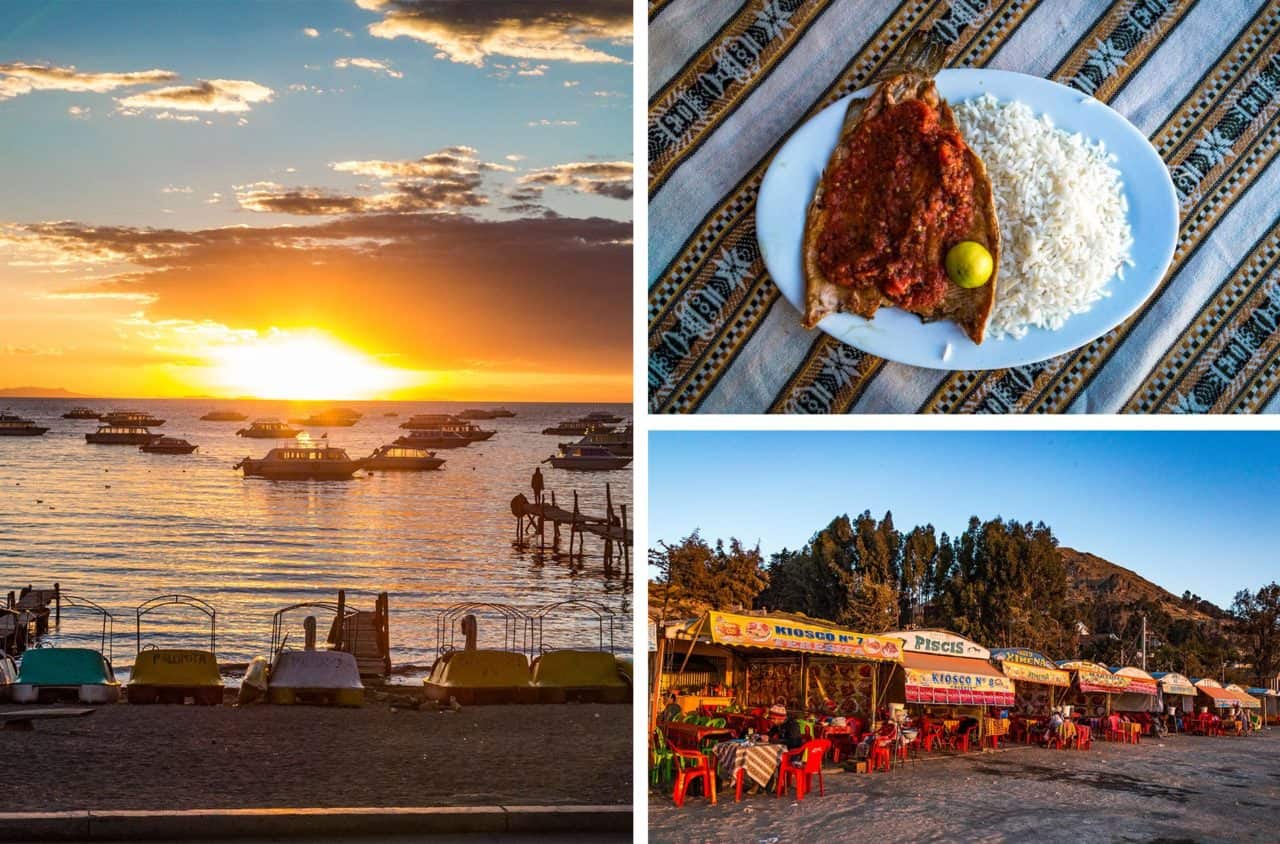
Copacabana is a small town built on the edge of Lake Titicaca. Here you are standing at 3,800 masl and the deep blue waters you see belong to the highest altitude lake in the world that can be navigated. If in luck, you even spot the Bolivian Navy sailing along the coast, protecting the Bolivian border that crosses the lake. A very unusual thing for a landlocked country! The Lake Titicaca is, in fact, so large that it’s impossible to see the other side which stretches over 190 km towards the neighbouring country, Peru.
In terms of tourism, Copacabana is either the entrance or the exit point of Bolivia to or from Peru. With its proximity to the famous Isla del Sol, the town has been turned into a must-go-to touristic hub oriented towards the visit of the island. Most of the visitors will hop-off buses, walk down the main avenue filled with souvenir shops, tourist agencies and restaurants, heading to the pier where the ferry leaves to Isla del Sol.
But as most of the visitors will follow the flow of the day-tours or decide to stay the night on the island to finally come back and pursue their travel into Peru or to La Paz, the little town of Copacabana and its surroundings are left to be discovered by a minority of people. And yes, outside of the main avenue or the pier, there is a sleepy town but one of those that will take you by surprise if you dare give it a chance.
This is a guide to what to see and do in Copacabana Bolivia, on a budget.
How to get to Copacabana?
La Paz to Copacabana
From La Paz, there is a collectivo that leaves the cemetery every hour. Because of important strikes in the streets of La Paz, we weren’t able to reach the place to catch the minivan and were told we will have to stay in La Paz as there were no other solutions to get to Copacabana.
This was actually wrong! Not sure why everyone we met or every blog we read says the contrary, but there are local buses to Copacabana from the main bus station (on Av. Peru). They may not be leaving as often as the collectivos but they are cheaper and for sure more comfortable than a packed minivan. The journey takes 3 hours and the views of the lake were absolutely amazing. Make sure to stay awake!
- 25 Bs (€3.20) – Bus from main bus terminal
- or 30 Bs (€3.80) – Collectivo from La Paz cemetery
- + 2Bs (€0.26) for the small ferry ride
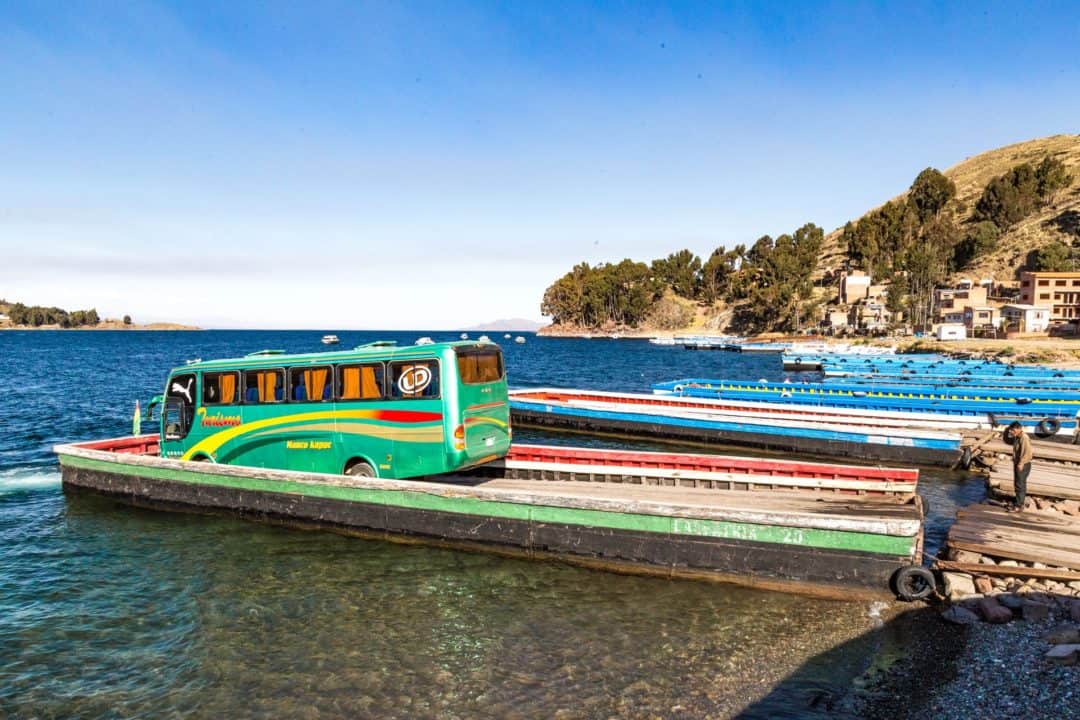
Important: Bus La Paz to Copacabana
During the journey from La Paz to Copacabana you will be asked to hop off the bus/collectivo and take a ferry across a small portion of the lake.
It is a matter of a few minutes and it will cost you a fee of 2 Bs per person. We would recommend to take all your belongings with you (except your backpack in the luggage compartment at the bottom of the bus) because even though everyone is supposed to hop off and take the ferry, we noticed some people didn’t bother and stayed in the bus…
Another tip, as you reach the other side of the lake, be careful to keep the bus on sight, they do not check if everyone is back onto the bus and will leave very quickly leaving you behind!
Peru to Copacabana and vice-vera
To get to Copacabana from Peru, you will need to take a 4-hour bus from Puno. This bus will stop at the border office of Kasani for you to clear migration. The bus will wait for you, but you will have to walk from the Peruvian border to the Bolivian one, stopping at each office to get your stamps in or out. We didn’t have to carry our big backpacks with us, but you may as well have to, depending on the bus company.
The process would be the exact same coming from Copacabana to Peru. Buses usually leave Copacabana from the main street (plaza Sucre) near the bus offices. Copacabana to Puno with Turbus cost 25 Bs (3.20) – the bus leaves around 12 pm.
More: All our guide to visit Peru on a budget!
Where to Stay in Copacabana?
Joshua Hostel
80 Bs (€10) – 4 bunk beds
If you are looking for a place with a kitchen, you need to know those babies are not that easy to find in Bolivia. But it is ok, it is cheap to eat out. Your best bet will be to check out hostels, but during our visit, they were all fully booked. So if you know when you are going to Copacabana we would recommend booking ahead. The Joshua Hostel seems to be the preferred one for budget backpackers for it comfort, location, great staff and kitchen.
La Cupula
175 Bs (€22) – Private room
If you book in advance you can have an amazing price for this gorgeous place. If there was only one to choose, we would recommend this place. Located on the edge of the Cerro El Calvario, the view of the lake is impressive and the rooms so beautiful and comfy. The architecture is inspired by the Arabic style with Pre-Colombian touch. We loved this place but it was unfortunately fully booked when we arrived. We wished we had a reservation. They have a kitchen too!
To not make the same mistake as us, have a look at the Cupula availability here.
Ecolodge Copacabana
360 Bs (€45)- Private room
For those with a higher budget and looking for a place to get away from it all & relax, this is for you! It looks fantastic and was recommended by friends.
>> Click here to check the prices and calendar.
Hostal La Academia – 60 Bs (€7.60) – Private Room -If you can’t book in advance or find out every good place is booked, make your way down the main avenue (6 de Agosto), and visit the few hotels. You will easily find a cheap double bedroom. Don’t forget to ask to see the room and if they can keep your luggage when you are visiting Isla del Sol. They more than likely won’t have a kitchen.
Copacabana, the duality of Aymara and Catholicism
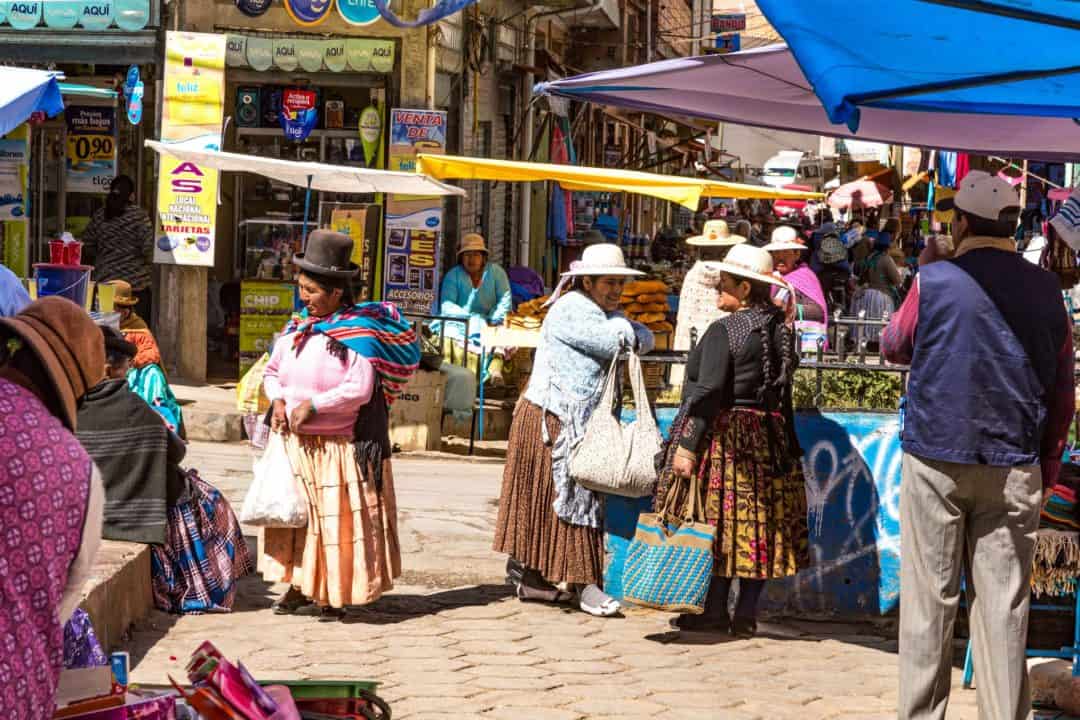
For those entering the country for the first time, Copacabana is the perfect place to be introduced to the traditions of the Aymara people but also witness the interaction of the Indigenous and Catholic culture. At the market, Cholitas walk around in their traditional Aymara outfits, stopping by the Cerro Calvario to preach Pachamama, while on the main square, in front of the church, cars are being blessed by priests.
It can seem odd that the Aymara, who are strongly attached to their indigenous traditions and folklore, also follow thoroughly Christian events. But this is actually a misconception since the Aymara are in majority Catholics.
Introduced during the colonial period, catholicism has been adopted by the Aymara people along with their ancestral beliefs. Despite the strong rise of the Indigenous activism in Bolivia, it is not unusual to see Aymara people rushing to Mass or participating to baptisms and celebrating Carnival while partaking in traditional customs of sacrificing animals
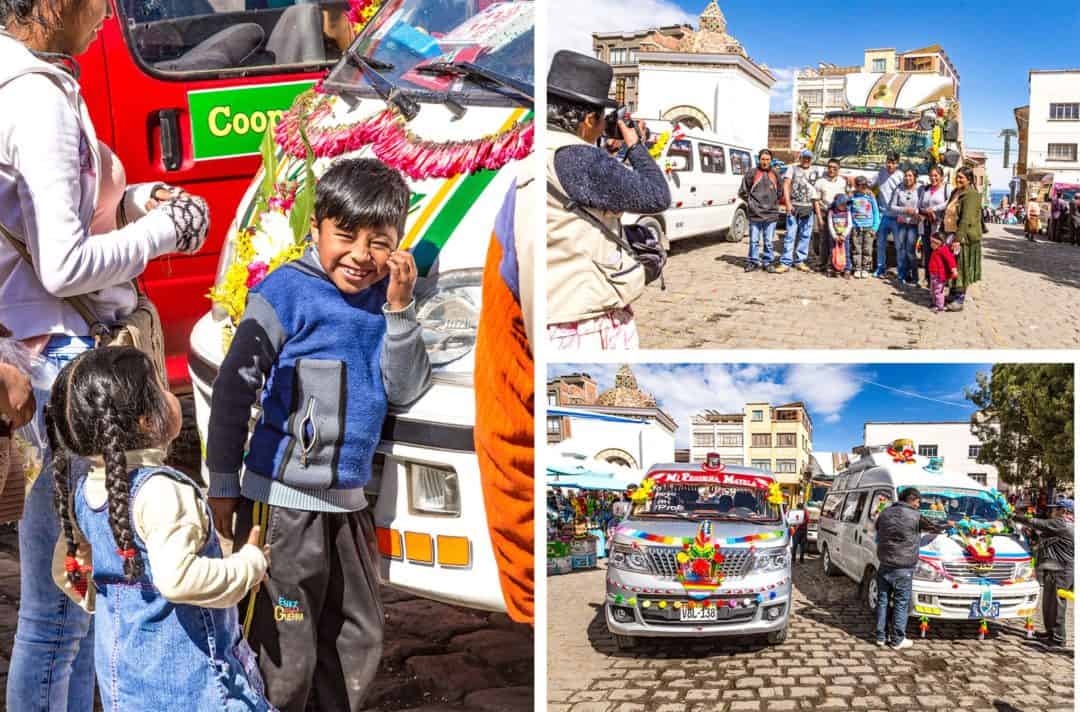
The ceremony of car blessing in Copacabana
Owners cover their cars with flowers, banners, ribbons, and many flashy props.
When you know how crazy Bolivians and Peruvians drive, this tradition can really seem silly but the ritual of blessing cars and the entire family is an important practice. So important that people come from all parts of both Bolivia and Peru with the only ambition of getting the protection of “Nuestra Señora de Copacabana”, the patron saint of Bolivia.
The virgin, who is mainly known for her miracles, is celebrated in the whole continent of South America as an emblem of the mix of Catholicism and Andean cultures. The ceremonies held early February for the day of the Purification of Mary (Feb, 2nd) attract thousands of pilgrims each year and are a great occasion to see the procession of cars. There, people roll up and queue for hours to make sure they will be able to get their cars and family blessed.
The priest starts the benediction of the car throwing holy water on the outside, the engine, the wheels and the seats inside. Then it’s the turn of the owner’s head and the rest of the family who uses the car. Finally, to correctly scare off the tourists looking the other direction, they pop bottles of beer or champagne and crack fireworks. Then it is time for a picture of the priest and the entire family in front of the car before leaving the place free for the next car and family.
Note: If you cannot make early February, do not worry, each day of the year (and more importantly in August), from 10 am to 2 pm the priests of The Basilica of Our Lady of Copacabana proceed to the blessing.
NEXT READ: 17 things to do while backpacking in Bolivia

Hiking Cerro El Calvario to the best views in town
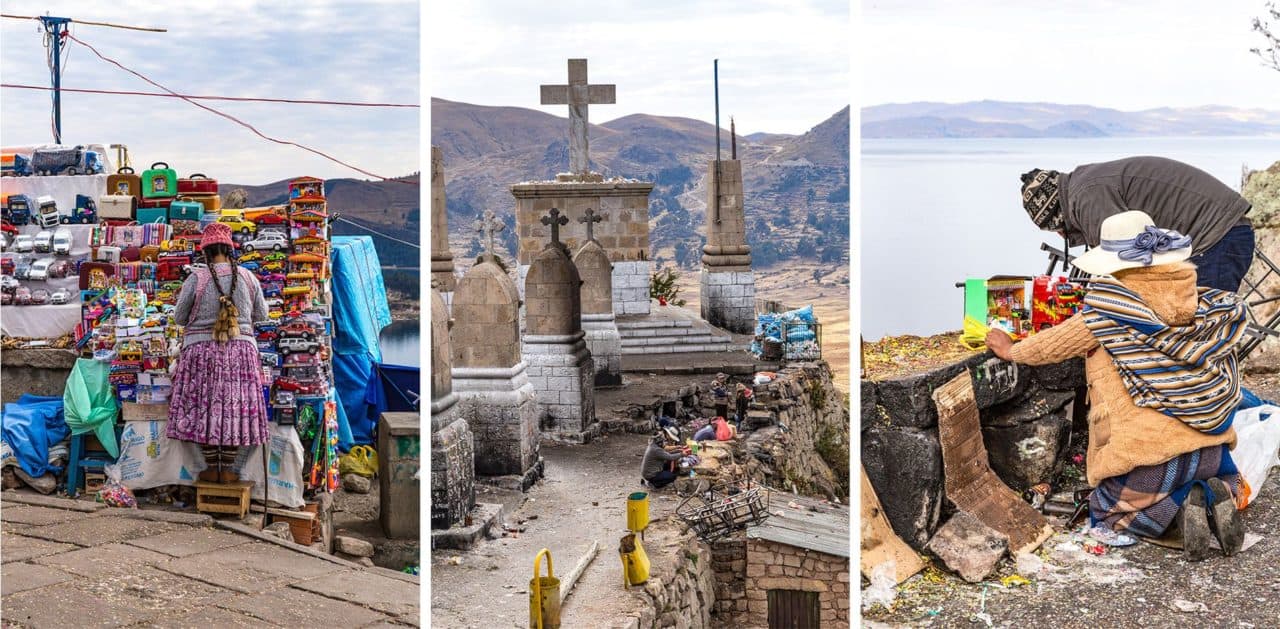
On the same topic, many Aymara families who already got their car blessed by the priest, also make their way to the Cerro El Calvario, in order to address their wishes to Pachamama (Mother-Earth, the main Aymara goddess). During the ritual, they burn candles and gift small toy cars bought out off on-site Cholita’s stalls.
Cerro El Calvario is the main hill overlooking the town and the bay of Copacabana.
To get there, you need to climb hundreds of steps leading to a mausoleum. Its name is quite well found as it means: The Suffering Hill… Since Copacabana is located at almost 4,000 masl, the walk-up is a truly big pain!
With lots of water and coca leaves, we managed the strong headaches to go away and reached the summit in about 30/40 min when it probably would have taken 10 min at our “normal” altitude.
You may also like: 24 hours in Puno to visit the Uros Island

Eating fresh trout in Copacabana
As you make your way down towards the lake, passing by the main square, you find a kyrielle of bars and restaurants. We haven’t tried any despite their attractive offerings of the Best Lake Titicaca’s Trout. But that was for a good reason… On the left of the pier where the ferry departs for Isla Del Sol, there are about 15 small shacks all aligned, facing the lake. Each offering a choice of fresh trout cooked in more than 20 different ways.
They all offer the same menu, so just pick the one with the name you like the most, or the one with the most people inside!
Note: We went to #7 and #12 and each time, ate the best trouts we’ve ever had in South America and probably Europe. So good we went both nights we spent in Copacabana and were never disappointed (or sick). Our choice? Garlic sauce, lemon sauce and spicy tomato sauce.

ARE YOU ON PINTEREST?
What about saving this post to your Pinterest board? Click on the photo to Save this blog post for later.
We are also on the platform and we love pinning great travel tips. Follow Tales From The Lens’ boards to see our latest pins.
Don’t be shy, come say hi!
Please note │ This blog post may also include affiliate links to hostels or products we recommend, which means if you buy something following a link on this page, we’ll get a small commission. This will be of no extra cost to you but will help us continue running this blog. Thank you for your support.

About the Author
Jen is the Funder, Author & Photographer behind Talesfromthelens.comJen has lived for the past 15 years across Oceania and Ireland while also travelling in Latin America, North America, and Europe. She has visited more than 65 countries and set foot on every continent in the world! She is a coffee nerd, passionate about photography, wildlife, and outdoor activities.
For more info, check out the About page.