
Isla de la Plata in Ecuador is mostly known for being a budget-friendly alternative to the Galapagos Islands. Its rich ecosystem, which is protected by the Machalilla National Park, attracts visitors looking for the Blue-footed boobies and frigatebirds but also those interested in whale watching and snorkelling.
Isla de la Plata is the ideal day-trip destination for nature and wildlife lovers on a budget.

Isla de la Plata is only a 1.5-hour boat ride from the small fishing town of Puerto Lopez.
The island boasts an incredible diversity of birds (32 species) such as gannets, blue-footed and red-footed boobies, frigate birds and pelicans. At sea, the rich coast of Isla de la Plata not only attracts dolphins, sea lions, green turtles and mantas rays, but also whales and orcas depending on the season.
The debated alternative to the Galapagos Islands
Because of the abundance of wildlife and its inexpensive cost, Isla de la Plata is actually often referred to as the “Poor Man’s Galapagos“…
While this small island is really nice to visit, it is still hard to believe that a day trip to a small island located 40 km from the coast of Ecuador could actually replace a once-in-the-lifetime experience in the Galapagos…
If you are looking for blue-footed boobies, snorkelling and whale watching on a budget, Isla de la Plata is an excellent choice.
We debated for a while but decided to skip the Galapagos islands. We had already seen King penguins and Magellanic penguins in Patagonia, as well as sea lions. But all in all, we weren’t in the mood for a trip that would cost us a month’s worth of travel in South America.

Isla de la Plata ECUADOR
All you need to know

How to get to Isla de la Plata?
The island is protected by the Machalilla National Park and can only be visited as part of a day trip organised by a licenced tour agency. Overnight stays and self-guided tours are,
You should expect to pay between $30 to $45 per person (depending on the season) for a full-day trip including snacks, lunch, a guide on the island and equipment to go snorkelling. If you have the chance to crossways with marine wildlife during your boat rides, the captain will find the time to stop and let you enjoy these amazing encounters! A bargain for a bird and whale watching tour.
There are many companies in Puerto Lopez and a few in Montañita offering tours to Isla de la Plata. We found the tours were more affordable from Puerto Lopez and since we also wanted to explore Los Frailes in the Machalilla National Park, we left Montañita to spend a couple of nights in the sleepy town of Puerto Lopez.
The reason tours are more expensive from Montañita is that the town is more touristy, driving up prices. You also need to pay for the extra transport from Montañita to Puerto Lopez to start the tour. To save a few dollars you can take the cheaper local bus option and join a tour in Puerto Lopez. Just make sure to be there before 9 am.
We booked our tour in the morning but it was the end of the high season and tourists were mostly gone. In high season, it is probably best to contact the company a little bit in advance by email or phone in order to secure a spot. We went with Palo Santo Travel Ecuador and would happily recommend them.


Looking for more adventures in Ecuador? You may also like these articles!
- Cotopaxi National Park: Hiking to the volcano refuge without a guide
- Hiking the Quilotoa Loop or visiting the crater lake as a one-day trip?
- Baños de Agua Santa: 4 unforgettable experiences on a budget
- 5 budget-friendly day trips from Quito
- Ecuador beaches: 5 amazing towns along the coast
A pirate story or a guano reflection?
The legend has it that the English seaman Francis Drake hid a silver treasure on the island during his time along the Ecuadorian coast. This would be one of the reasons why the island was given its name; Plata meaning Silver in English.
However, there are a lot of places on Earth thought to be the place where tons of silver and gold were buried by the Drake and his crew. Yet, no treasure has been found until now on Isla de la Plata.
Another explanation as to why the island is called “Silver”, would be the reflection of the layers of birds poop visible from the continent. Researchers believe that the guano left behind by the many birds flying and breeding around the island can reflect the sun and create an impression of a silver halo hugging the island.
Others may think that in the past, the guano was collected from the island and sold for a high cost. The word “


Birdwatching
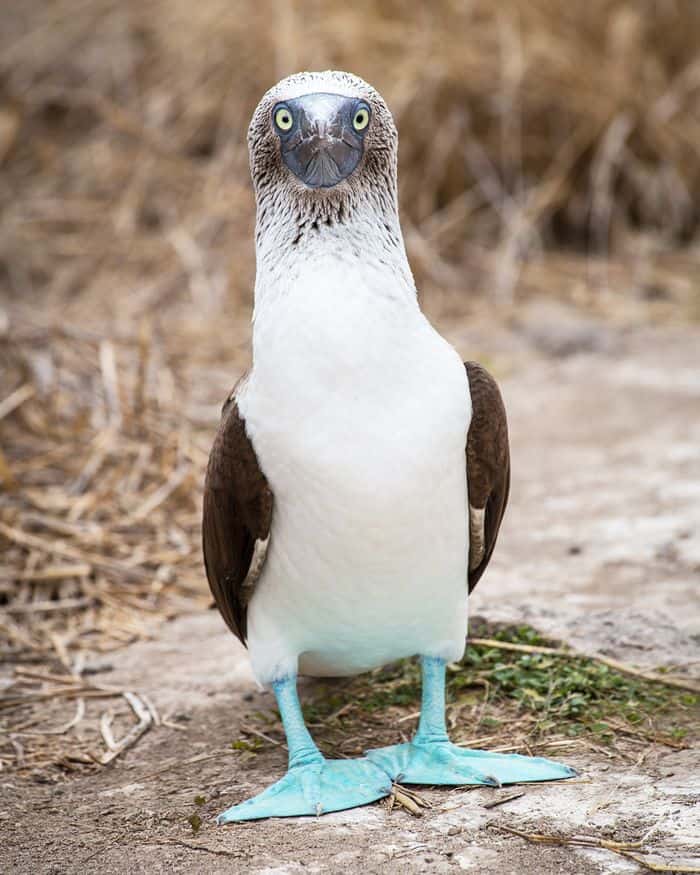
Blue-footed boobies on Isla de la Plata
The blue-footed booby is an endemic bird from the Pacific coast and is mainly found in the Galapagos, where 50% of the population lives. But for a less crowded and much cheaper excursion, Isla de la Plata is an excellent place to go birdwatching.
After a smooth ride from the continent, the boat drops you off on the gorgeous beach of Bahia Drake where you are welcomed by thousands of red crabs running around and hiding as your feet touch the sand. At the main
Beforehand, your guide may ask the group to choose between a short trail leading to frigatebird colonies or a longer trail with mainly blue-footed boobies. With the season of the frigatebirds being almost over, our entire group agreed to do the long walk, but we all thought it was a shame we couldn’t hike both trails.

After hiking the steep path to the top of the island, your guide will tell you more about the wildlife on the island. During the walk, we were joined on the trail by a few fearless blue-footed boobies heading back to their nests. We gave them the way and took this first opportunity to observe the bird’s unwary rhythm as they walked away from us.
The booby holds its name from the Spanish word “bobo” which can be translated into “stupid” in English. This term was initially used by the locals to describe how clumsily and awkwardly the birds walk.
Along the way, you will visit beautiful lookouts from where you will be given the chance to truly appreciate the beauty of this uninhabited island. You will more than likely cross paths with couples of boobies preparing their nests, and depending on the season you may spot males still chasing females with the intent to mate. At the end of September, we had the chance to see chicks but also notice males still protecting eggs.


Fun facts about the boobies
- The distinctive blue colour of the boobies’ feet comes from a diet of fresh fish. The brighter the feet are and the healthier the bird is. A female will be attracted to a male with bright blue feet.
- Males and females are almost identical. To recognise the sex of a boobie, you will need to look at its pupils. The female tends to have a larger star-shaped iris (see the image below – the female is on the right side)
- During the mating season, the male boobies dance and sing to the female, displaying their wings, beak and blue feet (see our video)

Snorkelling and whale watching
After a couple of hours on the island, you will return to the boat to go snorkelling. The captain will be in a small cove with shallow water and a gentle current. It is an exceptional opportunity to look for colourful fish and giant corals! And
If you take a tour between June and September you may be able to see Humpback whales. These giant marine mammals migrate each year from Antarctica to the Ecuadorian coast in order to mate and spawn. During the breeding season, Humpbacks are very active and the chances of them breaching out of the water to attract a partner is high.
We visited end of September and managed to spot a couple of Humpback Whales near the boat on our way to the Island. They came along peacefully before leaving us in a last deep dive, showing off their fluke and drawing huge smiles on our faces.

On the way back to the continent, the captain informed us he will be looking for more whales, but what we truly wanted to see was for the whales to show off out of the water!
This is one of the behaviours we have both been waiting for so long; joining whale-watching tours on every occasion during our travels across the world. We thought this time would be our only last chance as the mating season was almost finished.
Finally, the moment we had waited for. We saw a whale breaching a few hundred metres away.


Where to stay before and after visiting Isla de la Plata
Montañita
For a lively hostel but not a party one, we would recommend the Hidden House Hostel in Montañita. The place is big with a large garden, hammocks, a slackline, a quiet bar and a well-equipped kitchen. They offer a good price for dorms and private rooms and also surfboard rentals and classes.
We loved the laid-back atmosphere away from the craziness of town.
Puerto Lopez
In Puerto Lopez, we had more issues finding a cheap and lively place to stay. We stayed at the Yemaya hostel which was absolutely
You can also stay at the Viejamar hostel which is a little bit out of town but right on the beach. It could be a great place to relax and go surfing while staying out of the craziness of Montañita.
Penguins in South America!
If you are interested in seeing Penguins in South America, we have a dedicated article that lists all the places you can see the birds. From the Magellanic to the Humboldt and Galapagos penguins, you will get a full overview of all the places to add to your bucket list and how to get there!
> Click Here to read out dedicated article
DID YOU LIKE THIS ARTICLE? PIN IT!


*This article may also include affiliate links to hostels or products we recommend. This will be of no extra cost to you but will help us continue running this blog. Thank you for your support.

About the Author
Jen is the Funder, Author & Photographer behind Talesfromthelens.comJen has lived for the past 15 years across Oceania and Ireland while also travelling in Latin America, North America, and Europe. She has visited more than 65 countries and set foot on every continent in the world! She is a coffee nerd, passionate about photography, wildlife, and outdoor activities.
For more info, check out the About page.
Thanks for sharing this information.
I could’nt find the video of the blue footed booby. Loved to see that one.
Thank you Jacqueline. It seems that I had forgotten to link the video! I have now updated the blog post. You will find the link to our video in the “fun fact” section. Thanks again for pointing it out. Hope you’ll like it.