

The Azapa Valley | Chile
Mummies and Geoglyphs near Arica
Travelling to Arica is often just a quick stop before or after crossing the border of Chile-Peru. However, what visitors aren’t aware of is that the region has a strong history that goes back to 7,000 years ago and a few incredible places that shouldn’t be missed. If you are keen on learning about the oldest mummies ever found, the ancient Chinchorro culture or see mysterious animal figures etched onto the side of hills, the Azapa Valley is a must-go.
Here is a complete guide to help you visit the Azapa Valley in Chile.
What is The Azapa Valley
The Azapa Valley in Chile is a fertile oasis found a couple of kilometres away from the Northern town of Arica. Close to the border with Peru, this valley stuck between sandy hills is fed by the river San Jose and produces a large variety of fruits and vegetables. It is nowadays mostly renowned for the production of olives than for its incredible history…
In fact, over 7,000 years ago the Azapa Valley was the home to the Chinchorro people who used to practice mummification on all the members of their society. Mummy
But the Azapa Valley has a lot more to offer to the day-tripper.
How to get to the Azapa Valley?
The town of San Miguel de Azapa is located only 13km outside of Arica and can be accessed by taxi, collectivo (shared taxi) or by bike.
You can rent a bike in most of the hostels in town, but if you don’t feel like cycling (it can get very hot in the valley), the collectivo is the next most affordable option. Collectivos are shared taxis and can be found beside the international terminal. Those going to the Azapa Valley have a sign mentioning ‘San Miguel‘.
A collectivo ride to San Miguel de Azapa should cost about 1,000 CLP per person, and will only leave when the car is full. Because it is a shared taxi, they will bring you in and around the whole area on the way into the valley to drop off the other passengers.
If you don’t want to wait or are in a tight schedule, you can flag a normal taxi in the street and ask for a special price to drive you around the valley. It will take about 2 to 3 hours and may cost around 10,000 CLP per person.

Where to stay near the Azapa Valley
There aren’t really places to stay within the valley that you can book online. The closest town with accommodation that can serve as a base for a day trip into the Azapa Valley would be Arica.
The town of Arica isn’t an international tourist spot. You won’t find large hotels, but a limited range of accommodations from small guesthouses to hostels exist. In Arica, we stayed at the Hostal Sunny Days, the home of a New Zealander who really knows how to make you feel at home. The interior design is quite surprising (in a good way), the two kitchens are well equipped and the breakfast plentiful. It is very close to the international bus terminal and the fruit and veg market of the town. It is 5 minutes from the beach and 15 minutes from the
Hostal Sunny Days: dorms from CLP 12,000 (€16) – doubles from: CLP 28,000 (€37) – breakfast included.
You may also like the Hotel Puerto Chinchorro if you are looking for tranquillity with a view over the beach. Prices start from €60 per night for a double. If you want a place a bit more affordable, it is worth checking another hostel located in town: La Posada Gallo with bed-dorm from €11 and double from €20.
Are you planning a trip to northern Chile? You may be interested in these blog posts to help you prepare for your trip:
- Arica – Chile’s Last Surprise
- San Pedro de Atacama and around
- A Detour To La Serena and Pisco Elqui
- Valparaiso, Chile’s Most Colourful City
- A City Guide To Santiago, Chile
- Colchagua Valley: Self-guided Cycling tour & Wine Tasting

The Best itinerary to visit the Azapa valley
Once you choose your way of transport, head first towards the Archaeological Museum of San Miguel de Azapa. Visit the place and walk to the small dusty town, only 5 minutes away. Visit the cemetery and grab some lunch in the nearby restaurant.
The route to see the Geoglyphs is a different one than the route back to Arica. You can try to get a collectivo but they are less frequent and once dropped off they will head off, leaving you in the middle of nowhere! It might be wiser to take a taxi for this portion, but if you feel adventurous like us, you can alternate between walking, collectivo and hitch-hiking. You can then take any local bus heading back to Arica.
To help you understand the road better, here is a map of the area with the main stops.
Transport costs
Collectivo to San Miguel de Azapa (museum): 1,000 CLP (€1.40)
Taxi to the
Hitchhiking between Geoglyph’s viewpoints: Free
City Bus Back To Arica: 400 CLP (€0.56)

What to do around the Azapa Valley
1. The oldest mummies in the world
Before the arrival of the Incas, a more ancient civilisation roamed these lands. Little is known of the Chinchorro people except that they lived here over 7,000 years ago. In 1918 archaeologists unearthed the oldest mummies ever found and with this discovery found a civilisation that worshipped the dead. Future excavations have exposed a practice of mummification, which antedated the Egyptians.
This practice involved the burning of bodies, extracting the brain and then replacing it with feathers. After this, the mummies remained among the living for years. A truly creepy history which has been perfectly summed up by one of the first archaeologists on site, “the mummies reflect the savagery that these aborigines were still steeped in”.
The finding of these mummies also helped with the timeline for the first inhabitants of South America, a history little of which is known.

2. San Miguel de Azapa Archaeological Museum
In the San Miguel de Azapa Archaeological Museum, which is run by the University of Tarapacá, it is possible to see four mummies on permanent display alongside jewellery, weapons and tools. It is pretty amazing to be standing in front of mummies dating back over 7,000 years…
The museum is modern, well organised and a real bargain for only CLP 2,000 (€2.80) for adults and CLP 1,000 for kids. Also in the museum entrance fees is a short exhibit about farming techniques. Link to the museum’s website – http://masma.uta.cl/


3. The unique cemetery of San Miguel de Azapa
For some strange reason humans are drawn to cemeteries, and we are no exception. We have visited some at home and in many other countries and after hearing about the unique desert cemetery we made our way. It is probably the most unique we have seen.
Being in a desert means the graves are in the sun all day. Families have decided that this is either not good for their loved ones to lay in rest in the sun, or they want shelter when paying their respects. Whatever the reason, roofs and shelters have been made to cover the graves. It has resulted in the creation of an eery, empty shantytown.
Cost: Free entrance

4. The hillside Geoglyphs of the Azapa Valley
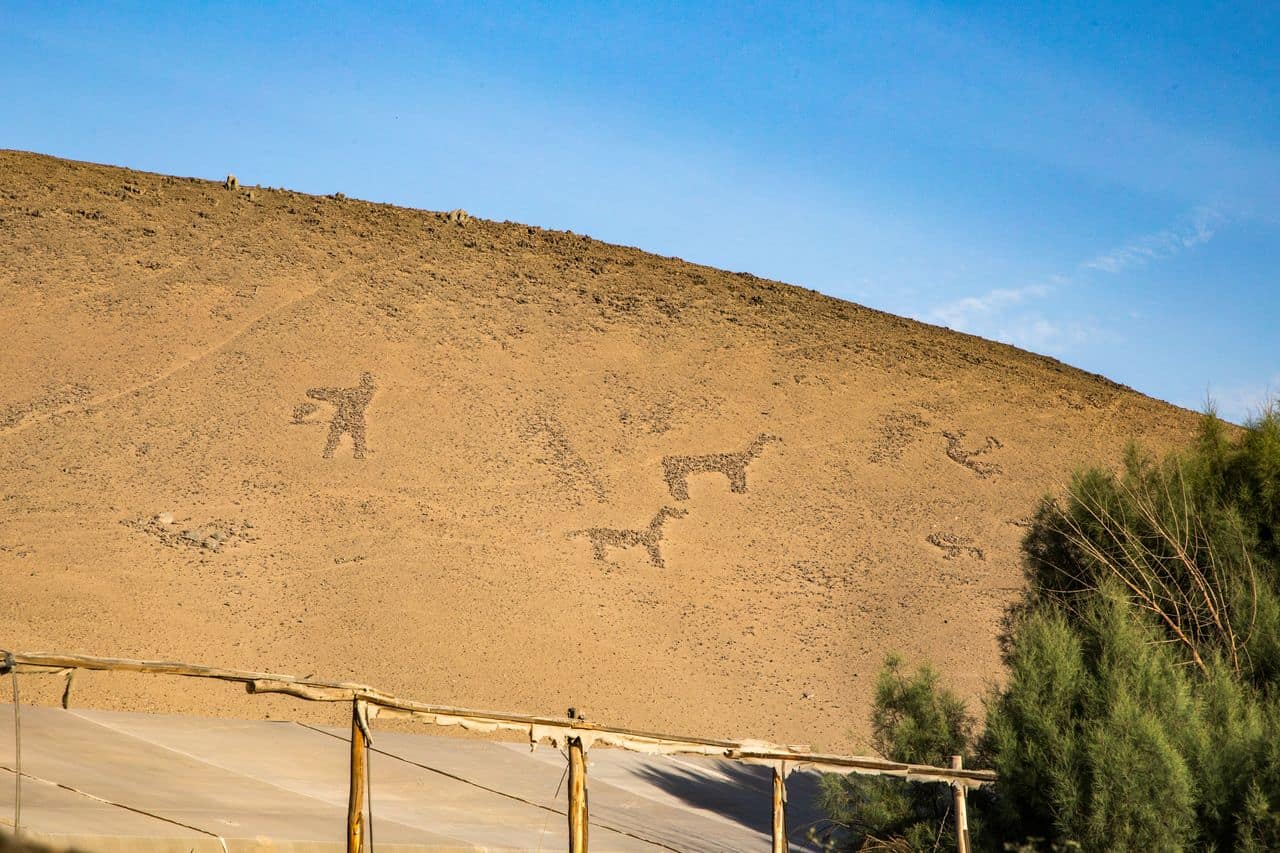
Similar to the animals of the Nazca Lines, the Azapa Valley geoglyphs depict animals and men etched into the side of the valley’s hills. Whereas the purpose of Peru’s Nazca Line remains a mystery, the geoglyphs in the Azapa Valley have a very specific purpose.
The animals are a sign to inform travellers they are getting close to the area where llamas and alpacas can be bought and traded. On the hillsides, other animals such as snakes and lizards can be also found. These are thought to be warnings to be careful of such animals in the area.
It is possible to see these Geoglyophs throughout the valley however, the best place to see them is from Cerro Sagrado (Sacred Hill) located near Pampa Alto Ramírez. Here, the geoglyphs are easy to spot with your own eyes but binoculars would have come in handy to see the details.
Unfortunately, the closer to Arica you go, the more they’ve been vandalised.
Cost: Free


Where to eat in San Miguel de Azapa
If you decide to visit the Valley de Azapa, you must try one of the specialities of the region: the Pastel de Choclo. Often served as a casserole, this dish is filled with beef meat and a sweetcorn paste, a bit like a cottage pie. The filling usually also contains raisins, olives and slices of hard-boiled egg. It is very delicious if well prepared. Maybe a little too sweet for those who prefer salty food for lunch, but it is something foodies must try when passing through the Azapa region.
Following the advice of a local, we tried the restaurant “La Pica Del Muertito” right next to the San Miguel de Azapa’s cemetery. It was even selected as the best “
La Pica del Muertito is a place local people like to go to with their families on the weekend. It is tasty, cheap and really comfortable. The Pastel de Choclo for lunch costs about CLP 5,000 (€7) per person.

ARE YOU ON PINTEREST?
What about saving this post to your Pinterest board? Click on the photo to save this blog post for later.
We are also on the platform and we love pinning great travel tips. Follow Tales From The Lens’ boards to see our latest pins.
Don’t be shy, come say hi!
Please note │ This blog post may also include affiliate links to hostels or products we recommend, which means if you buy something following a link on this page, we’ll get a small commission. This will be of no extra cost to you but will help us continue running this blog. Thank you for your support.

About the Author
Jen is the Funder, Author & Photographer behind Talesfromthelens.comJen has lived for the past 15 years across Oceania and Ireland while also travelling in Latin America, North America, and Europe. She has visited more than 65 countries and set foot on every continent in the world! She is a coffee nerd, passionate about photography, wildlife, and outdoor activities.
For more info, check out the About page.