
Puerto Varas is a small town settled by Germans in the mid-18th-century along the shore of Lake Llanquihue. Overlooked by the beautiful and iconic Volcano Osorno, Puerto Varas is the perfect opposite of the nearby, ugly town of Puerto Montt. Here, in the Lake District, it is charming. It’s nice to chill, eat traditional German cuisine, climb volcanos and prepare for further adventures in the region or down south towards Patagonia.
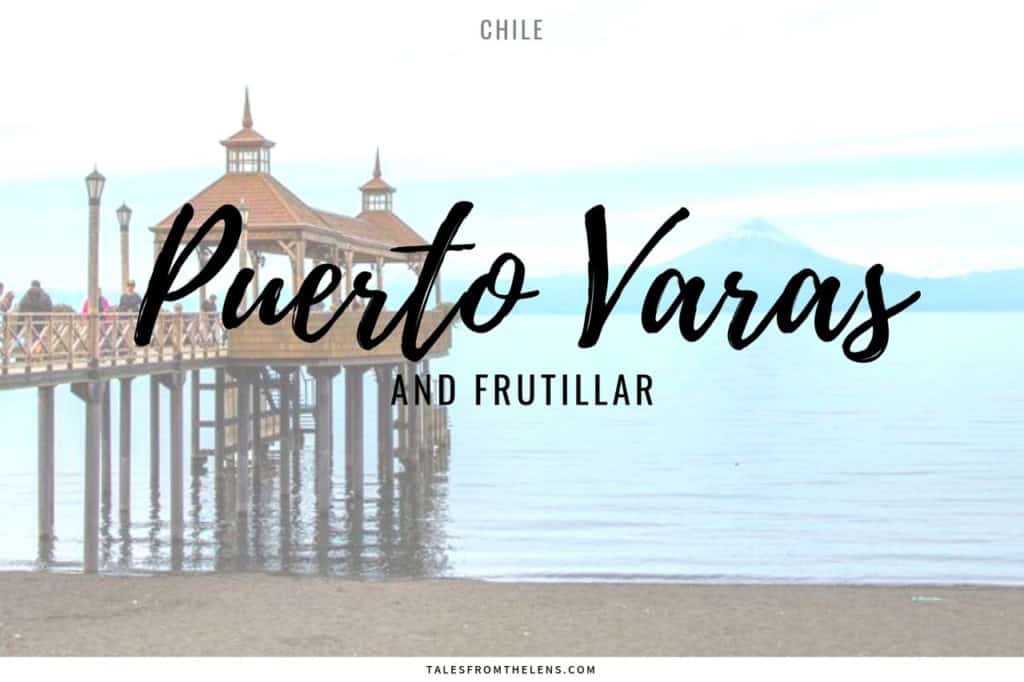
CHILE’S LAKE DISTRICT: PUERTO VARAS AND FRUTILLAR
The region surrounding Puerto Montt up to Pucon is known in Chile as the Lake District. Dotted with numerous clear blue lakes and snowed tipped peaks, it is a paradise for hikers and line fishermen. But what makes the region so beautiful is also what threatens it the most: the violent natural forces of volcano eruptions and strong earthquakes.
Puerto Varas and Frutillar are in fact located at the feet of two of the most active volcanos in South America. The last eruption in the area happened in April 2015 when Calbuco sent a huge column of ashes in the atmosphere without much warning.
The picturesque Chilean lake district region is, however, a safe place to visit with a few nice things to do if you have the chance to stop by before entering or leaving Patagonia.
The town of Puerto Varas
Puerto Varas is a sleepy but very charming town compared to Puerto Montt. Right on the side of lake Llaquihue, which is the second-largest in the country, Puerto Varas, has seen its first settlers, building houses from local Alerce wood and volcanic rocks.
The centre of town holds its charm to the strong German influence it gained from the immigration during the mid-18th-century. The architecture is quite remarkable here, and most of the buildings are protected under a national heritage program.
La Iglesia Sagrado Corazon de Jesus
The most iconic and famous building in Puerto Varas would be the “Iglesia Sagrado Corazón de Jesus”. A red-roofed church that graciously overlooks the entire old town. But finding a nice place to view it with the lake and the Osorno Volcano in the background isn’t an easy task!
For this, you’ll need to go high and walk up the surrounding hills. The issue is that everywhere you could have a good view from, is either overgrown by trees or facing a house. It was actually hard to find a good spot but after alking around the upper neighbourhood, we finally got one place in between two houses with a perfect view.
Here are the coordinates to this viewpoint:
41°19’20” S 72°59’28” W – Google maps

Walk along the Pérez Rosales boardwalk
Stop in Puerto Varas and you cannot miss the opportunity to explore the shore of Lago Llanquihue. From town, a promenade takes the locals and tourists along the lake to a water sports centre, a few fancy hotels and restaurants before leading to a beautiful metallic sculpture representing a woman. Depending on the angle, it actually seems that she is either trying to get the Osorno’s attention or is hugging the volcano.
The sculpture actually represents the Princess Licarayen who was sacrificed by her tribe, the Huilliche, in order to calm Piri Pillen whose rage resulted in strong earthquakes and violent eruptions of the volcano Osorno where he was trapped. Once her heart dropped in the mouth of the evil, strong snow started falling before melting on the side of the volcano, resulting, at last, in the creation of the 3 lakes of the region, Llaquihue included.

Visit when the city’s roses bloom
Each year, from December to March, the city turns into a gigantic rose garden with all these beautiful flowers blooming. The city is then plunged in a heavy scent and dotted with vibrant colours. You will find roses in every garden and on the side of each street.
Another moment to visit Puerto Varas isn’t as obvious at first but makes a lot a sense according to the strong Germanic influence. You get it, it is Oktoberfest. The festival is celebrated in the German manner with folk music, a mix of Chilean and German street food and; of course, a lot of beer.

The little German town of Frutillar
Frutillar is a small village by the lake, only 30 minutes from Puerto Varas by local transportation. The village is actually split in two and while Frutillar Alto (High) is more residential and commercial, Frutillar Bajo (Low) on the shore of the lake, is more traditional and preserved for the tourists’ leisure. We found Frutillar Bajo to be the most beautiful and photogenic place along lake Llaquihue.
Music

The town is famous for being the music city of Chile. Internationally renown, the artistic centre, Teatro del Lago (lake theatre), hosts classical concerts since 2010 and attracts classical music lovers from all around the world.
Architecture
Besides the cute wooden houses boarding the lake, one of the highlights of Frutillar is its pier. Stretching out into the lake, it offers another fantastic perspective of Volcan Osorno and is definitely a photo to keep.

Kuchen cake

Finally, as far as we are concerned, we would add Kuchen to the list. It is a typical German cake that is absolutely delicious and cannot be missed in Frutillar. The best one can be found at the German club.

The Volcano Osorno
Located at the edge of Lake Llanquihue and facing the towns of Frutillar and Puerto Varas, Osorno is one of the most beautiful volcanoes of the southern Andes. Easily recognisable thanks to its conical shape and impressive size, this stratovolcano is still active but hasn’t erupted for the past century.
The volcano is accessible by car. A ski resort at 1200 masl is the spot to rent equipment or take a chairlift and zip line outside of the ski season. If you don’t have a car, you can take a half-day tour of the park, rent a taxi or hitch-hike from Puerto Varas. There are unfortunately no local buses or collectivos going to the resort, but if you are not scared to hike, here is a good itinerary.
Hike from Petrohue to the Ski resort
For this hike, it is best to take a couple of days and stay near Petrohue for the first night. There are campsites for those who have adequate gear. First, you need to take a collectivo to Petrohue. On this first day, we would recommend relaxing and maybe going for a couple of walks around.
The next morning, take the trail called “Desolation Pass“, it will take you through the National Park Vincent Perez Rosalez and will lead you to the ski resort of Osorno Volcano. If you have a bit of time you can walk a bit more to have a view from higher or take the chairlift (that is expensive though). You can hitch-hike back or walk through the same way to go back to Petrohue. You can also hitch-hike from Petrohue to the ski resort and walk up from there. However be aware that the trail is very rocky and that it is not advised to go on the glacier without a guide as the melted snow can hide crevasses, making the experience very dangerous.
If you prefer a tour guide for this excursion, you can look at the availability here, and here.
Climbing to the top of the Osorno volcano
For those willing to climb the Osorno Volcano, be prepared for a challenging and unforgettable trip. It is actually more of a Mountaineering trip than a hike as it requires you to wear a harness, crampons and a helmet. Only experienced people can do this climb alone with a permit from Conaf. Otherwise, you will need to take a guided tour.
Other hikes in and around Puerto Varas
Monte Calvario
Monte Calvario is a small hill easily accessed from the centre of Puerto Varas. This park offers a beautiful view of the town, the lake and the volcano Calbuco. It is for sure a great spot to relax, picnic or read a book in the shade of the very tall trees.
If you are an early bird, our advice is to come up to the park to watch the sunrise.

Alerce Andino National Park
The Alerce Andino National Park covers about 400 km² of lush forest in the region of Los Lagos (Lake District) near Puerto Montt. It is managed by CONAF which is in charge to preserve the Alerce, the largest tree species in South America. It is an endemic cypress from the area that is unfortunately endangered because of deforestation and fires.
You can stroll around the park freely and also camp if you wish (wild camping is permitted). The park isn’t really touristy, so if you don’t have a car you may need to join a tour to visit. There are a few great hikes such as the climb to Paso Triangulo along the Laguna Fria.
Another easy way to discover the Alerce trees and native vegetation of the region is to take a short walk from Frutillar to the reserve forest “Edmundo Winkler” managed by the University of Chile. There is a small fee to enter and visit the park where students preserve arboreal species and have a nursery program for reforestation.

Where we ate in Puerto Varas
One sure thing is that eating in a restaurant in Chile isn’t really a backpacker friendly thing to do. However, when we find a nice street food truck, we are two happy people forgetting all about cooking and dishes. In particular in Puerto Varas where the street food scene is quite large, with up to 12 trucks offering delicious meals throughout the day right outside the main mall. We decided on a tasty Falafel (as we always do).

Drinking a good cup of coffee
If you are looking for a great cup of coffee in southern Chile, you may need to wait for a long time! We only found 2 places. One in the bus terminal of Puerto Natales and one in the streets of Puerto Varas. So before heading south to Patagonia or after a dry month on instant coffee, make sure to stop by Cafe apie.

Where we stayed in Puerto Varas
Compass del Sur. Overall it was pretty good. We stayed in the attic which caused many knocks on the head due to the low roof, but it was the only room available when we arrived. We were lucky, everywhere else was fully booked.
What we liked about the hostel
It was clean and quiet. The weather outside was absolutely terrible and there was enough space for everyone to chill in the leaving room and hang out on the internet (which was surprisingly excellent). Our favourite part was definitely the breakfast with freshly homebaked brown bread and banana bread. You cannot beat this!
What we liked less about the hostel
The timetable of the kitchen is a little bit strange. Because it is used by the staff in the morning, you cannot use the kitchen before 12 pm. Also once you checkout, the access to the facilities must be paid such as shower and the use of the kitchen. We at first found this to be pretty uncool but in the end, it is not too expensive and quite fair.
Overall, we would absolutely recommend staying at the Compass del Sur. Compared to the other hostels we saw, this place was quiet, warm and clean. There are not many hostels in Puerto Varas, so Compass del Sur tends to be fully booked, so make sure to check their availability online, here.

Cost and useful information
Exchange rate(average) : €1 = 714.20 CLP
Transport:
Bus – Castro (Chiloe Island) to Puerto Varas: 6,500 CLP (€9.10)
Bus – Puerto Varas to Frutillar: 2,400 CLP return (€3.35)
Accommodation:
Hostel – Compass del Sur: 12,000 CLP pp/pn (€16.80)
DID YOU LIKE THIS POST? PIN IT AND SHARE THE LOVE

“Would love to visit Chile one day. Have so far only been to Argentina and Uruguay in South America, so there is still a few more countries to explore on that continent. 🙂
So many unknown places as well, I have never heard about Puerto Varas before. :)”
Hello Jasper, this is all we wish for you! Chile is a wonderful country but it requires so much time to visit it all. We spent 3 months there… Keep posted to discover new places !