

How to visit the Tarabuco Market from Sucre | Bolivia
The thing we liked most about Bolivia is the authenticity you’ll see wherever you go. Even in large cities, you are sure to cross Aymara and Quechua communities, where men and women wear their traditional clothing daily, contrary to other places in South America where folklore is often only displayed for tourists.
However, the “Plurinational State of Bolivia” as it has been called since the new 2009 Constitution, is a melting pot of more than 50 different pre-colonial nations speaking 36 dialects and just as many cultures and traditions.
These are not as easy to encounter while visiting the main towns on the gringo trail. But a short drive in any direction and gone are the brick buildings or paved roads. You will pass many ramshackle huts made out of adobe where farmers live and tend to their animals and crops in the traditional ways.
In the countryside, every villager is wearing unique dress-like clothing, a testimony of their culture and history. Not for tourist pictures, but for the love of tradition and maybe lack of accessing the alternatives.

As we hop on the collectivo, the switch is almost immediate. First, we are the only tourists and by the looks we receive, the other 10 passengers packed in our van seem quite surprised by our presence. To avoid any confusion, we smile back at them and nod to say Buenas Dias. Their facial expressions turn quasi-instantly into shyness, a reaction we have noticed many times since we set foot in Bolivia.
As the van drives out of town, we enter the dry countryside where rolling hills share the landscape with Choclo (Andean corn) farms and large herds of goats and sheep. Our road trip companions are also going to Tarabuco, a dusty little town, 2 hour drive from Sucre.
Today, it’s market day and what we will see is worth every second of an eventful drive… Let’s go to Tarabuco, a colourful Sunday market in the heart of Bolivia.
Tarabuco, the Bolivian market you cannot miss
As we reach the town and hop out of the van, we are first hit by the empty streets and the lack of tourist infrastructures we had been used to so far. At the Tarabuco market, the Andean culture is at its highest and tourism at its lowest. It is genuine and the tradition has not been lost to crowds of souvenir seekers. Unlike many other “authentic” Andean markets we have visited across South America, Tarabuco remains true to itself and most of the market is a myriad of stalls selling day to day supplies for the local communities.
Of course, we won’t be the only tourists today, but compared to other markets we had the chance to visit such as Otavalo in Ecuador or Pisac in Peru, Tarabuco is a lot less touristy.
Here, the farmers come from the most remote villages and gather to buy or sell their products. This market is the reason for their daily hard labour and Sunday is an important tick on the calendar for the family income. For a few visitors like us, it is an incredible chance to witness Bolivia’s life, a country with more than two-thirds of the population belonging to one of the many indigenous communities.
The diversity of Bolivia and its groups is strongly displayed by the patchwork of traditional outfits and hats worn by the locals. It is the only place in Bolivia we have seen such diversity in headgear.

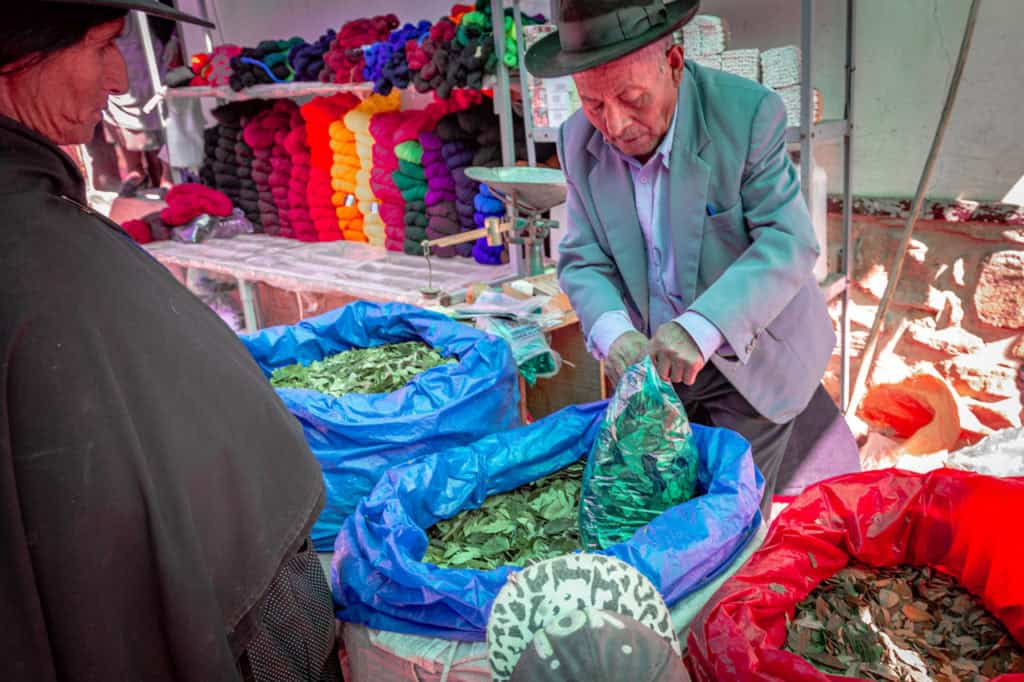

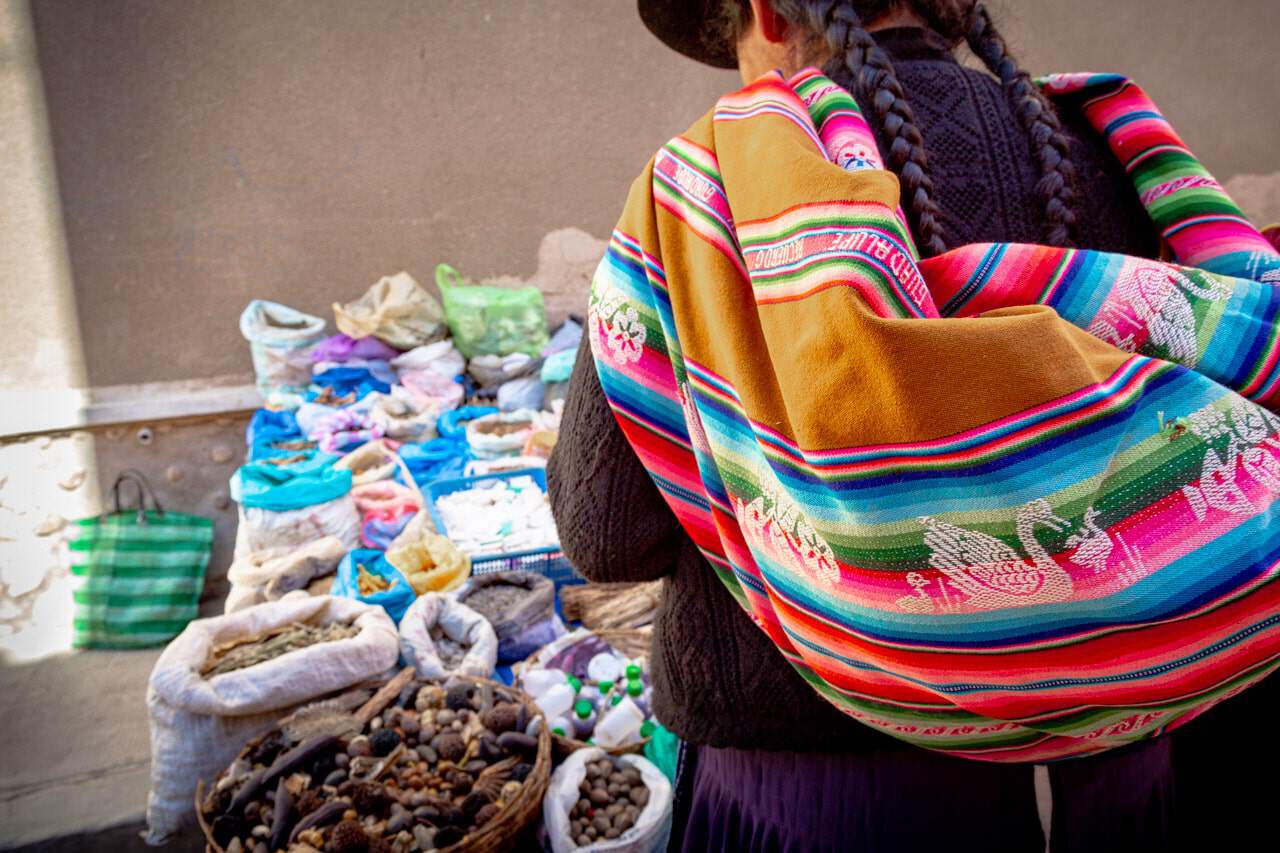
In Tarabuco, men wear poncho-like shirts while women exhibit the most colourful aguayos, a bulky and bright wrap they attach to their shoulders. Made of merino wool this important apparel is used by almost all Bolivians to carry anything from children to supplies.
The Sunday Market is also called the textile market, as many of the shop/stalls display aguayos, covers and ponchos. There are two types, the homemade that is quite thick, sometimes not finished, and the bright industrial fabric that is easy to recognise. This product made in Peru is sold at a low price and most Bolivians use them nowadays.
They are also loved by tourists, and we would be lying if we were saying we didn’t buy any. It would have been nice to buy the real aguayo but small budget happens. Count 50 Bs for the industrial large textile, and min 250 Bs for hand-weaved version. All well bargained, of course.
Next: What to do and see in and around Sucre
We continue our tour of the market hopping from stalls selling coca leaf to wool or ceremonial baskets, making our way down toward the food market. There, we find an even bigger crowd of locals bargaining kilos of red onions, green beans or rice, and carrying live chickens in bags.
Surprisingly enough, as we turn around to enter the indoor market, we bump into a stall selling Cascara. Called Sultana in Bolivia, these coffee cherries are a pure delight for the pallet for whoever likes to taste a tea-like coffee!
We are addicted back home, and since the EU has banned its commercialisation for lack of categorisation, we are more than happy to get a big bag for only 26 cents, before heading back to the van and ultimately Sucre.


How to get to Tarabuco Market?
Tarabuco village is about 40 km outside of Sucre in the south of Bolivia. The market is only held on Sundays from 9 am to 2 pm. To get to Tarabuco there are a few different ways that would fit any needs and budget.
Collectivo
This is the cheapest and the transport that most locals use to travel around the Bolivian countryside. These small vans that can fit up to 10 people are sort of shared taxis that follow a fixed route. There are a lot of these across Latin America, and if you have been travelling around a little while you might be familiar with them.
The collectivos to Tarabuco leave Sucre from the crossing between Avenida de las Americas and Avenida German Mendoza. There are a few buses from the city centre (14 – 8 – cost: 1.5 Bs) that stop nearby but the best way if you are in a hurry is to take a taxi and ask to be dropped off at the bus for Tarabuco (in Spanish you can ask “Parada de los Colectivos por Tarabuco”). The taxi fare shouldn’t be more than 5 Bs per person.
There are a lot of Colectivo to Tarabuco and they usually leave when full so find one almost full. However, it is best to go there as early as possible to make sure you will get a colectivo. Later on during the day, there is a lot less transport as they are all in Tarabuco to bring back locals and tourists from the market. It is best to leave your hostel in Sucre by 8 am and come back from Tarabuco around 2 or 3 pm.
> The Colectivo costs 20 Bs (€1.30) one-way and takes 1.5 to 2 hours.
Taxi
Some taxis may also offer their service to drive you to Tarabuco and back for about 70/80 Bs per person – you can try to bargain a bit.
If you choose this way of transportation, make sure you agree on the price ahead as well as how long you can stay at the market and where to find your driver to return to Sucre.
> Always pay the driver once back in Sucre.
Take a tour
There are a few tour companies that can take you for the day with a private van. It will cost about 40 Bs per person which is the same as if you were visiting independently. However, this will only include transport.
If you are looking for a higher service such as a private tour or lunch included, it will cost you more. Tours have fixed hours but leave directly from the main square in Sucre. It might be best if you are alone and are looking to meet people.
Although, on Sundays, I can bet you that everyone in your hostel will be planning a trip to the market, so ask around if you can join a group!
Now, if you really want to join a tour, you can look for Condor café (2024 updated: closed) or Oasis Bolivia.

FAQ about visiting Tarabuco Market from Sucre
We need you!
If you are visiting Tarabuco, we would love to hear your feedback. This article is very popular because there isn’t much information online on how to visit Tarabuco Market from Sucre. We want to make sure we are giving the most accurate details to our readers and we need your help to keep this blog post as updated as possible.
If you see any wrong information or have any feedback on travel time, how to get to Tarabuco, closures, etc. we would love to hear from you. Please drop us a comment or send us an email!
We appreciate you and hope you are enjoying your time in beautiful Bolivia. Thanks, Jen.

ARE YOU ON PINTEREST?
What about saving this post to your Pinterest board? Click on the photo to save this blog post for later.
We are also on the platform and we love pinning great travel tips. Follow Tales From The Lens’ boards to see our latest pins.
Don’t be shy, come say hi!

About the Author
Jen is the Funder, Author & Photographer behind Talesfromthelens.comJen has lived for the past 15 years across Oceania and Ireland while also travelling in Latin America, North America, and Europe. She has visited more than 65 countries and set foot on every continent in the world! She is a coffee nerd, passionate about photography, wildlife, and outdoor activities.
For more info, check out the About page.
Here are the GPS Coordinates for the Collectivos to Tarabuco: (-19.0493622, -65.2460184) Copy and Paste e.g. in Google Maps