
Standing on the edge of a cliff with a drop of over 1,000 metres below and it finally hits you… “What am I doing here?” Why am I about to cycle the death road? As travellers, we have a weird pleasure in experiencing the most deadly experiences. We flock to jump out of planes and off bridges, we take tours through jungles with countless amounts of creatures that could kill us.
Why do we do these crazy things? Probably because they are fun, they are different and they are a huge part of our travel. This is why we left our comfortable jobs, quit the routine and decided to do something different. Some people do it for the confidence it gives them, some to have a story to tell their friends and some for a great Instagram shot.
But whatever their motivation, many people arrive in La Paz for one reason…to cycle the Death Road.
In this article we will cover all there is to know about cycling the Death Road, and will share our experience!
What Is The Death Road?
The most basic description is that the Death Road connects La Paz to the Bolivian Amazon, the towns and the fertile coffee region between. The city of La Paz is located between 3,000m and 4,000m and the entrance to the Amazon is way down at 800m. That’s a lot of downward travel in a country formed by mountains. To navigate this route without flying means traversing the mountains and the valleys of the Yungas, known for its incredible coffee and coca farms.
A straight, flat area to make a road is hard to come by here. Roads going up and down over the mountains are not feasible and a road at the bottom of the valley would be at the mercy of the elements. For this reason, roads were literally blown into the sides of the mountains.
Dynamite was used to clear routes (which are still being made today). This is the same tactic used in countries around the world and which has created some of the most scenic roads to drive on. But this is Bolivia, one of Latin America’s poorest countries. Blind hairpin turns, potholes the size of cars, two-way roads barely wide enough to fit only one car and hundreds of metre drops are some of the things to expect.
The old road
The death road is actually 421km long taking anywhere from 18 – 34 hours to travel!! If it was flat, the journey could take only 6 hours. The famous road open to cyclists is only 56km, starting from the mountain pass of La Cumbre at 4,650m to the small town of Coroico, 1,525m.
This route is no longer used since the completion of the new mountain road which took 20 years to create. Although void of major traffic, there are still towns and houses located along the old road, so a few taxis and cars can still be seen braving the route. But now the main traffic here is the daily tours of adventure junkies.

Travelling via the new road
We travelled the new road in a 4×4 when we worked in Caranavi, the fertile Coffee region. The new road is fantastic, but it hasn’t changed Bolivians crazy driving habits of speeding and high-speed overtaking around blind corners. It’s terrifying! When we did the route there was a dense fog and 95% of the cars, trucks and buses didn’t use any lights. We could only see cars pass us 15m before they actually did.
Along the new road, there are 3 junctions that are still being built. Because of this, deviations onto the old Death Road have been put in place. Sections of the new road are only accessible at night when the roadworks are finished for the day. The added experience of darkness may actually be good since it prevented us from seeing the drops all around.

Where does the name “Death Road” come from?
Made famous when it was named by a Canadian business men who saw first hand its danger. It has been known by similar variations in local languages. It is unknown how many people have died on the route over the years.
Many of the accidents occur with buses and trucks in which the amount of passengers is not documented.
Why should you cycle the Death Road (or not)?
If you are an adventure junkie, if you want to tick off one of those amazing bucket list opportunities then the death road is for you. It’s one of the best Bolivia tour, and a unique experience that we didn’t live anywhere else during our travels through South and Central America.
It really is open to all levels of cyclists and confidence levels. The guides only make you go as fast as you are comfortable going and if at any stage you feel uncomfortable you can hop on the safety buses which follow each group.
There were two guides in our group, one at the front and one at the back. The guide at the back stays to make sure everyone is ok if they have to stop or stay with anyone a little more nervous. There is no issue with going slowly and enjoying the experience and the view.
If you don’t like speed or if you have never ridden a bike you may think twice before booking a tour. Just don’t feel forced to do something just because everyone else does it and it’s COOL… Jenny who is not comfortable with extreme sports and speed decided to not do the cycle. She is still happy with her choice. Zero FOMO for her.

What you should know before cycling the Death Road
- It is an old road in the mountains.
- Landslides happen. They are cleared but it leaves some rocks on the roads.
- Most of the road is loose gravel.
- There are potholes.
- Accidents happen when people go too fast and hit loose stones and potholes.
- Accidents happen when people are overconfident. Maybe it is a good thing to be scared.
- The road is shared with cars and sometimes small mini-vans.
- When it rains the road is slippery and view not as impressive.
How to book a tour?
There are many options for Death Road tours. Walk around central La Paz, just off of San Francisco square, and you will see many agencies touting day trips. However, there are only 2-3 legit companies who have high standards, good quality and experienced guides. The most important is that they regularly purchase new bikes and have big bike shops to maintain them.
These companies tend to be more expensive but security has a price. From what we have heard from people throughout Bolivia is that the cheaper agencies buy second or third-hand bikes, don’t have the experience or the bike workshops to service the bikes. When it comes down to it, you get what you pay for. We felt that cycling the death road was worth paying for better equipment and supporting companies with high standards.
Steven chose his trip with Gravity Assisted Mountain Biking due to the reviews online and for the great feeling he had about them after we visited their office. He also had several recommendations from travelers in Chile.
The price is steep for backpackers, about €110, but after the tour, Steven confirmed it was worth it. Included in the price are transport, snacks, good condition bikes (suspension, brakes, etc.), lunch at an animal refuge in Coroico, overalls to protect your clothes, a branded buff and a t-shirt.

Find out all our favourite Experiences in Bolivia you can book on Viator! We hand picked the most popular and well rated tours on the platform that we would recommend, so you know you are booking an top-notch activity without any stress…

Good to know
There are options to stay in Coroico after the tour and relax in the jungle and make your own way back to La Paz by public bus. The tour companies have no problem transporting all of your luggage for the day. They will also facilitate ziplining along the route and guided tours of an animal refuge at the end of the cycle, but these are add-ons you will need to pay for.
For Steven, an added benefit of this trip was spending time with the guides who were either from La Paz or had been living there for several months. He learned about great places to get food, live music bars and some of the not so obvious aspects of living in Bolivia.

What to expect Cycling Death Road in Bolivia?
Morning start
The morning starts early. Our group met at 6 am in Café del Mundo for registration and a wake-up coffee. This is fine for those staying in the centre of La Paz but as I was staying in Sopocachi, I had to get a taxi for 20 Bs (€2.55). We then all hoped on the bus to highest pass of the Death Road, La Cumbre, at 4,650m.
On our trip, we had a local driver and a local guide who was an avid downhill mountain biker who competed in national competitions. Also with us was a Dutch guide who had cycled from Europe to Asia, competed in various bike races and was now transitioning to downhill mountain bike competition. During the bus ride, the guides explained what to expect throughout the day.
Start of the cycle
Once at the pass, we received the bikes which were then set up to our size. We then put on our jumpsuits and helmets. To wake us up a bit we took part in a Bolivian ritual, we sipped some 96% alcohol and made a prayer to Pachamama (Mother Earth) for a safe ride. After another safety briefing, we were off.
The way things work in terms of who goes first is simple. Gravity takes over. Generally, the bigger (heavier) people will end up going faster downhill and therefore will be in front. The lighter naturally end up at the back of the group.

Cycling on the paved road
The first section of the ride is on the new road and it is a perfectly smooth surface. It is slightly nerve wrecking because cars fly past, but it is an easy start. This is also an important step as it allowed us to create a natural order which we followed for the rest of the day.
After a fun and fast start, it was uphill for the next section so we had a choice. Try to cycle it or hop back on the bus to the start of the old road trail. Several people wanted to cycle but the majority ruled. Since more people wanted to take the bus, everyone had to follow and take the bus. Maybe this was a good thing as cycling uphill for 45 minutes at 3,000m might have been a poor decision.

Onto the Death Road at last
For the old road section, it was a bit stop/start The guides allow you to get some speed but stop regularly to get the group back together and explain the next section of the road. For example, they tell you if there is a series of sharp turns or if this section is really bumpy. This helps with controlling your speed so you don’t go flying off your bike or off the edge!
In the beginning, I felt the guides stopped us too much, but actually, it was perfect. Each time I felt I was getting comfortable the guide would stop. Getting comfortable may have meant a lapse in concentration and ending up in an accident. Safety first.
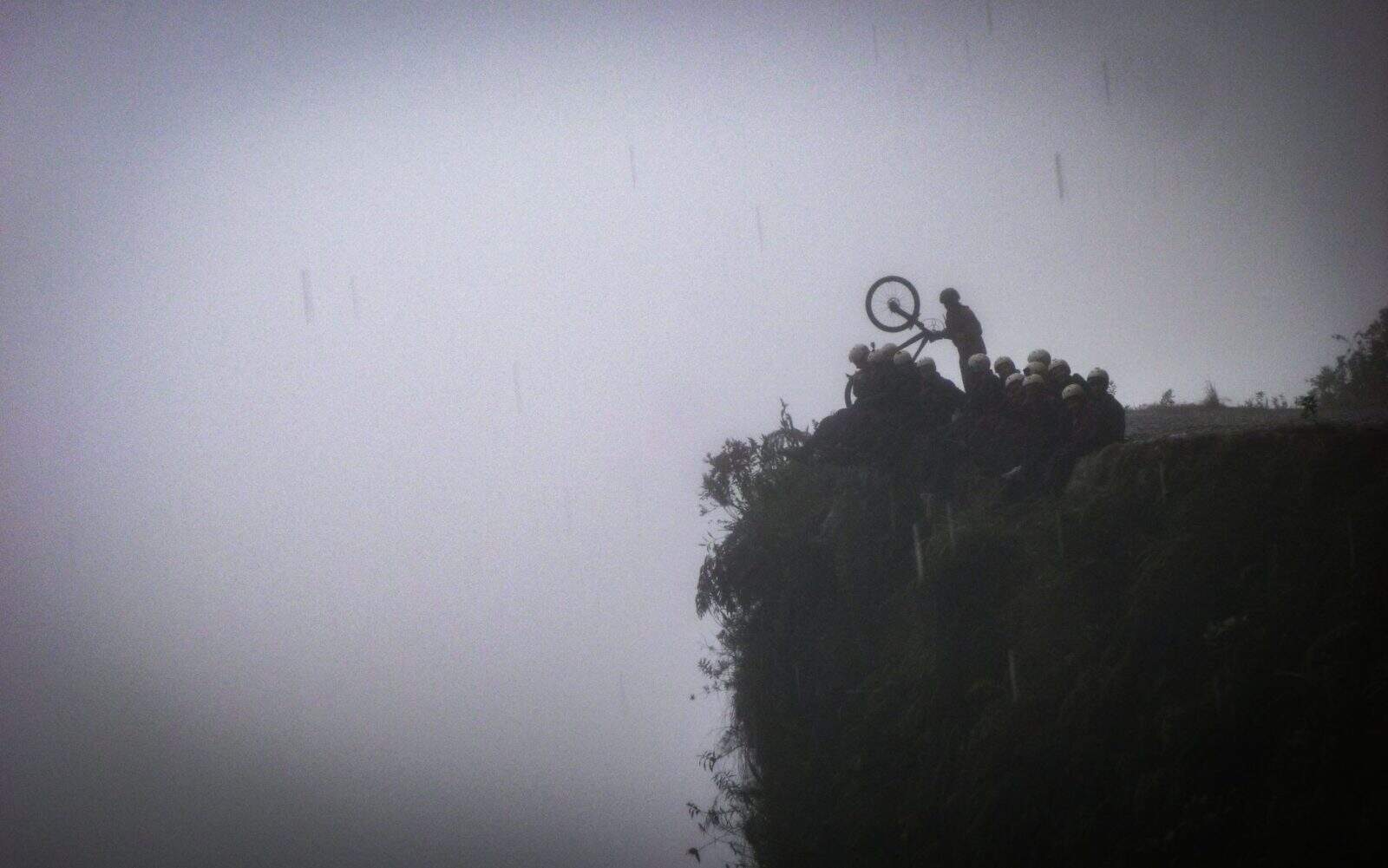
There are several sections where the guides will stop to take group photos, have snack and toilet breaks. One of these is the famous cliff where the group will dangle off the edge. Unfortunately, our view was blocked by the dense cloud. It did give some pretty eery photos.


Is it Safe?
Yes, if you are not an idiot. People have died while cycling the road, mainly because they became overconfident. The started going too quick, taking corners faster than advised. Some people have fallen and sprained wrists. When we did it there we no issues. I thought at the time that the guide was being over safe, but on reflection, she stopped for a regroup at the exact moment people were getting comfortable.
During the ride, Steven lost one of his contact lenses and had a near accident….he almost went off the edge. While taking a bend too fast he went a little to close to the edge. At the next stop, Steven was welcomed with ” wow bro, that was close, you were almost gone” by a Brazilian man who was right behind at the time.

Final thoughts
The weather
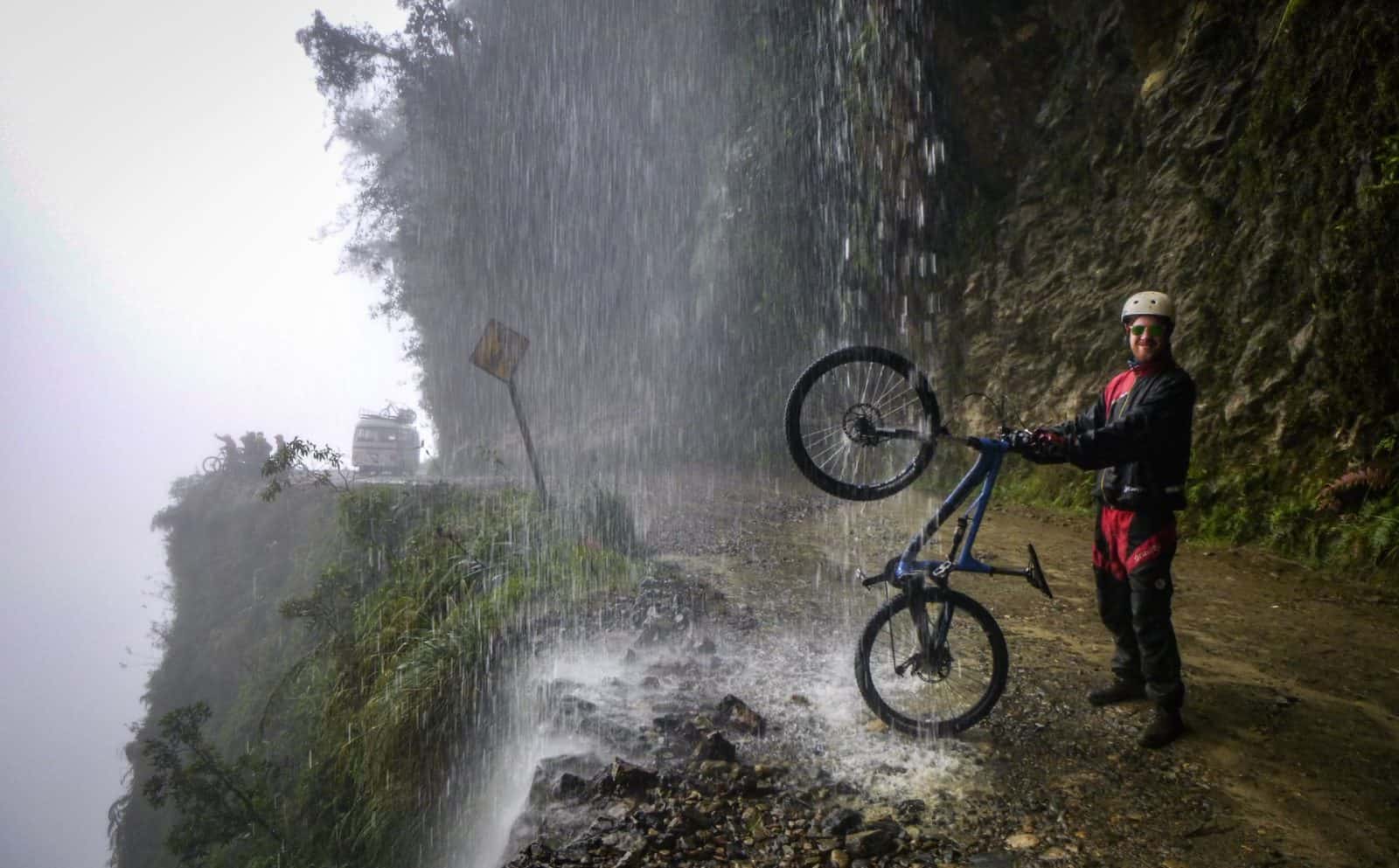
As you can see from the photos, Steven had an awful weather. This was bad luck. His guide told him two days before it was clear, the waterfalls along the route had almost no water. But at this altitude, things can quickly change. For most of the ride, the tour was in a dense cloud which blocked the views and sometimes made it hard to see.
Clothes got soaked and more concentration was required while cycling. But all things considered, it was still amazing. The cloud created a sense of eeriness. Maybe not seeing how big the drops off the side was a good thing also?
Should you do it? Why?
Ultimately it is up to you and your comfort levels. Unless you have a crazy fear of going fast, Steven would recommend this day out. Many travellers we met afterwards told us how much they loved it and shared photos of how they had clear and perfect weather. The views looked amazing.

Busing the entire Death Road
If you feel like you want to see the full death road it is possible to take a bus from La Paz to Rurrenabaque, the base for tours into the Amazon. The route is meant to be 18 hours but regularly takes well over 20. It is the cheapest way to get into the jungle and can give great views.
However, it was nerve-wracking in a 4×4, we couldn’t imagine what it’s like on a bus. We did meet people who did this trip and said it was scary but it was fine in the end.
NEXT Rurrenabaque, the gateway to Bolivia’s jungle – 3 Days In The Bolivian Amazon
Cost and useful information
- Day-tour with Gravity – (Transport, Bike, Helmet, Uniform, T-shirt, Buff, snacks & lunch included): 849 Bs (€110) per person
- Entrance fee to the Community: 50 Bs (€6.40)
- Tips for the driver and guide: the amount you feel like is fair
- Snack at the Senda Verde animal refuge: 20 Bs (€2.60)
- Optional extras are – Breakfast/coffee atCafé del Mundo, Ziplining & a tour of the Senda Verde animal refuge

Superb post, guys! I have been all about going to Bolivia (hard to convince my Argentine boyfriend who says I should just go to some parts of Buenos Aires and it is almost as Bolivia.. Anyway, other story) and had been fascinated with the Death Road from the first time I heard about it 😉
Your post gives a great overview of what to expect on the tours of the Death Road – and you didn’t scare me completely off, even though I’m not that much a fan of speed (but of bikes thus 😅).
Thanks for sharing your experiences!
Becci, you really should go to Bolivia. It’s amazing and much cheaper than Argentina! But…we agree with your boyfriend, there is so much to do in Argentina, maybe he can bring you on a holiday for a nice study break!