
If Cairo is chaos and Aswan is calm, then Luxor is where ancient Egypt comes roaring back to life. This city feels like a living museum with temples the size of airports, tombs carved with stories of kings and gods, and sunsets that turn sandstone into gold.
Luxor sits on the east bank of the Nile, in Upper Egypt. It was built on top of ancient Thebes, once the capital during Egypt’s New Kingdom. At its peak, this city was the beating heart of the pharaohs’ empire, home to huge religious sites, royal tombs, and some of the most incredible architecture you’ll ever see.
Today, Luxor is still layered with that history. On the East Bank, Karnak and Luxor temples still stand tall, connected by a 3 km avenue lined with sphinxes. That path was only uncovered in 1949, and over the last 20 years, it’s been slowly cleared from the modern city that had built up around it.
When walking in Luxor, you’ll pass tea shops packed with locals, souqs selling spices and souvenirs, and feluccas gliding down the Nile, just steps from columns that have been standing since the time of pharaohs.
Across the river, the West Bank holds the country’s most famous tombs: the Valley of the Kings, the Valley of the Queens, and the mortuary temples of pharaohs like Hatshepsut and Ramses III. It’s also where the hot air balloons lift off at sunrise, giving you a bird’s eye view of the past!
This guide brings together the best things to do in Luxor, based on firsthand insights and what I found most helpful while planning and visiting. I’ve also included practical tips to help you organize your days, avoid common mistakes, and actually enjoy the experience without feeling rushed.
Where to Stay?
East Bank Hotels
West Bank Hotels

Explore the Immense Karnak Temple
Karnak Temple is the largest religious complex ever built in Egypt (2nd in the world). It is located on the east bank of the Nile, in honour and worship of Amun-Ra, the sun god.
Its construction began around 2000 BCE, and over the centuries, successive pharaohs added their touches to its sprawling halls, obelisks, and sanctuaries.
Right at the entrance, ram-headed sphinx statues line both sides of the path, symbolising protection and strength. Beyond them lies the massive Great Hypostyle Hall, filled with 134 stone columns reaching 21 meters high.
It’s one of the most photographed spots in Egypt, and for good reason; the scale is staggering.


At the centre of the complex, you’ll find two towering obelisks: the Obelisk of Thutmose I and the Obelisk of Hatshepsut, still the tallest standing in Egypt. Their inscriptions remain surprisingly clear, narrating victories and dedications to the gods and pharaohs.
Don’t miss the Sacred Lake and the Scarab Statue nearby. Legend has it that if you walk around the scarab seven times while making a wish, it just might come true. I gave it a shot; you never know!
Deeper inside the complex, you’ll find the Alexander the Great Sanctuary, a smaller, tucked-away chapel where Alexander depicted himself as an Egyptian pharaoh to be accepted by the locals. It’s not signposted, so use a map or ask your guide to take you there.
For those interested in hidden gems, the Karnak Open Air Museum is worth exploring. It is included in the entry ticket; you just need to know about it because there aren’t any signs. If you are not travelling on your own and your guide gives you some free time, explore this part of the complex to find empty alleys lined up by reconstructed shrines and statues.
You can easily visit Karnak temple on your own since it is in Luxor’s center of Luxor and close enough to most hotels. However, if you want the full story and someone to point out details you might otherwise walk past, consider joining a guided tour that includes Karnak and Luxor Temple.
Travel tip: You can walk to Luxor Temple from Karnak via the Avenue of Sphinxes. This is a 3-kilometre path with little shade, but a great thing to do in Luxor at the end of the day. Ensure you have your Luxor Temple ticket ready (you can buy it online and have the QR code on your phone). Time it right to arrive just before sunset in Luxor Temple and enjoy the site as the lights turn on.
- Entrance Fee: 600 EGP (around €11) per adult.
- Opening Hours: 6 AM to 5:30 PM. Guided tours usually arrive between 9 and 11 am (early morning, lunchtime, and the end of the day are generally quieter).
Visit Luxor Temple at Sunset

Luxor Temple sits proudly in the heart of Luxor City, making it one of the most accessible ancient sites in Egypt. Built around 1400 BCE, primarily by Pharaohs Amenhotep III and Ramses II, this temple was a ceremonial space where Egyptian kings were crowned. Back then, Luxor was still known as Thebes, the powerful capital of Ancient Egypt.
Whether you walk from Karnak Temple along the 3-kilometre Avenue of Sphinxes or enter from the main gates, you’ll be greeted with a breathtaking view of giant stone statues of Ramesses II standing guard at the entrance of Luxor Temple.
These towering figures, carved from solid granite, are impossible to miss, their gazes locked in eternal watchfulness.
Right beside them stands the Obelisk of Ramesses II, a lone sentinel after its twin was gifted to France in the 19th century (It is currently standing at the Place de la Concorde)
Stepping inside, you’ll find yourself in the Grand Colonnade, a path flanked by towering stone pillars that lead you straight to the Court of Amenhotep III. The scale is massive, and the carvings on the walls depict scenes of ancient rituals and grand celebrations. It’s easy to imagine how pharaohs once walked these paths during festivals like Opet, where statues of the gods were paraded between Luxor and Karnak.


Interestingly, parts of the temple were converted into a military camp during the Roman Empire. You can still spot Roman frescoes on the temple’s walls, with faint but clear images of Roman soldiers.
Visiting Tip: One of the best times to visit is right before sunset. Because of its central location in Luxor City, you can easily walk to the temple in the late afternoon, watch the sun dip behind the statues of Ramesses II, and stay until the lights come on. The illuminated columns and towering statues against the night sky are truly a sight.
If you’re short on time, a few hours are enough to visit both Luxor and Karnak temples. You can either go on your own or join a 4-hour guided tour that focuses just on these two sites. But if you’re looking to make the most of your day and also visit the Valley of the Kings and Hatshepsut’s Temple, it’s worth booking this full-day tour that includes all the major highlights. Tour costs include admissions and sometimes a lunch.
- Entrance Fee: 500 EGP (about €8).
- Opening Hours: 6 AM to 9 PM. Arrive around 5 PM for sunset and stay to see the lights turn on.
Enter the Tombs of the Valley of the Kings
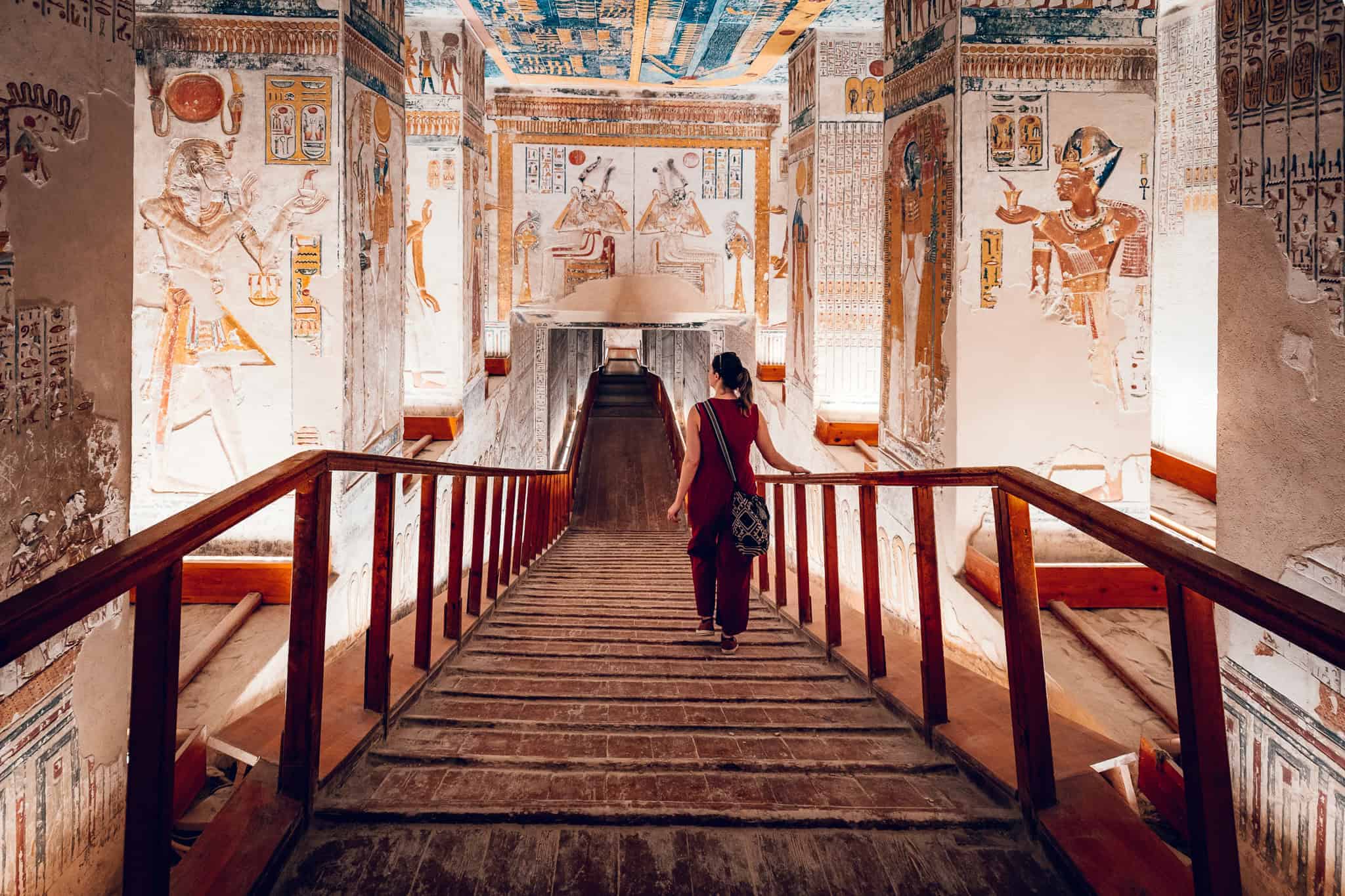
Hidden away on the west bank of the Nile, the Valley of the Kings is where Egypt’s most powerful pharaohs were laid to rest. After realising the Pyramids were far too obvious (and tempting) for tomb robbers, the Egyptians shifted their royal burials to this secluded valley, hoping its rugged cliffs would hide the entrance to the afterlife.
Ironically, it didn’t quite work out; most tombs were looted long ago. But the wall paintings remain beautifully preserved, telling stories of the afterlife with vibrant colours and incredible details. It’s astonishing to think that what you’re looking at was painted over 3,000 years ago and only rediscovered during the 18th century.
More than 60 tombs belonging to iconic pharaohs like Tutankhamun, Ramses II, Seti I, and Tuthmosis III have been discovered here.
The valley itself is watched over by a natural pyramid-shaped peak (an omen of protection in the afterlife).


The standard ticket (750 EGP) gives you access to 3 tombs of your choice from around 11 that are typically open. Though it changes often depending on the excavation and preservation work, so check the sign at the entrance to see what’s accessible that day. There are also 3 additional tombs which require a separate ticket:
- KV62 – Tutankhamun: 700 EGP (€13). His tomb is small, but you get to see his actual mummy.
- KV9 – Ramesses V & VI: 220 EGP (€4). It’s one of the longest shafts in the valley, and the artwork is spectacular. In my opinion, it is the best tomb I visited – the deep blue painted ceiling is incredible.
- KV17 – Seti I: 2,000 EGP (~€35). This is the deepest and most elaborate tomb. If you’re willing to splurge, it’s breathtakingly detailed.
I visited all three, and while they are all great to see, KV9 was by far my favourite. However, entering Tut’s tomb is something not to miss for its mummy, history, and unique paintings (I loved the monkeys). If you aren’t a hardcore Egyptologist enthusiast, Seti I can be skipped. While huge, beautiful, and less crowded, it is very expensive, and I still can’t decide if it was worth the price.
If you’re exploring independently or coming from a cruise, you can reach the Valley of the Kings by taxi. It’s about a 35-minute drive from the East Bank. Another option is to join this day tour, which includes hotel or cruise pickup and a comfortable A/C vehicle.
Note: Guides can give background info, but they’re not allowed inside the tombs with you. So if you’re booking a tour, make sure you know what’s included. There’s also a few things you’ll want to be aware of before going: like ticket options and which tombs are actually worth it. I’ve covered all that in this detailed guide on what to know before visiting the Valley of the Kings (coming soon). If you’re mainly looking for an easy and affordable way to visit the Valley and Hatshepsut’s Temple without needing to coordinate transport, this budget-friendly tour gives you about five hours to explore both.
Take a look at the Valley of the Queens

Often overlooked in favour of the Valley of the Kings, the Valley of the Queens is a quieter, more compact burial ground just southwest of its famous neighbour. It’s where the wives of pharaohs, royal children, and high-ranking nobles were buried during the New Kingdom period.
The valley contains over 90 tombs, though only a handful are open to visitors; and when I visited, the famous Tomb of Queen Nefertari was closed (I can’t find any information when/if it will reopen – please let me know in the comment if you know!).
Even without Nefertari’s tomb, it’s still worth the detour. The atmosphere is much calmer than the Valley of the Kings, and you can take your time exploring without the crush of large tour groups.
Some of the tombs, though smaller in size, have impressively vivid artwork and give insight into the roles royal women played in life and in the afterlife.
Tombs are clearly marked and easy to access, though there aren’t as many open at the same time.
- Entrance Fee: The main ticket costs 220 EGP (€4). Separate ticket to: Queen Nefertari Tomb (if open) : 2,000 EGP (€35)
- Travel Tip: Combine it with a visit to Deir el-Medina and Medinet Habu, both nearby and often less crowded than the major sites.
Stop at the Colossi of Memnon

Standing tall on the edge of Luxor’s west bank, the Colossi of Memnon are two massive stone statues that once guarded the entrance to what was the grand mortuary temple of Amenhotep III. Each statue stands about 18 meters high and depicts the pharaoh seated on his throne, hands on his knees, facing east toward the rising sun.
Although the temple they once fronted is long gone (destroyed by floods and reused stone), the statues remain timeless sentinels. Time, earthquakes, and erosion have weathered them, but their scale and presence are still impressive.
The statues are right off the main road, and you can easily visit them en route to the Valley of the Kings or Medinet Habu.
They’re free to see, and since they’re so accessible, it’s a quick but worthwhile stop. You don’t need long there; just a few minutes to appreciate their size and snap some photos.
Learn about the workers at Der eL-Medina
Not far from the Valley of the Queens, Deir el-Medina offers a completely different perspective on ancient Egyptian life. This was the village where the artisans and labourers who built and decorated the royal tombs lived with their families.
It’s one of the few places in Egypt where you can walk through a preserved settlement and really get a feel for how ordinary people lived (those who weren’t royalty).
The ruins of the village are surprisingly intact. You’ll see the outlines of tiny stone homes, narrow alleys, and even a central well. Life here wasn’t easy; tucked away in the desert, conditions were harsh; but these workers were highly skilled and well-respected.
Many were literate, which is rare for the time, and they left behind a trove of written records that offer insight into daily routines, disputes, wages, and religious practices.
But the real highlight is the tombs. A few are open to the public and, while smaller than those in the Valley of the Kings, they are incredibly detailed and colourful. These workers clearly used their skills to craft stunning final resting places for themselves, filled with scenes of daily life, rituals, and vibrant deities.
- Entrance Fee: 220 EGP (€4) for the site.
Enjoy Medinet Habu without the crowds
Medinet Habu is one of those places that doesn’t get nearly the attention it deserves. Also located on the west bank, not far from the Valley of the Queens, this mortuary temple of Ramses III is incredibly well-preserved and surprisingly quiet.
If you’re looking to escape the tour bus circuit without missing out on grandeur, this is the spot.
The outer walls are massive and still covered in detailed carvings; many showing the pharaoh’s military victories, particularly against the “Sea Peoples.” Inside, the temple opens up to courtyards, hypostyle halls, and intricate reliefs that still show traces of original paint.
- Entrance Fee: 220 EGP (€4).
- Tip: Hire a local guide if you can. The temple’s reliefs are packed with storytelling; having someone explain them adds so much to the experience.
- Don’t Miss: The smaller side chapels; they’re easy to skip but often hold the most interesting details.
Wander Through the Valley of the Nobles

The Valley of the Nobles is one of Luxor’s most underrated gems. While the Valley of the Kings gets the fame and crowds, this site offers something more intimate: the tombs of high-ranking officials, scribes, and artisans who served the pharaohs. Their tombs may be smaller, but the detail and artistry are often just as impressive, if not more personal.
The tombs of Nobles are 9 tombs:
- 1.Tomb of Rekhimre and sennefer (EGP 120 / 60)
- 2.Tomb of Nakht and menna (EGP 200/ 100)
- 3.Tomb of Khonsu (EGP 120 / 60)
- 4.Tomb of Gurnet murai (EGP 120 / 60)
- 5.Tomb of Ramose (EGP 200/ 100)
- 6.Tomb of El-Khokha (EGP 120 / 60)
- 7.Tomb of Abo naga arm north (EGP 50 / 25)
- 8.Tomb of Abo naga arm south (EGP 120 / 60)
- 9.Temple of Seti the first (EGP 200 / 100)
Located between the Ramesseum and Deir el-Medina on the west bank, the valley features over 400 tombs, though only a handful are open at any given time. Some of the best-known and most beautifully decorated include:
- Tomb of Sennefer (TT96): Known as the “Tomb of the Vineyards” for its ceiling covered in grapevines.
- Tomb of Rekhmire (TT100): Rich in daily life scenes and detailed depictions of foreign tribute.
- Tomb of Ramose (TT55): Features both traditional and Amarna-style art, showing the transition during Akhenaten’s reign.
The tombs here feel more human. You’ll see scenes of family life, agriculture, music, and even banquets.
- Entrance Fee: Varies per tomb – see above.
Marvel at the Temple of Hatshepsut

Let’s continue exploring the west bank of Luxor, with the Temple of Hatshepsut. This multi-level mortuary temple was built for Queen Hatshepsut, one of the few women to rule Egypt as pharaoh (and she made sure no one would forget it).
Designed to blend into the limestone cliffs behind it, the temple’s layout is striking: a series of collonaded terraces leading up to sanctuaries cut into the rock. The symmetry and clean lines are stunning, and from a distance, it almost feels modern.
Reliefs throughout the temple depict Hatshepsut’s divine birth, trade expeditions to the land of Punt, and her achievements as a ruler; all carefully crafted to legitimise her reign in a male-dominated world.
- Entrance Fee: 440 EGP (€4).
Check out the Howard Carter Museum & House
If you’ve ever been fascinated by the story of Tutankhamun’s tomb, visiting the Howard Carter House gives that story a tangible, human side. This modest mudbrick house, found very close to the Colossi of Memnon, is where British archaeologist Howard Carter lived and worked during his years in Egypt; and where he returned after discovering King Tut’s tomb in 1922.
The house has been turned into a small museum that offers a peek into Carter’s life during the excavation period.
You’ll find original furniture, tools, handwritten notes, and period photos scattered throughout the rooms. There’s even a replica of King Tut’s tomb set up in a side building, which gives a clear sense of what Carter saw when he first peered through the now-famous doorway and answered, “Yes, wonderful things!” when asked by his sponsor Lord Carnarvon if he could see anything.
- Entrance Fee: 220 EGP (€4).
Stroll & shop at the Luxor Souk


Just a short walk from Luxor Temple, the Luxor Souk is the perfect place to slow down and soak up the local atmosphere. Unlike the chaotic tourist markets you might find elsewhere in Egypt, this one is far more laid-back. Locals go about their day, shopkeepers chat from doorways, and there’s a mix of stalls selling everything from spices to fresh produce and home goods.
As you wander, you’ll pass colourful spice pyramids, woven baskets, alabaster figurines, and plenty of shops selling the usual souvenirs. But what I like about this souk is how enjoyable it was. I went in the morning (it opens at 11 a.m.), and the sellers weren’t aggressive or pushy.
After some friendly haggling that felt more like banter than pressure, I bought a small carved scarab and a Bastet statue. This was a good change from the very aggressive sellers I met in other parts of the world, such as Marrakech or even Peru!
There are also local cafés scattered around where you can stop for a mint tea or a fresh juice. In the evenings, the market gets livelier, especially around the main thoroughfare, but it never feels overwhelming.
- What to Bring: Small bills for easier bargaining.
- Best Time to Visit: Late afternoon or early evening when it’s cooler and more lively.
Visit the Ramesseum – Ramses II’s Forgotten Temple
The Ramesseum, the mortuary temple of Ramses II, often flies under the radar, but it’s absolutely worth a stop. Located not far from Medinet Habu, this site may be in ruins compared to others, but what remains still shows off Ramses II’s ego and ambition in full force.
Once a massive complex rivalling others in size and decoration, the Ramesseum is now best known for the remains of a giant fallen statue of Ramses II. It originally stood over 17 meters tall and likely inspired the poem Ozymandias by Percy Bysshe Shelley. You can still see the colossal head and broken torso lying across the ground, surrounded by pillars inscribed with hieroglyphs and battle scenes.
The temple also features deep relief carvings, including depictions of the Battle of Kadesh; a key moment Ramses II loved to brag about.
- Entrance Fee: 220 EGP (€4)
Learn about Mummification

The Corniche in Luxor is a great place to go for a stroll, but it also hosts the Mummification Museum, a small but fascinating space to learn how the ancient Egyptians turned bodies into mummies.
It’s one long hall with dim lighting and focused exhibits that walk you through the embalming process step-by-step.
You’ll see tools used for mummification, jars that held organs (called canopic jars), and even a real mummy on display, along with mummified animals like cats and fish. It’s all very compact, but you can take your time, read everything, and come away with a deeper understanding of the rituals surrounding death in ancient Egypt.
- Entrance Fee: 220 EGP (€4)
- Allow about 30 min


Hide from the heat at the Luxor Museum
Set between Luxor Temple and Karnak Temple along the Nile Corniche, the Luxor Museum offers a well-curated, modern space to appreciate the artistry and craftsmanship of ancient Egypt without the overwhelming scale of Cairo’s museums.
It’s compact, calm, and beautifully arranged, making it one of the country’s best museums.
The collection includes statues, stelae, tools, jewellery, and even some well-preserved mummies, all displayed with excellent lighting and clear explanations. Highlights include a stunning statue of Thutmose III, a head of Amenhotep III, and artefacts found during the excavation of Luxor Temple and Karnak.
- Entrance Fee: 400 EGP (€7).
Take a Hot Air Balloon Ride Over Luxor

There’s no better way to see the scale and beauty of Luxor than from above, and a hot air balloon ride at sunrise offers exactly that. Lifting off from the west bank in the early morning, the balloon floats silently over the Nile, the desert, and the lush green farmland that lines the river.
Below, you’ll spot the Valley of the Kings, Hatshepsut’s Temple, the Colossi of Memnon, and scattered villages slowly coming to life.
The light at dawn is incredible. As the sun rises, it casts a soft orange glow over the temples and tombs. You’ll share the sky with dozens of other balloons, which, in fairness, is a beautiful sight!
Flights are weather-dependent and can be cancelled if winds are too strong. Unfortunately, ours was cancelled due to a sandstorm reducing visibility.
When booking a hot air ballon ride in Luxor, you’ll usually be picked up around 4:30–5:00 AM from your hotel, transferred to the launch site, and in the air for 45 minutes to an hour. Most companies offer similar routes, so the difference is determined by group size, reputation, and price.
- Cost: Around €40–60 per person depending on company and group size.
- Booking: Book a day or two in advance; check if your tour includes transfers and insurance.
- Local Tip: Dress in layers, it’s chilly in the morning but warms up quickly once the sun is out.
Sail the Nile on a Felucca
One of the most relaxing ways to experience Luxor is from the deck of a felucca, a traditional wooden sailboat that’s been gliding along the Nile for centuries. The best way to enjoy the Nile, is to book a 2 hour sailing sunset tour. Feluccas usually depart from the east bank near Luxor Temple.
Prices online vary from €10 to €30 for a private boat. Alternatively you can walk along the promenade and haggle with the locals.


- Booking: Haggle gently or book online for peace of mind. Be careful to book a sailing boat, some tours are motored felucca so double check before booking.
- Local Tip: Sunset is the most photogenic time, but daytime rides are quieter and less crowded. Bring a light scarf or jacket for wind on the water.
Visiting Luxor – practical info you need to know
The Luxor Pass – Is It Worth It?
The Luxor Pass is a ticket that gives you unlimited access for five days to most of Luxor’s main archaeological sites. There are two versions of the pass: Standard and Premium, which differ only in that the second includes access to Queen Nefertari’s tomb (currently closed) and Seti I’s tomb.

When you break down the costs, the Luxor Pass; is more expensive than buying individual tickets in Egyptian pounds (EGP), assuming you’re visiting each site once. The pricing at the entrances is in EGP, while the Luxor Pass is sold only in euros or US dollars, so the value you get depends heavily on currency exchange rates at the time of your visit.
Right now, there’s another factor to consider: Queen Nefertari’s tomb is currently closed. That’s a major highlight of the Premium Pass; without it, the extra cost becomes much harder to justify.
That said, there are still a few situations where the pass can make sense:
- You want the freedom to revisit sites (like Karnak or the Valley of the Kings) as many times as you like over five days.
- You prefer the convenience of a single ticket and want to pay in Euro or USD (though you can buy tickets online if you want to avoid carrying EGP cash)
- You’ve previously bought the Cairo Pass (within the same calendar year), which qualifies you for 50% off the Luxor Pass.
In short: unless you plan on revisiting sites, covering everything in five days, or scoring the Cairo Pass discount, the Luxor passes are not worth it.
Where to Buy the Luxor Pass?
You can purchase the Luxor Pass either at the Valley of the Kings visitor center or near the Karnak Temple ticket office (on the left after upi pass the security gate – if you are asked for your ticket, say you want to purchase the Luxor Pass).
You will need your passport and a passport-sized photo. Payments are only accepted in USD or Euros cash only. Egyptian pounds aren’t accepted…
Local Tip: The pass must be used on consecutive days, and it’s ideal if you plan to visit multiple sites on

Where to Stay in Luxor
The city is split between the East Bank, where most hotels, restaurants, and transport hubs are, and the West Bank, which offers a quieter, more local vibe right near the tombs and temples.
East Bank – Best for Convenience
Most travellers base themselves here near Luxor Temple, Karnak, the train station, or the airport. It’s ideal if you stay just a few nights and want easy access to restaurants and shops.
- Hilton Luxor Resort & Spa – Riverside luxury with a pool and spa, perfect for relaxing after long sightseeing days.
- Pavillon Winter Luxor – Affordable elegance next to the historic Winter Palace, with a lush garden and central location.
- Nefertiti Hotel – Budget-friendly, great rooftop views over Luxor Temple, and a solid on-site restaurant.
West Bank – Best for Atmosphere and Peace
If you’re staying longer or want a more local feel, the West Bank is quieter, greener, and just minutes from top sites like the Valley of the Kings, Hatshepsut’s Temple, and Medinet Habu. It’s more relaxed, with plenty of guesthouses and homestays run by locals.
- Villa Sunrise – A peaceful guesthouse with beautiful views, warm hosts, and hearty homemade meals.
- New Memnon Hotel – Clean, friendly, and perfectly located for visiting the West Bank sites.
- Villa Desert Rose – Stylish, quiet, and full of local charm. Generous breakfasts and a relaxed vibe.
When to Visit Luxor
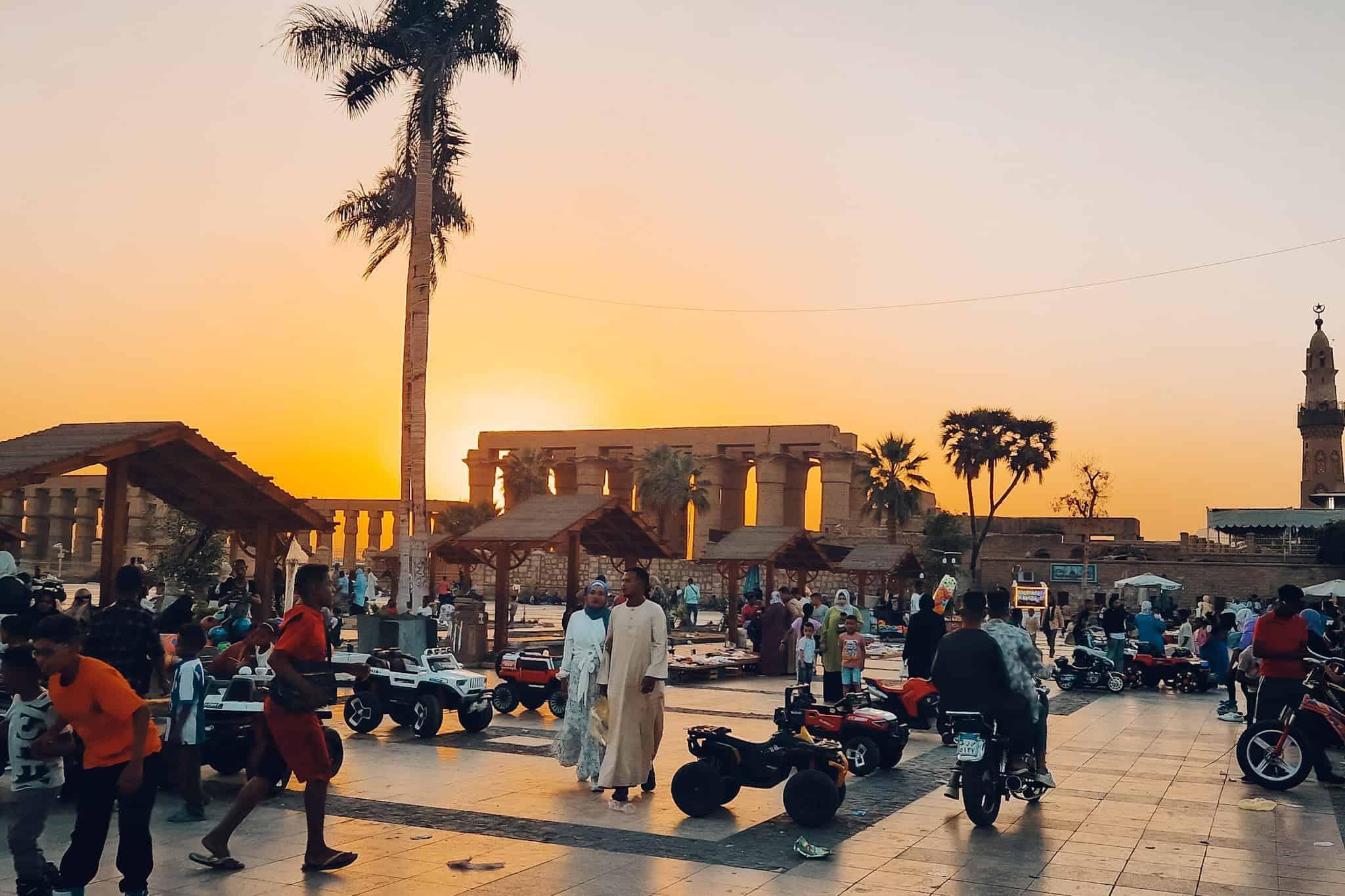
The city sits deep in Upper Egypt, which means it gets hot (really hot), especially in summer. The best time to visit Luxor is during the cooler months, from October to April.
During this period, daytime temperatures range from the mid-20s to low 30s°C (70s to 80s°F), making it comfortable to explore temples, tombs, and ruins without melting in the sun. Evenings are cooler, so bring a light jacket, especially from December to February.
From May to September, the heat becomes intense, often exceeding 40°C (104°F) during the day. Sites like the Valley of the Kings and Karnak Temple become much harder to enjoy in the midday sun.
Special Considerations:
- Ramadan: Egypt slows down during this month. Sites remain open, but opening hours shift. Some restaurants may close during the day.
- Crowds: December and January are peak tourism months. While the weather is ideal, expect more tour buses and larger crowds at major attractions.
Travel Tip: Luxor’s sites are mostly open from 6 AM to 5 PM (check openings though), and early morning is always the best time to beat the heat and the crowds.
How to Get to Luxor, Egypt
International Travel to Luxor
Luxor has a small international airport (LXR), though direct flights from outside Egypt are limited.
- From Europe: There are just a few direct flights a week from Paris, London, Barcelona or Rome.
- From the US or Asia: You must connect via Cairo, Kuwait or some cities in Europe (Paris, London)
The most common route for international travellers is to fly into Cairo first, then continue to Luxor by plane, train, or other means.
Getting From Cairo to Luxor
Plane: Flying is the fastest and easiest way to travel from Cairo to Luxor, with a flight time of about one hour. EgyptAir operates multiple flights daily, and while prices vary, you can often find good deals if you book in advance. This is the most time-efficient option, especially on a tight schedule.
Train: Trains are a popular alternative, especially the overnight sleeper train, which offers a “comfortable” and cost-effective way to cover the distance. These sleeper trains include private cabins and meals, with tickets starting around $80 USD. There are also seated train options that are more budget-friendly, though they’re slower and less comfortable for the long journey.


Car: Driving from Cairo to Luxor takes roughly eight to nine hours, but it’s not generally recommended due to the long distance and varying road conditions. Some tour companies offer private car transfers, but flying or taking the train tends to be much more convenient unless you’re stopping along the way.
Cruise: While most Nile cruises start in Luxor and head south to Aswan, a few itineraries go in reverse or even depart from Cairo, though these are much longer and less common. These cruises typically span four to five days and stop at key temples along the river.
Tour: Many guided group tours that begin in Cairo include Luxor as a key stop and handle all transportation logistics for you. This is an excellent choice if you prefer everything arranged beforehand, though it offers less flexibility than planning your own route.
Getting From Aswan to Luxor
The train is the most efficient and budget-friendly option, taking 3–4 hours with comfortable first-class seats. Flights exist but aren’t common due to the short distance. A Nile cruise is the most scenic route, lasting 2–4 days with visits to Kom Ombo and Edfu.
How to Get Around Luxor
Much of the East Bank is walkable, especially around Luxor Temple, the souk, and the Corniche. If you’re staying centrally, you can reach many key spots on foot. However, keep in mind that sidewalks are inconsistent, and the sun can get intense by mid-morning.
As you walk around, you’ll likely be offered caleche rides (horse-drawn carriages), taxis, or tours. Locals might also approach you, offering boat rides or guided tours. It can feel a bit overwhelming if you’re not used to it. If you’re not interested, just keep walking and say “La, shukran” (no, thank you). If they keep insisting, don’t engage and continue your stroll.

If you’d rather avoid being approached altogether, the best way to get around Luxor is by taxi. Uber is available in Egypt, but it’s very limited in Luxor. Locals use a similar app-based service called Careem, based on a bidding system.
I found the App and overall experience with Careem a bit frustrating; as soon as drivers realised we were foreigners, we started getting messages asking for higher prices than what was shown in the app. It got annoying, so I gave up on it. You’re better off asking your hotel to call a taxi and help you agree on a price in advance.
Public ferries run regularly between the East and West Banks and only cost a few Egyptian pounds. It’s a nice local experience and gets you across the Nile quickly.
For exploring the West Bank, where everything is more spread out, hiring a private driver or guide for the day is the easiest and most convenient option. Most hotels or guesthouses can arrange it for you, and it’s especially helpful if you’re trying to visit several sites in one day.
How Many Days to Spend in Luxor, Egypt?
Luxor may look small on the map, but there’s more to see than most realise. To really enjoy it without rushing, plan to spend at least 3 full days. This gives you time to explore the major sites on both banks of the Nile and still leave room to wander, relax, or fit in a hot air balloon ride or a felucca sail.
- 1 Day will let you see either the East or West Bank, but not both in any depth. You’ll likely stick to highlights like Karnak and Luxor Temple or a quick spin through the Valley of the Kings.
- 2 Days give you time to visit both sides of the Nile. You can spend one day on the temples and tombs of the West Bank and the other on the East Bank’s monuments and museums.
- 3–4 Days is ideal. You can visit the top attractions without feeling rushed, add smaller gems like Deir el-Medina, the Ramesseum, or Medinet Habu, and still enjoy a more relaxed pace with a felucca ride, souk visit, or sunset views.
- 5+ Days works if you’re interested in a deeper dive: perhaps with extra time for Christian monasteries, Banana Island, or simply soaking in the quiet charm of the West Bank.
Which SIM Card Is Best for Egypt?
Staying connected in Egypt is easy and affordable, and having a local SIM can make your trip smoother, especially when booking rides, looking up opening hours or buying entry ticket (and adds-on).
The most convenient and reliable option is to use an eSIM from Airalo. It saves you the hassle of visiting a mobile store, and you can install it before you even land in Egypt. Their eSIM plan offers solid coverage across the country, including Luxor, and you can top it up directly through the app. It’s a good fit if you only use data for maps, messages, and basic browsing.

Final Thoughts on Luxor
There’s something about Luxor that sticks with you. For a city surrounded by some of the most famous temples and tombs in the world, it felt surprisingly calm. Even while walking through the center, past rows of taxis and market stalls, there was a quiet undercurrent I didn’t expect, especially coming from the chaos of Cairo.
What struck me most was how easily you can slip from city life into something completely timeless. Cross the Nile, and suddenly you’re in the middle of the West Bank – dusty, open, with mountains rising behind ancient stone walls.
Some of these sites were buitl more than 3,000 years, yet they still sit there with the kind of presence that makes you stop mid-sentence!
For more help planning your trip, check out my guide to Famous Landmarks in Egypt where I share the best spots across the country you really shouldn’t miss.

ARE YOU ON PINTEREST?
What about saving this post to your Pinterest board?
Click on the photo to save this blog post for later. We are also on the platform and we love pinning great travel tips. Follow Tales From The Lens’ boards to see our latest pins.
Don’t be shy, come say hi!
Please note │ This blog post may also include affiliate links to hostels or products we recommend, which means if you buy something following a link on this page, we’ll get a small commission. This will be of no extra cost to you but will help us continue running this blog. Thank you for your support.

About the Author
Jen is the Funder, Author & Photographer behind Talesfromthelens.comJen has lived for the past 15 years across Oceania and Ireland while also travelling in Latin America, North America, and Europe. She has visited more than 65 countries and set foot on every continent in the world! She is a coffee nerd, passionate about photography, wildlife, and outdoor activities.
For more info, check out the About page.