
Nestled in the heart of Southern France, Camargue is a natural region renowned for its unique landscapes and rich biodiversity. Home of long deserted beaches and pink flamingos, the region is also a blend of salt flats, marshes, and wetlands, making it a haven for wildlife enthusiasts and nature lovers.
Camargue’s history is as vibrant as its landscapes, with a heritage deeply rooted in both Roman and Medieval times, which can be seen as you visit the towns of Aigues-Mortes or Saintes-Maries-de-la-Mer.
Not only a crucial ecological site, the region is also an integral part of French cultural identity, anchored in its Provencal roots, where traditions of bull farming mix seamlessly with horseback riding and gypsy folklore.
I grew up in the South of France, about 2 hours’ drive from Camargue. I often visited Camargue for a weekend or even a day trip. Last year, I even participated in a hen party that took place in a “Manade”!
This guide dives deep into the heart of Camargue, sharing the must-visit spots, activities, and hidden gems that make this area a jewel of Provencal culture and natural beauty. Join me as we explore the best that Camargue Regional Nature Park has to offer.
This article lists all the top things Camargue, France and how to visit on your own. If you don’t have access to a car or don’t have enough time to organize everything, you can join one of the 4×4 guided tours from the city of your choice.
The 4×4 Safari tours in Camargue are specially tailored to show you the best of Camargue Natural Regional Park: white horse, bulls, Manade, flamingos and more! Choose your city below to find the best day tours to Camargue.
Top things to do in Camargue, France

Visit a working Manade
A Manade is a traditional Camargue ranch where bulls and horses are raised in semi-wild conditions.
By visiting a Manade, you will witness the guardians (cowboys) herding bulls and learn about the region’s equestrian traditions. Raising bulls in the Camargue region of France for traditional races or bullfighting festivals significantly differs from the practices associated with ferias and corridas in Spain.
Here, the focus is on games that test the agility and intelligence of the bulls, such as the Course Camarguaise, where participants attempt to retrieve rosettes from the bulls’ horns without harming them. This reflects a more harmonious relationship between humans and bulls, celebrating the animals’ strength and spirit without the intent to kill.
Typically, the experience includes a guided tour, often on a hay wagon or horseback, allowing you to observe the animals in their natural habitat. Guardians (cowboys) demonstrate their skills in herding and managing the livestock, sharing insights into the daily routines and the historical significance of their practices.
The visit often concludes with a convivial gathering, where you’ll get to enjoy local Camargue cuisine such as ‘Guardiane de Taureau’ (bull stew) while listening to local Gypsy music.

Look for Pink Flamingos
Camargue is a bird watcher’s paradise, home to over 400 bird species, including the emblematic pink flamingos. In fact, it is one of the few places in Europe where you can see pink flamingos in their natural habitat.
The best spots for bird watching are the marshes and lagoons, particularly during the migration seasons in spring and autumn. Here are some of the best places to see Pink Flamingo in Camargue.
Parc Ornithologique de Pont de Gau
Spanning over 60 hectares of marshes and ponds inhabited by herons, flamingos, storks, teals, and raptors, this park is a haven for birdwatching. It offers well-marked trails and observation platforms for visitors to get up close to the pink flamingos.
The shortest trail is 2.6 km, taking about 1 to 1.5 hours to complete. It is one of the best family-friendly activities in Camargue.
How to Get There ¦ Located just a few kilometres from Saintes-Maries-de-la-Mer, the park is easily accessible by car. Follow the D570 road towards Saintes-Maries-de-la-Mer, and signs for the park will guide you the rest of the way.
Practical Information ¦ The park charges an entrance fee, which goes towards the conservation of the site and its inhabitants. It’s advisable to bring binoculars and a camera with a good zoom to capture the flamingos without disturbing them. Also, consider visiting during the cooler parts of the day when the birds are more active.
Étang de Vaccarès
This large lagoon is a prime location for observing pink flamingos in the wild. The vast, open waters and surrounding marshlands create an ideal habitat for flamingos to feed and breed.
How to Get There ¦ Access to Étang de Vaccarès is primarily via the D37 or D36B roads, with several viewpoints and stops along the way. The lagoon is more remote, so having a car is essential.
Practical Information ¦ There are no entrance fees to view the lagoon, but facilities are minimal, so bring water, snacks, and sun protection. The area around Étang de Vaccarès is also great for cycling, with several scenic routes available (more details below).

Salin d’Aigues-Mortes
While primarily a salt production site, Salin d’Aigues-Mortes is another excellent location to view pink flamingos, especially since these birds are attracted to the salt flats’ briny waters.
How to Get There ¦ The site is located near the town of Aigues-Mortes. You can reach it by taking the D979 road out of Aigues-Mortes towards Le Grau-du-Roi. Guided tours at the Salin are available.
Practical Information ¦ The visit to Salin d’Aigues-Mortes can be done on foot, by bike or with a little train. We have detailed everything you need to know in the next section.
Fangassier Lagoon
As the only breeding site for flamingos in France, it is one of the best places to witness these majestic birds from April to September.
Guided tours, booked through the “Bureau des Guides Naturalistes“, ensure a respectful and informative experience, highlighting the lagoon’s significance within the Camargue’s ecological tapestry.
How to Get There ¦ take the D36 road from Arles to Salin-de-Giraud and then follow the signs for the lagoon.
Practical Information ¦ The best time to visit the lagoon is from March to July, when the flamingos are nesting and breeding. The lagoon is not accessible by car, but you can park at the nearby salt works and walk or bike to the lagoon.

BEST ONLINE CAR RENTAL COMPARATOR – DISCOVER CARS
When booking a rental car in France online, we recommend using Discover Cars because they offer Full coverage for less than €7. It is one of the best rental car comparators out there!
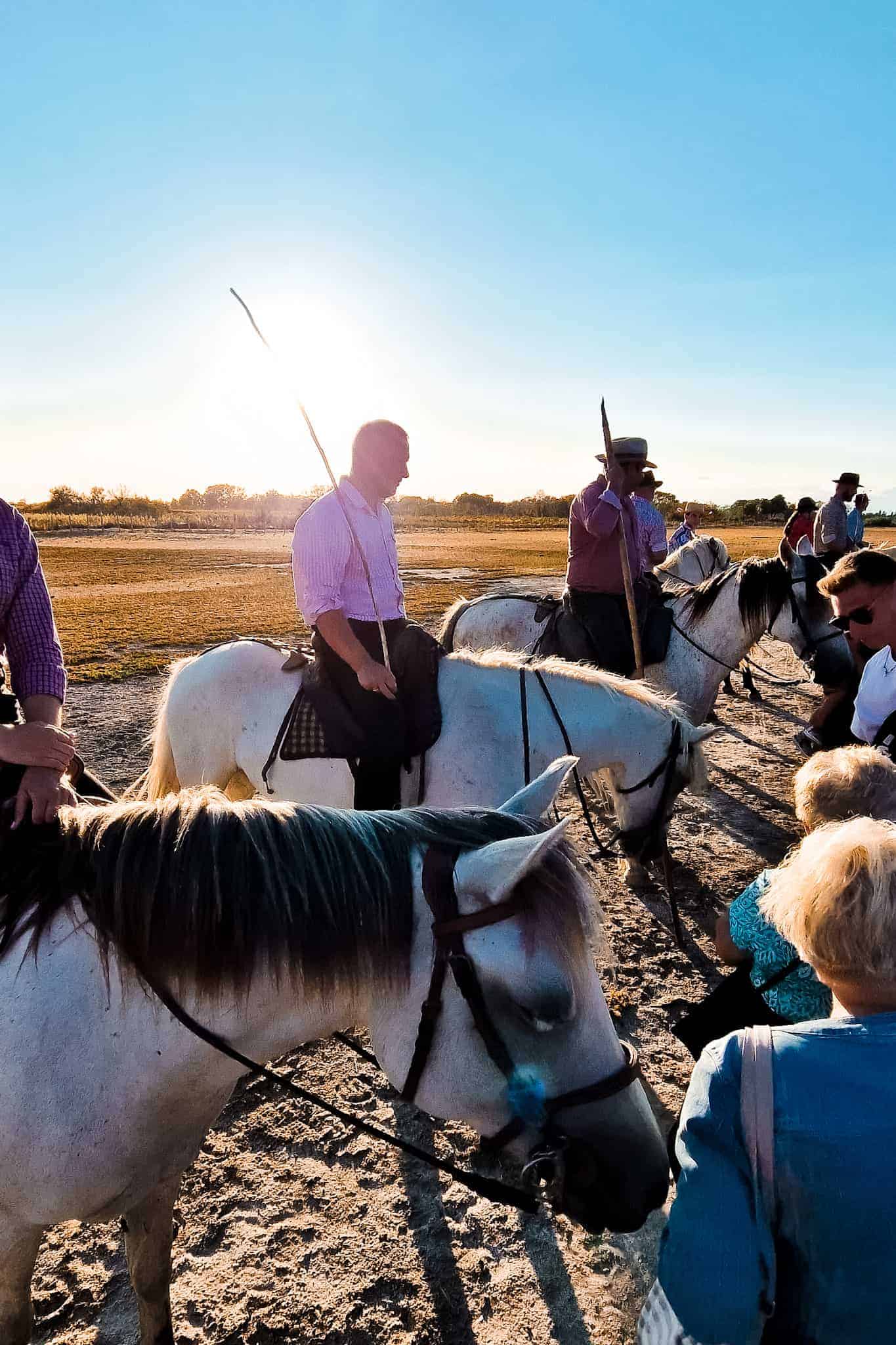

Where to see the Camargue White horses
The white horses of Camargue are emblematic of this unique region in southern France. These horses are not truly wild but live in semi-feral conditions within the Camargue Regional Nature Park and surrounding areas. Known for their ruggedness, stamina, and calm demeanour, the Camargue horses are small, sturdy, and possess a distinctive white coat as adults, although they are born with a darker coat that lightens as they age.
Historically, these horses have been an integral part of Camargue’s culture and environment, traditionally used by the guardians for cattle herding and management of the black bulls.
While the term “wild” might suggest complete freedom from human interaction, the horses of Camargue are more accurately described as free-roaming within the managed reserves and ranches (Manades). These areas provide them with a habitat where they can live in conditions closely resembling their natural state, but they are still overseen by humans who ensure their well-being and manage the land they inhabit.
You can come across these horses by driving or cycling around the marshes but one of the best ways to see them, is to join a 4×4 Guided Safari Adventure!


Participate to the Courses Camarguaises
Bull games, or “courses camarguaises,” are a deeply rooted tradition in the Camargue region, embodying a unique blend of sport, culture, and respect for animals. Unlike the Spanish bullfights, these events do not aim to kill the bull; instead, they highlight the agility, intelligence, and bravery of both the bull and the participants, known as “raseteurs.”
In these games, the raseteurs attempt to remove ribbons, strings, and other tokens attached to the bull’s horns, using only a hook and their dexterity, in an arena filled with spectators.
The bulls used in these games, known for their speed and quick reflexes, are often stars in their own right, returning to their pastures after the events.
The best time to witness the thrilling spectacle of courses camarguaises is during the spring and summer months, when numerous festivals and events take place in the local villages and towns.
Summer Season in Camargue
Throughout the summer, small towns and villages across Camargue host their own “ferias” and festivals, many of which feature courses camarguaises. These events are integral to local life and offer an authentic glimpse into the traditions of the region.
When ¦ June to August
Rice Feria in Arles (Feria du Riz)
Celebrating the harvest of Camargue rice, the Feria du Riz is another significant event featuring courses camarguaises. It’s a testament to the agricultural heritage of the region and its enduring cultural traditions.
When ¦ September
Trophies & Competitions
Every year, raseteurs face each other at a series of trophies and competitions. Among these, the most prestigious is the Trophée des As, a championship that pits the top raseteurs against the most challenging bulls over the course of the season. On the official website of the federation, you can find the calendar of all the events and then look for the city organising the game.
Tip: To find the tickets online, google “Arenes de” + the city of your choice. Ie. “Arenes de Beaucaire” – Expect the websites to be in French. You main need to reserve a seat via phone but some have ticket online or directly outside the arena on the day of the game.
Saintes-Maries-de-la-Mer Pilgrimage (Pèlerinage des Saintes-Maries)
This pilgrimage honors Saint Sarah, the patron saint of the Gypsy people, and includes a variety of festivities such as processions, music, and courses camarguaises. It’s a unique opportunity to experience the fusion of religious tradition and local culture.
When ¦ 24th & 25th of May

Visit the pink Salt pans
The pink salt pans of Camargue, a striking feature of the region’s landscape, are renowned for their vibrant hues and the traditional method of salt harvesting they support. These salt marshes, particularly around Salin d’Aigues-Mortes, turn a remarkable shade of pink due to the proliferation of algae that thrives in the high-salinity water.
The process of salt collection here is an age-old tradition, yielding the famous “Fleur de Sel,” a premium sea salt cherished by chefs worldwide.
The pans not only contribute to the local economy through salt production but are also a habitat for diverse wildlife, including flamingos.
Salin d’Aigues-Mortes
The Salin d’Aigues-Mortes welcomes visitors every day from the end of March to mid-November, offering three distinct ticket options: a ride on the little train, a biking adventure, or a self-guided walking tour.
Self-Guided Walking ¦ The well-marked trail is about 4km and entry cost €9 per adult. The tickets for a self-guided walk can be purchased online or directly at the ticket booth outside the salin. Although, make sure to arrive early as the entry is not permitted within three hours before closing (6pm). While animals are not allowed, trolleys are, making this a family-friendly outing.
Biking ¦ The bike route covers around 30 kilometers. You will need bring your own bicycle and a repair kit to address any potential issues. Because of the long distance, prefer an electric bike if you can, or make sure to come as early as possible to beat the summer heat. Tickets are available online or at the booth. Visitors must exit by 6:00 PM, and wearing a helmet is compulsory.
Little Train ¦ The little train offers an accessible option to explore the salin, with tickets available at the train’s departure point or from the automatic ticket dispenser. This option is especially appealing for those seeking a less strenuous way to see the sights or for families with children, offering a relaxed and enjoyable experience. Note: Those requiring wheelchair access should contact the company by phone or email, as online booking is not possible.
How to Get There ¦ The salin is located on the D979 between Grau-du-Roi and Aigues-mortes. There is a large parking and a bike/pedestrian trail along the main road if you come from Aigues-Mortes. Just follow the painted marks “salin” on the floor.
Salin du Midi
Salin du Midi also known as Salin de Giraud is renowned for its salt pans, offering a unique landscape that contrasts starkly with the marshlands of Camargue. If you are near Arles, do no miss them. They are located about 40km from the city centre.
For the best view of the Salin, make sure to stop at the Salt Pan Observation Mound. It is located about 2km south of the town via the D36.
You can turn your visit of the Salin de Giraud in a day trip to see the salt pan and pink flamingos either on foot or by bike. The loop circuit from the Tourism office to the Etang du Fangassier, is about 30km. You can rent a bike in the little village of Salin-de-Giraud if you don’t have one. Just be aware this area can be quite windy with the Mistral.
Take a boat cruise
For those seeking to experience the region from a distinct vantage point, consider setting sail on a cruise. From Saintes-Maries-de-la-Mer, you have the option to join the Tiki III, an iconic paddle boat characteristic of the Camargue, for a 90-minute journey.
This adventure takes you to the mouth of the Rhône River and the Bac du Sauvage, offering chances to see birds like erons, and even local bulls and horses along the way. The cruise includes a visit to a manade.
When ¦ Everyday from April until end of October
Booking ¦ €16 per adult – €9 per child (4 to 14 yo) – Website

Taste Camargue dishes
Local specialties include ‘Gardiane de Taureau’, a bull meat stew, and ‘Fougasse d’Aigues-Mortes’, a sweet bread and ‘Tellines’, small shellfish seasoned with garlic and parsley.
Gardiane de Taureau
Gardiane de Taureau is a hearty stew that stands as a symbol of Camargue cuisine. Made from bull meat, which is a staple in the region due to its bull-raising traditions, this dish is slow-cooked with red wine, herbs, and vegetables until tender.
The result is a deeply flavorful and comforting dish often served with Camargue rice, showcasing the local produce and culinary techniques passed down through generations.
Fougasse d’Aigues-Mortes
Fougasse d’Aigues-Mortes is a sweet, brioche-like bread that originates from the town of Aigues-Mortes. Unlike its savory namesake found in other parts of Provence, this version is flavored with orange blossom water and sometimes filled with sugar or fruits, offering a delicate and fragrant treat. It’s typically enjoyed as a dessert or a snack, often accompanied by a cup of tea or coffee.
Tellines
Tellines are small shellfish, similar to clams, that are harvested from the sandy shores of the Camargue. These are usually prepared simply, sautéed with garlic, parsley, and olive oil, to highlight their natural, subtle flavor.
Camargue Rice
Cultivated in the unique saline environment of the Camargue, this rice is known for its quality and distinct taste. It can be found in various colors, including white, red, and black, each with its own texture and flavor profile, serving as a versatile base for many regional dishes.


Walk around the Medieval town of Aigues-Mortes
Aigues-Mortes is renown for its well-preserved 13th-century towers, fortifications and walls that surround it. You can buy tickets to walk along the ramparts and visiting the iconic Tour de Constance are highlights, where you can enjoy panoramic views of the Camargue and the nearby Salin.
If you prefer wandering through the narrow alleyway, you will find the old town bustling with shops and restaurants where you can taste the local gastronomy. Allow about 2 hours to stroll around, visit the small boutiques and grab some food or a cafe on the main square.
For those looking to experience the town’s beauty without the walk, a 25-minute small train tour offers a comfortable and informative journey through the old town.
Camargue Regional Natural Park: Walk, bike, drive
There’s no better way to experience the region’s breathtaking beauty than by exploring the 14 discovery routes within the Camargue Regional Natural Park.
These trails can be done on foot, by car, or by bike.
- The Sea Dike ¦ An immersive journey starting from the Gacholle lighthouse, ideal for mountain bikers and walkers, covering 24 km round trip with no car access. Time varies based on the mode of travel, with trekkers spending 4-5 hours to complete the route.
- The Marshes from Albaron to Saliers ¦ A 20 km loop that can be explored by car or by bike, offering a deep dive into the marshlands’ biodiversity. Expect to spend 1-2 hours by car or up 3 hours if you cycle.
- Bulls and Vineyards ¦ This loop starts froom Arles and passes through Salier and Gimeaux. It is a great place to see Bulls roaming the marshes and maybe stop at a couple of vineyards. Accessible by car (count 2 hours) or by bike (3 to 4 hours).
- Arles to the Vaccarès pond ¦ This trail from Arles to the Vaccarès pond is only suitable for Mountain or trekking bikes. It takes up to 4 hours to complete it.
- Camargue Horses and Rice Paddies ¦
- Bac du Sauvage ferry to Les SaintesMaries-de-la-Mer ¦ cycle or drive between the Bac du Sauvage ferry and Cacharel ranch. The journey lasts about 1.5-3 hours by car or 2h30 to 4 hour by bike.
- The Méjanes Trail ¦ Known also as the trail of the 5 gorges, it’s a path that weaves through the estate of Méjanes, accessible by bike or on foot only.
- The Vaccarès ¦ This two-day biking trip encircles the Vaccarès pond, inviting an extended exploration of the area’s flora and fauna, ideal for slow immersion in the region.
- Pink Flamingos and Salt Pans ¦ A route where you will see stunning pink flamingos and traditional salt pans, perfect for a half-day excursion by bike or for a full day on foot.
- A Unique Camargue Village ¦ Explore Salin-de-Giraud where you can learn more about the salt confection and enjoy the gorgeous colours of the salt pans. Expect up to 2 hours on foot or by bike.
- Along the Banks of the Rhône ¦ From Salin-de-Giraud to Port-Saint-Louis-du-Rhône, this path offers scenic river views, suitable for a 1 to 3-hour journey by bike or a nice 4 hour walk.
- The City Surrounded by Water ¦ Discover Port-Saint-Louis-du-Rhône on foot (2 hours), bike (1 hour) or by car (20 min).
- From the Van Gogh Bridge to the Vigueirat Swamps ¦ This route from Arles to the Mediterranean Sea, part of the “Via Rhôna”, merges art history with natural beauty only accessible y bike. Count 3 to 4 hours.
- Alpilles, Crau, Camargue ¦ Dive into the diverse natural landscapes of the region, a longer route that showcases the ecological variety. Accessible with a mountain bike only. (5 to 8 hours).
You can find all the circuits on the Official Website of Arles.

Learn about the Romans in Arles
Arles, a UNESCO World Heritage Site, stands as a testament to the grandeur of Roman and medieval architecture in the south of France.
As a must-visit city alongside Saintes-Maries-de-la-Mer, Arles is celebrated for its remarkable Roman monuments, which include the awe-inspiring Roman amphitheater, evoking the majesty of Rome’s Colosseum, and the ancient theater that once seated 10,000 spectators.
In this 2-hour private guided tour, you’ll get to see everything the town has to offer while learning about its history.
Arles’ timeless beauty has captured the imagination of many artists, most notably Van Gogh, and is home to several art museum such as Réattu Museum, Van Gogh foundation or the Museum of Ancient Arles.
It is also well known locally for its photography festival (Rencontres d’Arles) that take place for a couple of months every year in the summer.

Other places to visit in Camargue
Les Saintes-Maries-de-la-Mer
Les Saintes-Maries-de-la-Mer mesmerizes with its stunning beaches and vibrant cultural scene. This coastal town is a melting pot of historical richness and natural beauty, famous for its annual gypsy pilgrimage to the legendary church.
With streets lined with quaint shops and cafes, it offers a deep dive into Camargue’s traditions. As a pilgrimage site for the Romani people, it honors Sara, the Black Virgin, amid a backdrop of diverse landscapes and a sanctuary for 277 bird species, including the iconic flamingos.
Domaine de Méjanes
The Domaine de Méjanes is a quintessential slice of Camargue heritage, nestled in the heart of the region’s breathtaking landscapes. This sprawling estate offers a deep dive into the traditional Camargue lifestyle, where the iconic white horses roam freely, and the culture of bull farming is celebrated.
The park offers a variety of activities, from horseback riding tours that traverse the estate’s vast natural beauty to exciting bull games that showcase local customs.
Marais du Vigueirat
The Marais du Vigueirat is a treasure trove of biodiversity, spanning 1,200 hectares and housing over 2,000 species. The reserve’s meadows, water bodies, and the largest reed bed in the Camargue make it a premier location for birdwatching.
This local guided tours led by a naturalist will take you to the heart of the Marias du Viguerat with an electric minibus. You will stop at several observatory decks to look for wildlife. This is an ideal activity for family adventures.
Le domaine de la Palissade
Le Domaine de la Palissade offers an unspoiled natural sanctuary adjacent to the Mediterranean’s rare and endangered wetlands. Spanning 702 hectares, the domain is committed to conservation, providing paths for walking or horseback exploration amidst wild landscapes.
Camargue Museum
The Camargue Museum is a deep dive into the region’s rich cultural and natural history. Through its exhibits, you can explore the ecological diversity, traditional crafts, and the evolution of human settlements within this unique landscape.
The museum serves as a comprehensive guide to understanding the intricate balance between nature and human activity in the Camargue, offering insights into the region’s past, present, and future.
The Rice House
The Rice House celebrates Camargue’s agricultural heritage, focusing on the pivotal role of rice cultivation. This museum, set within a working farm by the Rozière family, rice farmers for five generations, educates visitors about the cultivation process unique to the territory.
Representing 99% of French rice production, the visit includes a tour of rice fields, farming equipment, and an overview of the rice transformation stages, offering a grain-to-plate perspective on this essential crop.
Camargue’s Beaches
The Camargue boasts some of the most unspoiled and picturesque beaches in the south of France, each offering a unique slice of coastal paradise.
Plage de Piemanson, near Salin-de-Giraud, is one of the most remote, providing vast stretches of sand and a sense of wilderness. Beauduc Beach is a favorite among kite surfers and those seeking solitude, accessible via a rough track that adds to its secluded charm.
Espiguette Beach, near Le Grau-du-Roi, features extensive dunes and is a protected natural site, making it ideal for nature lovers and those looking for a peaceful retreat.

What to do near Camargue?
Les-Baux-de-Provence
Nestled atop a rocky outcrop, Les Baux-de-Provence is a picturesque medieval village offering breathtaking views of the Alpilles.
The village is renowned for its artisan shops, olive oil mills, and vineyards, offering a taste of the local lifestyle. Visiting Les-Baux-de-Provence means wandering through ancient cobblestone streets, exploring the ruins of the Château des Baux, and immersing yourself in the history and beauty of this iconic Provencal destination.
Just a stone’s throw from Les Baux-de-Provence, the Carrières de Lumières (Quary of lights) is an extraordinary art and music venue set within a vast limestone quarry, that you cannot miss.
This immersive experience projects the works of famous artists onto the quarry’s walls, floors, and ceilings, accompanied by music, creating a mesmerizing spectacle that transports visitors through art history in a truly unique setting.
Nimes
Nîmes is a city steeped in history, boasting some of the best-preserved Roman monuments in Europe, including the Nîmes Arena and the Maison Carrée.
Wander through the Jardins de la Fontaine, one of the oldest public gardens in Europe, and explore the contemporary Musée de la Romanité, which showcases the city’s Roman past.
Here is a great 2-hour private walking tour in Nimes Historical Center.
Avignon
Famous for its Palais des Papes, the largest Gothic palace in the world, Avignon is a city of historical significance and stunning beauty. Walk along the remnants of its medieval walls, cross the iconic Pont d’Avignon, and explore the vibrant Place de l’Horloge.
Avignon’s annual theatre festival, the Festival d’Avignon, transforms the city into a lively cultural hub, attracting performers and visitors from around the globe.
For a deap immersion within Avignon History, make sure to check out this city walking tour trip including the Popes Palace entry.
Best time to visit Camargue?
The best time to visit Camargue largely depends on what you’re looking to experience, but generally, the spring (April to June) and autumn (September to October) months are considered ideal.
Spring brings the region to life, with wildflowers blooming across the landscapes, making it a perfect time for birdwatching, especially to see the iconic flamingos. The weather is pleasantly warm, and the natural beauty of Camargue is at its peak, offering stunning backdrops for hiking, photography, and horseback riding.
Autumn offers mild temperatures and fewer crowds, making it a great time to explore the outdoor beauty of Camargue. The harvest season brings a unique charm to the region, with local festivals and the opportunity to experience the rice harvest. Birdwatchers can still enjoy a rich array of species, as many birds linger before migrating for the winter.
Summer (July to August) is popular among tourists for its sunny weather and vibrant festival season, including the famous gypsy pilgrimage in Saintes-Maries-de-la-Mer. However, it can get quite hot, and the presence of mosquitoes is more pronounced.
Winter is quieter and cooler, which can be appealing for those looking to avoid crowds, though most attractions may closed.
Faq about Camargue, France

ARE YOU ON PINTEREST?
What about saving this post to your Pinterest board?
Click on the photo to save this blog post for later. We are also on the platform and we love pinning great travel tips. Follow Tales From The Lens’ boards to see our latest pins.
Please note │ This blog post may also include affiliate links to hostels or products we recommend, which means if you buy something following a link on this page, we’ll get a small commission. This will be of no extra cost to you but will help us continue running this blog. Thank you for your support.

About the Author
Jen is the Funder, Author & Photographer behind Talesfromthelens.comJen has lived for the past 15 years across Oceania and Ireland while also travelling in Latin America, North America, and Europe. She has visited more than 65 countries and set foot on every continent in the world! She is a coffee nerd, passionate about photography, wildlife, and outdoor activities.
For more info, check out the About page.