
If you’re planning a trip to Cairo for the first time, chances are you’ve already listed the obvious sight: the Pyramids of Giza. But you’re probably here because you have a nagging feeling in the back of your mind, that little worry saying, “What if I miss something amazing and only realise after I’m already back home?”, or maybe “what to do in Cairo besides the Pyramids”?
Fair enough. Before heading to Egypt, I spent hours researching, digging through websites, blogs, and forums because I knew Cairo had to offer more than the Pyramids!
This guide is specifically crafted to put your mind at ease. Based on my personal experience of exploring Cairo. It covers not only the iconic must-sees for first-timers, but also several easily overlooked places.
Keep reading my take on the best things to do in Cairo as a first timer, and I promise you’ll go home with unforgettable memories and no regrets.
Places to visit
- Pyramids of Giza
- Grand Egyptian Museums
- Coptic Cairo
- Khan El Khalili Bazaar
- Citadel & Islamic Cairo
Where to Stay?
Top Tours to Book
The Obvious: Visiting the Pyramids of Giza, but there is more!
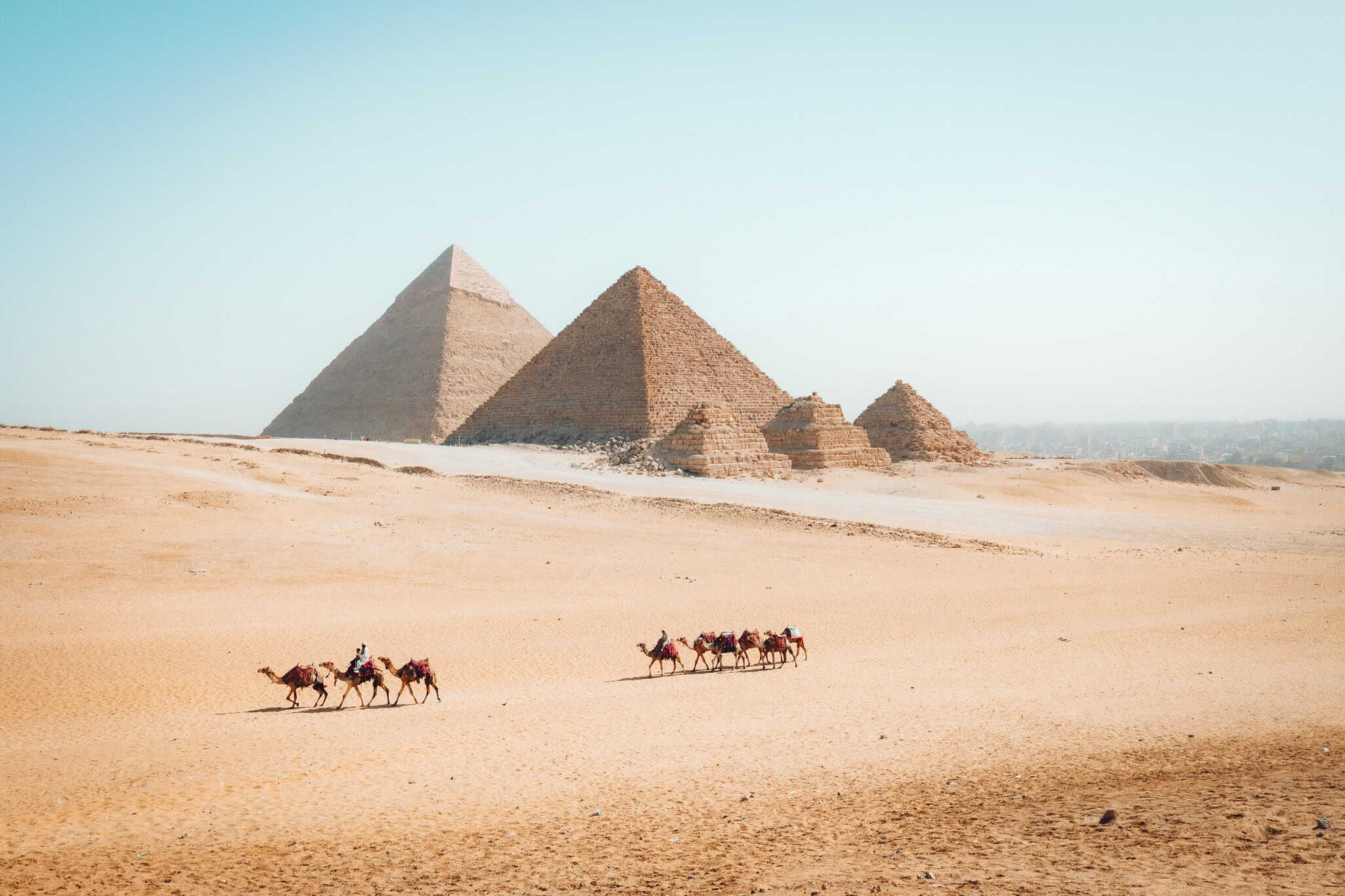
You’re not going to Cairo without seeing the pyramids. I know, it’s obvious. But here’s the thing: no matter how many photos you’ve scrolled past or documentaries you’ve watched, nothing prepares you for standing in front of them.
There are three main pyramids at Giza: the Great Pyramid of Khufu (the largest and oldest), Khafre’s Pyramid (recognizable by the chunk of limestone casing still clinging to the top), and Menkaure’s Pyramid (the smallest, but no less impressive).
Just downhill, the iconic Great Sphinx sits half-buried in sand, carved from a single slab of limestone and staring down the centuries. It’s more worn than most postcards show, but seeing it up close is worth it.
So, how do you actually visit the pyramids? Whether you’re planning to go solo or want the ease of a tour, here’s what you need to know.
Best Way to Visit the Pyramids on Your Own (No Tour Required)

You can visit the pyramids independently, and in my opinion, that’s the best way. There are two entrances: the main gate (for tour buses, which can be crowded and hectic) and the southern local gate (much quieter, with no buses allowed). If you’re like me and prefer fewer crowds, definitely use the local entrance.
Gates usually open at 7 AM. If you’re early, you walk straight to the Sphinx before any tourists arrive. Seriously, you’ll have it to yourself for nearly an hour. We got amazing photos and spent peaceful moments just taking in the view.
From the Sphinx, you can explore the pyramids freely. While most tours rush straight to the Great Pyramid, if you wander towards the middle or smaller pyramids, the crowd thins dramatically. Within minutes, you’ll have these ancient giants practically all to yourself. Believe me, there’s nothing like standing in silence beside something so monumental, feeling like you’ve stepped back in time.

What’s next? >> PYRAMIDS OF GIZA AT YOUR OWN PACE
Our self-guided itinerary to visit the Pyramids on your own
This guide explains how to visit the pyramids independently, with a walking route, map, and spots on the Giza Plateau not covered by guided tours.
Entering the Great Pyramid


Here’s the deal about entering the Great Pyramid: it’s not comfortable, but it’s absolutely epic. For around €25 extra on your entry ticket (about 1500 EGP), you get access to the King’s Chamber.
Entering involves climbing through a steep, narrow shaft. It’s hot, humid, and cramped. You’ll have people coming down while you’re going up, so you’ll need to squeeze aside occasionally. Once you reach the King’s Chamber, there’s nothing but an empty stone sarcophagus and eerie silence. The room echoes mysteriously, the walls closing in with thousands of years of history.
However, it’s thrilling, slightly claustrophobic, and incredibly memorable. If heat or tight spaces make you uneasy, this might not be ideal, but if you’re up for an adventure, go for it! It’s a once-in-a-lifetime experience.
If climbing inside the Great Pyramid sounds too intense, there’s a smaller pyramid nearby, housing the tomb of Queen Hetepheres. It’s still steep but much quieter, slightly cooler, and free. It’s a perfect alternative, especially if you’re travelling on a budget.
Finding the Hidden Viewpoints (No Camel Required)

There are iconic panoramic viewpoints behind the pyramids. Tour operators try to sell camel or horse rides there, I didn’t feel good about that. I didn’t know how the animals were treated, and frankly, it’s expensive and unnecessary.
Instead, here’s what I did: I walked. By following our self-guided itinerary, you’ll find yourself completely alone, enjoying stunning views of all the pyramids perfectly aligned. These hidden viewpoints are worth the effort and way better without the crowds and camel tours.
Tomb of Meresankh III: The Secret Gem Nobody Tells You About
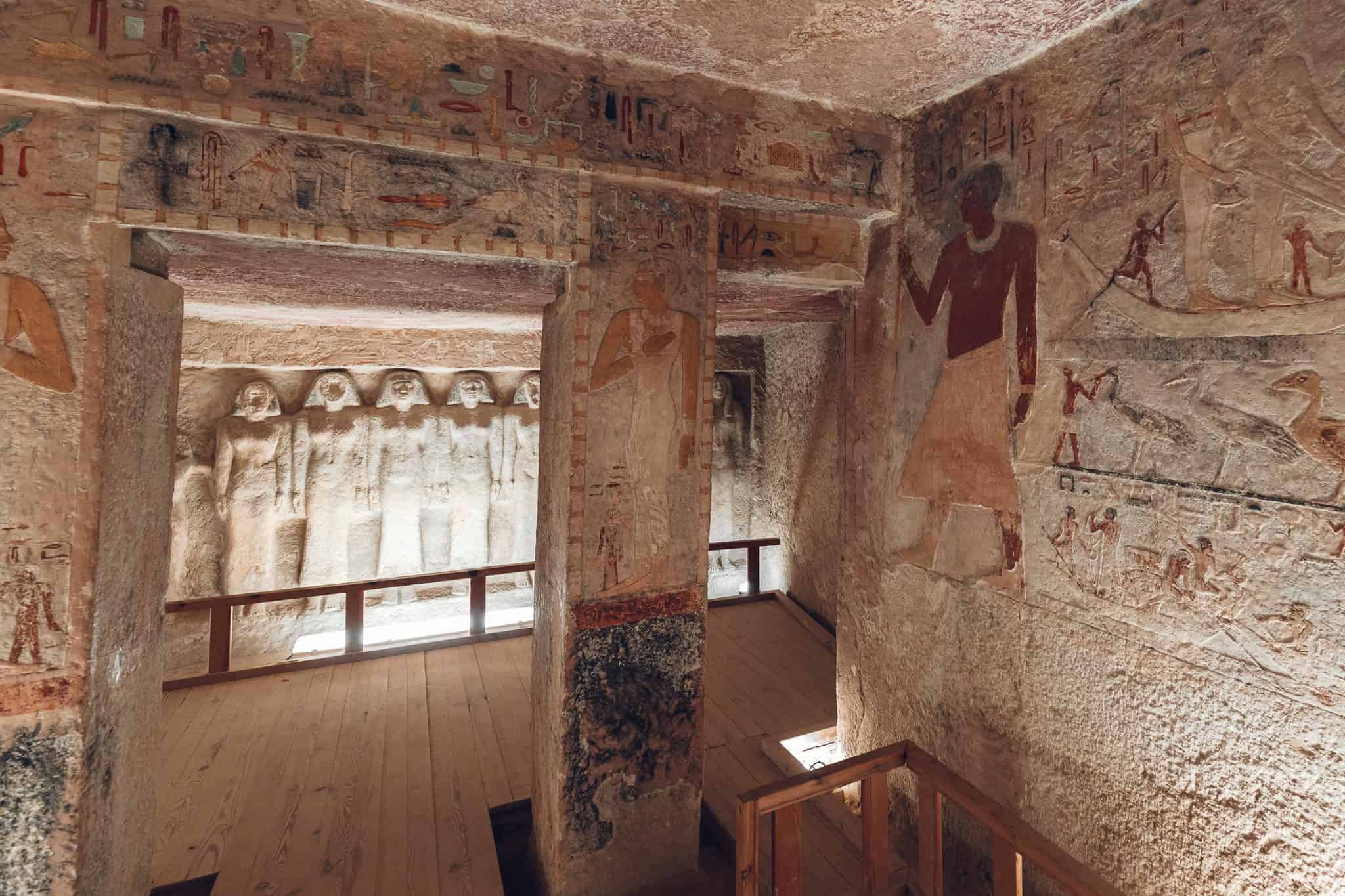
So, this tomb wasn’t even on my radar at first. I just randomly added it to my ticket (only about €5 extra), not knowing what to expect. And wow, it turned out to be one of the coolest parts of the entire Giza experience.
Meresankh III was a queen, and her tomb features stunningly vibrant hieroglyphics and beautifully preserved statues, just as you’d expect from the famous Valley of the Kings. However, here, right next to the pyramids, it is almost completely overlooked by tourists.
Officially, photos aren’t allowed, but the guards smiled, winked, and said, “It’s a secret.” Obviously, they’re hoping for a tip, and it’s absolutely worth giving one (about 100-200 EGP).
This was genuinely a highlight, something completely unexpected and totally different from anything else you’ll see around Giza. If you’re visiting the pyramids, trust me, do not skip Meresankh III’s tomb. It’s the kind of hidden gem that makes travelling independently so rewarding.
Visiting the Pyramids with a Tour
If you’d rather skip logistics and focus on the experience, visiting the pyramids with a tour can make things much easier. Hotel pickup, transport, and a guide to explain what you’re seeing takes a lot of the guesswork out of the day, especially if it’s your first time in Cairo.
For a straightforward introduction, this half-day tour of the Pyramids of Giza and the Sphinx is a solid option. It’s ideal if you’re short on time but still want to see the highlights without rushing.
If you prefer a more flexible experience, a private pyramids and Sphinx tour with a camel ride gives you control over the pace and lets you avoid larger groups. It’s a good choice if you want to linger or focus more on photography.
For travelers looking to pair the pyramids with a visit to the newly built Grand Egyptian Museum, this full-day tour offers great context and saves you from organizing multiple visits on your own.
And if you want to go beyond Giza, this extended tour to Giza, Saqqara, and Dahshur is worth considering. It’s a longer day, but it shows how pyramid construction evolved over time; something you won’t get by sticking to Giza alone.
Visiting Cairo’s Museums: Old vs. Grand Egyptian Museum (GEM)
When I planned my trip to Cairo, I was a bit confused. There’s the famous old Egyptian Museum in Tahrir Square, near downtown Cairo, and then there’s this brand-new one: the Grand Egyptian Museum (GEM), near the Pyramids of Giza. Should you visit both? Is one better than the other? Let me break it down.
Old Egyptian Museum


The Old Egyptian Museum remains one of Cairo’s top attractions, even as its role has shifted in recent months. Sitting in the middle of bustling Tahrir Square, the museum feels frozen in time, not just because of what it houses, but because of how it feels to walk through it.
This is not a polished or modern museum. It’s crowded, dusty, and slightly chaotic, with artifacts packed into aging glass cases and handwritten labels that feel straight out of the early 20th century. Walking through the halls, it’s easy to imagine archaeologists passing through with newly unearthed discoveries, heading straight from the dig site to the lab.
That atmosphere is exactly what gives the place its character.
However, one major change is the removal of Tutankhamun’s golden mask and original sarcophagus, which were transferred to the Tutankhamun galleries at the Grand Egyptian Museum in late 2025. For many visitors, that was the main reason to come here, and its absence is noticeable.
Even so, the museum still holds enormous value. The Royal Mummies Hall remains a powerful experience, with mummies displayed close enough to feel genuinely unsettling. The collections are vast, and unlike the GEM, very little is curated for flow or storytelling, leaving you to wander, observe, and absorb.
I loved it for exactly that reason. It’s busy and imperfect, but it feels authentic in a way few museums do anymore. If you want a museum that feels like modern Egyptology in action, this is it.
Grand Egyptian Museum (GEM)
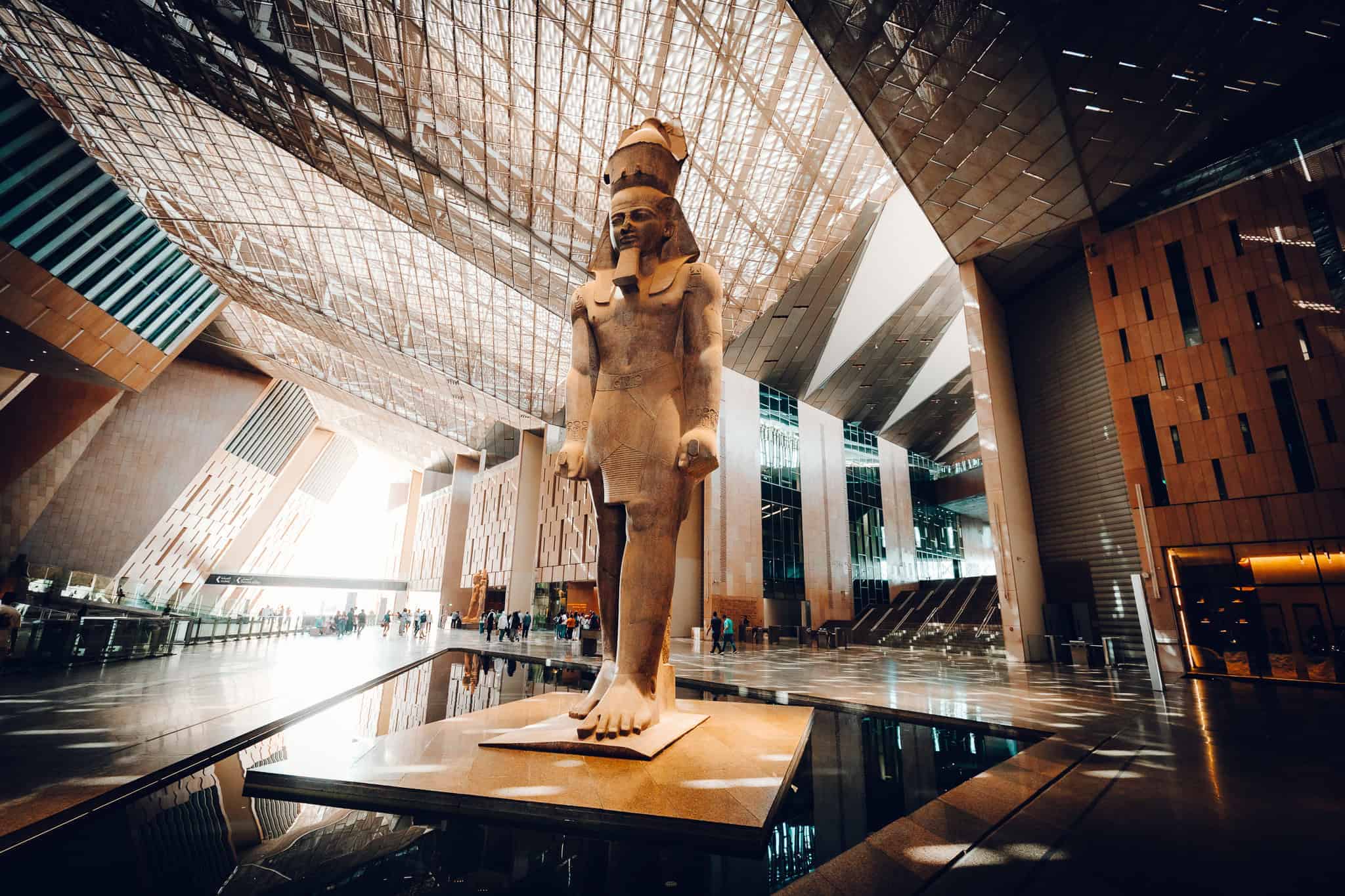
Now, contrast this with the brand-new Grand Egyptian Museum (GEM). The contrast with the Old Egyptian Museum is immediate. The space is vast, modern, and intentionally designed, with wide galleries, controlled lighting, and air-conditioning that offers real relief from Cairo’s heat.
The experience begins the moment you enter the gigantesque and high-ceilinged building. A monumental statue of Ramesses II dominates the entrance hall, setting the tone for what follows. Everything here is curated with clarity and purpose. Artefacts are spaced out, clearly labeled, and presented in a way that makes them easy to appreciate rather than overwhelming.
When I visited in April 2025, the museum was only partially open. As of November 2025, the GEM is now fully operational, including the long-awaited Tutankhamun Galleries. For the first time, all 5,000 objects from Tutankhamun’s tomb are displayed together, including the golden mask and sarcophagi that were previously housed at the Old Egyptian Museum.
Beyond Tutankhamun, the scale of the collection is impressive. Massive statues, sarcophagi, reliefs, and everyday objects from sites across Egypt are displayed with context and breathing room.
Should You Visit Both?

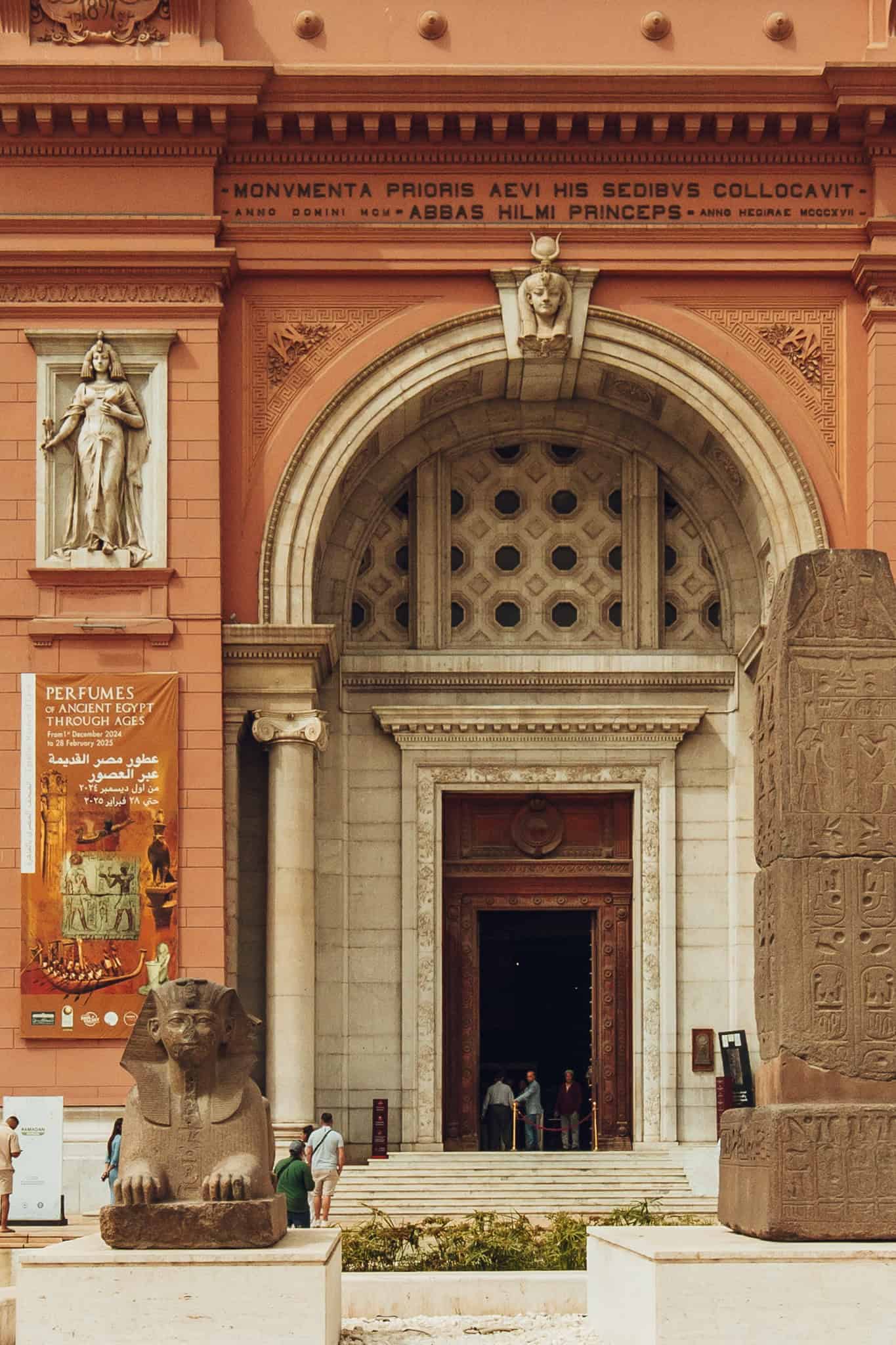
If you have the time, visit both the Old Egyptian Museum in Tahrir Square and the new Grand Egyptian Museum (GEM) in Giza. They genuinely complement each other, and together, they give you a fuller picture of Egypt’s incredible history.
If you’re short on time and can only do one, here’s how to choose:
- For a modern, polished visit with clearly curated exhibits, wide galleries, and air-conditioning, the Grand Egyptian Museum is the better choice. The scale is impressive from the start, with a towering statue of Ramesses II greeting you at the entrance, and the fully opened Tutankhamun Galleries now housing the complete collection from the tomb.
- For atmosphere and character, choose the Old Egyptian Museum. While Tutankhamun’s golden mask and sarcophagus have moved to the GEM, the Royal Mummies Hall alone makes the visit worthwhile. The building itself is also a beautiful landmark in Egypt, and the museum retains that old-school, early-archaeology feel that you won’t find anywhere else.
Ticket Prices & Opening Hours
Old Egyptian Museum:
- Entry: around €6–8 for foreigners
- Open daily from 9 AM to 5 PM
- Location: Tahrir Square, Downtown Cairo
- Getting there: Easily reachable by metro (Sadat Station), Uber, or even on foot if you’re staying nearby.
- Website: egyptianmuseumcairo.eg
- Note: I haven’t been able to book the ticket online. You can buy them on site at a booth or ticket machine (accepts card & cash)
- Photography is allowed with DSLRs and phones (no tripod or flash).
Grand Egyptian Museum (GEM):
- Fully open as of November 2025
- Entry: from 1,450 EGP
- Open daily from 9 AM to 6 PM (check the website to double-check, as it might change depending on the season)
- Location: Near the Pyramids of Giza – soon you’ll be able to walk there (pedestrian path is being built)
- Getting there: Best by Uber or private car, about 30–40 minutes from Downtown Cairo
- Photography is allowed with DSLRs and phones (no tripod or flash), except in the Tutankhamun Galleries, where only mobile photography is permitted.
- Website: visit-gem.com
Other Museums Worth Visiting in Cairo
Beyond the headline-grabbing Egyptian Museum and the Grand Egyptian Museum, Cairo has several smaller institutions that add important context to the city’s long and layered history. If you have extra time or want a break from pharaonic overload, these museums are well worth working into your itinerary.
Coptic Museum
Located in the heart of Coptic Cairo, the Coptic Museum provides essential insight into Egypt’s Christian history. The collection spans manuscripts, icons, textiles, and stonework dating from the Roman period through the early Islamic era.
I found this museum especially useful after visiting nearby churches because it helped tie together what I’d just seen. It’s compact, well laid out, and easy to visit without feeling overwhelmed.

National Museum of Egyptian Civilization
The National Museum of Egyptian Civilization offers a broader view of Egypt’s past than most museums in the city. Rather than focusing solely on ancient dynasties, it traces Egyptian history from prehistoric times through the Greco-Roman, Coptic, Islamic, and modern periods.
The layout is modern and easy to follow, and the famous royal mummies gallery (7 Kings and 3 Queens of Egypt) is one of the most thoughtfully presented exhibits in Cairo. This museum works particularly well if you want big-picture context.
Museum of Islamic Art
If you’re interested in Islamic Cairo beyond mosques and architecture, the Museum of Islamic Art is an excellent stop. Its collection covers ceramics, metalwork, textiles, manuscripts, and woodwork from across the Islamic world, with a strong focus on Egypt. The galleries are calm and uncrowded, making it a good place to slow down and appreciate craftsmanship you’ll see echoed throughout the city.
Museum of Modern Egyptian Art
For something completely different, the Museum of Modern Egyptian Art focuses on Egyptian artists from the 20th century onward. The collection highlights how artists responded to nationalism, colonialism, and social change, offering a perspective that’s often missing from traditional sightseeing routes.
Tahrir Square

Tahrir Square, often translated as Liberation Square, has been a focal point of modern Egyptian history for more than a century. While it’s most closely associated with the 2011 revolution, its name dates back to the 1919 uprising against British rule.
During the revolution, tens of thousands of people gathered here from across the country, turning the square into a long-term protest site and a symbol of political change.
Today, the square carries a quieter, more somber feeling. For many Egyptians, it represents both the hope of that brief revolutionary moment and the reality of how quickly it was suppressed. In 2020, the government added a striking centerpiece to the traffic circle: an ancient obelisk surrounded by four ram-headed sphinxes relocated from Luxor, blending Egypt’s deep past with its modern identity.
You’re unlikely to linger here for long since it’s a busy traffic hub, but you’ll almost certainly pass through it. The Old Egyptian Museum is just steps away, and the Steigenberger Hotel El Tahrir Cairo is a convenient base if you want to stay in the area.
Exploring the Coptic Cairo

I’ll admit, after a couple of days navigating the busy, noisy, and slightly chaotic streets of Cairo, I needed a break. And that’s exactly what Coptic Cairo gave me: a peaceful, almost hidden neighbourhood, rich with history yet surprisingly quiet.
It felt like entering a different world with less honking, less heat, fewer crowds, and just a sense of calm. Definitely one of those places to visit in Cairo, away from the hustle and bustle.
What Makes Coptic Cairo Special?


Coptic Cairo is one of the oldest parts of Cairo, featuring cobblestone streets, hidden alleyways, ancient churches, and tranquil courtyards. Historically, this is where Christianity first took root in Egypt, and you can genuinely feel the weight of history as you stroll around.
Once you walk past a few souvenir shops at the main entrance, the scene changes drastically. Stone walls line the streets, small churches quietly appear behind corners, and you’ll find locals quietly going about their day. I was amazed by how quickly the city’s chaos faded away here; despite the large tour groups.
You can spend a good couple of hours wandering around and exploring narrow streets without a specific destination. The main sites tend to get busy with groups, but if you explore around, the tourist crowd thins out and depending on where your curiosity takes you, you might end up in some very local part of Coptic Cairo, such as the Orthodox and Coptic cemeteries.
Story time! I can’t figure out where I took the photo on the left. The sign says “to cave/monastery Anba Barsoum” but there isn’t such a place in the area on Google Maps! I really got lost in there, I guess!!
How to Get to Coptic Cairo Easily
The easiest way to get to Coptic Cairo is by taking the Cairo Metro (blue line) from Tahrir Square. The metro was clean, safe, incredibly cheap (only 15 EGP, which is about €0.40), and super convenient. Just hop off at Mar Girgis Station, and the area is right there as you exit.
If you prefer Uber, that’s fine too, but keep in mind that drivers usually drop you off outside the Coptic area (here). Don’t worry, finding your way to the Coptic main street (Mari Gerges) leading to the museum and the Hanging Church is straightforward enough.
Must-See Spots in Coptic Cairo
Once you’re there, I’d suggest starting at the Coptic Museum. It’s not huge, at first, I wasn’t even sure if I’d find it interesting, since everyone mainly talks about pharaohs and pyramids. But this museum completely surprised me.
For just EGP 100 (€2), you’ll get a beautifully curated, vast collection of ancient manuscripts, religious icons, and textiles, offering insights into Egypt’s early Christian heritage. You’ll also get a better view of the Fortress of Babylon and the Roman tower once you’re inside the museum grounds.
After visiting the Coptic Museum, it’s an easy walk to the Hanging Church, one of the most important Christian sites in Egypt. The church is built above the remains of a Roman fortress, and that unusual setting is what gives it its name. At street level, there’s nothing obviously “hanging” about it, but once inside, sections of glass flooring reveal the Roman tower ruins below, making it clear that the structure is quite literally suspended above them.


Architecturally, the church is unique, with a beautiful wooden ceiling shaped like the hull of Noah’s Ark. Now, compared to some lavish churches I’ve seen elsewhere, the decor here was a bit understated. But it’s not about grandeur; it’s about history and significance. Standing in a place that has been a cornerstone of Egypt’s Christian community for centuries is pretty special.
The church dates, in fact, back to the early medieval period and still preserves details such as its ship-shaped wooden ceiling, medieval carved screens, and centuries-old icons, including one of the most revered images in Coptic Christianity (Coptic Mona Lisa). It also served as the seat of the Coptic Pope for generations, anchoring its role at the heart of Egypt’s Christian life.
If you’re up for more exploration, check out the nearby Church of St. Sergius and Bacchus, traditionally said to be the spot where the Holy Family took refuge during their flight into Egypt. Even if you’re not religious, it’s fascinating from a historical perspective.
Wander and Get Lost (in a Good Way!)
My favourite part about Coptic Cairo was wandering around. Take a left turn after entering the area (from the Uber drop-off – map here), and you’ll stumble upon a hidden network of alleys lined with tiny bookshops.
I’d recommend not rushing it. Spend an hour or two in the area, soak in the peaceful atmosphere, and take a moment to slow down. It’s rare in Cairo to find a place where you can enjoy quiet moments, and Coptic Cairo offers exactly that.
Prefer a Tour of Coptic Cairo?
If you’d rather not navigate public transport or piece together the historical context on your own, there are several guided tours that make exploring Coptic Cairo easier. They also often combine it with other areas of the city, such as the Islamic quarter.
This all-inclusive Coptic and Islamic Cairo tour with lunch covers the highlights of Old Cairo with hotel pickup and a knowledgeable guide to explain what you’re seeing.
If you’re looking for something broader, this full-day tour includes the Citadel, Old Cairo, and the Khan El Khalili bazaar. A solid choice if you’re trying to pack more into a single day.
And for a more in-depth experience, this Old Cairo full-day tour focused on both Islamic and Coptic sites gives you time to explore beyond just the churches and into Cairo’s layered religious history.
All three options include transport, which is helpful if you’re staying outside the city center or want a break from Cairo traffic.
Haggle Through Khan El Khalili Bazaar

If you visit Cairo and miss the Khan el-Khalili Bazaar, you’ve genuinely missed the soul of the city. It’s been the beating heart of Cairo for more than 600 years, back when it was a bustling stop on the old spice route.
Many people would recommend starting your visit at El Fishawy Café. This not-so-hidden gem (anymore) has been around since 1773, serving traditional mint tea and shisha. It is indeed a great spot and a good area to meet up with your group, but my favourite route to Khan El Khalili Bazaar is from Bab al-Futuh, one of Cairo’s old city gates.
From there, you can walk down Al-Muizz Street toward Khan El Khalili. This street is one of the oldest in Cairo, lined with beautiful mosques, minarets, medieval houses, and hidden gems, such as old hammams. During twilight, the golden sunlight against the stone buildings is stunning!
If you’re a solo female traveler or just prefer exploring with a woman-led perspective, I recommend this tour led by a female guide that includes the pyramids, the Grand Egyptian Museum, and Khan el-Khalili. Alternatively, this full day tour of the Citadel and Old Cairo includes a stop at the Bazaar, which is perfect to enjoy Cairo safely.


Market Tips for Cairo
1. Dealing With Vendors
In Cairo’s markets, vendors will often show off their products, which can feel like pressure, but it’s usually just part of how selling works here. If you are not interested, a polite no (La Shoukran) and a smile are enough.
When a vendor is particularly persistent, stepping into another nearby shop is an easy way to disengage. That said, I didn’t find most vendors in Egypt overly aggressive. It’s generally far less intense than places like Morocco or parts of South America, though it can still happen in busy tourist areas.
Always ask permission before taking photos. Most vendors don’t mind, but asking first is considered respectful and goes a long way.
2. How to Bargain Without Stress
Bargaining is expected, and it’s part of the game. Assume the first price you’re given is at least double what the vendor is willing to accept, and sometimes more. Start lower and make your way up to a middle ground. If the final price doesn’t feel right, walk away politely. If the price is right, the vendor will often call you back. If not, you’ll almost certainly find the same item elsewhere.
In my experience, smiling helps, and a sense of humor goes a long way. Vendors are much more likely to give you a fair price if the interaction feels friendly rather than tense.
Climb the Citadel and Wander Through Islamic Cairo
If there’s one thing I learned quickly about Cairo, it’s that the city isn’t just ancient Egypt. There’s a rich medieval Islamic history waiting to be discovered as well. The best place to start exploring this is the Citadel of Saladin.
Its construction began in the late 1100s under Saladin, though the site evolved far beyond his original vision. For hundreds of years, the Citadel functioned as Egypt’s center of power, expanding into a self-contained complex with residences, religious buildings, and administrative spaces. From its upper terraces, the views stretch across domes and minarets in every direction, and on clear days you can make out the pyramids on the horizon.
What stands today reflects constant reinvention. New rulers built over the remains of earlier dynasties, gradually raising the ground level and reshaping the layout. The most eye-catching structure is the Muhammad Ali Mosque, an Ottoman-era addition that now defines the Citadel’s profile. Nearby, the more restrained Al-Nasir Muhammad Mosque offers a glimpse into Cairo’s Mamluk past.
The Citadel is divided into two main sections. Most visitors enter through the southern enclosure, once reserved for royalty and now home to the major monuments and museums. Depending on how deeply you explore, expect to spend one to three hours here.

Just downhill from the Citadel, you’ll find two incredible mosques: Sultan Hassan Mosque and Al-Rifa’i Mosque, filled with beautiful Islamic architecture, intricately designed ceilings, and soothing silence.
When you’re wandering through Islamic Cairo, it would be a real shame to skip Al-Azhar Mosque. Founded back in 970 AD, it’s not just another mosque; it’s one of the oldest continuously operating universities in the world and has long been the heart of Islamic scholarship.
Walking inside, you’ll immediately sense its profound significance. The mosque features beautifully intricate Islamic architecture, elegant marble courtyards, and ornate minarets.
Remember to dress modestly (covering your knees, shoulders, and ideally your hair for women), and you’ll be warmly welcomed to explore all these incredible places in Cairo.
>> CAIRO ATTRACTIONS
Best Day Trips & Activities to Book in Cairo
Looking for the best day trips from Cairo? Check out this article to find the best guided tours to cut the stress and help you see Egypt’s highlights without wasting time or energy.
Take a Felucca Ride at Sunset (But Here’s My Honest Take)
Taking a felucca ride on the Nile is often listed among the top things to do in Cairo. A felucca is a traditional wooden sailboat with no engines. You can hire one on the corniche in Garden City (across the Four Seasons Hotel) or Maadi Corniche.
But here’s my take. While it’s lovely, the Nile in Cairo feels like any major river in any big city around the world. Concrete buildings, hotels, traffic, and city noise surround you. Personally, if you have plans to visit Aswan, I’d recommend saving your felucca experience for there.
Down south, you’ll sail between islands, see lush greenery, temples, villages, and truly experience Egypt’s beautiful countryside.
However, if you’re only in Cairo for a short visit or a weekend, go ahead, take the ride at sunset. Pack some snacks (some tours include dinner), relax, and watch the city glow in golden colours. It’s a pleasant way to unwind after a busy sightseeing day.
Try Egypt’s Most Delicious Street Food


Okay, if you love food like I do, koshari might be worth the flight ticket to Cairo alone. At first glance, it seems totally bizarre. This carb-loaded dish mixes rice, pasta, lentils, spicy tomato sauce, crispy fried onions, and vinegar. It shouldn’t work, but it does.
Beyond koshari, explore other street foods. Try taameya (Egyptian falafel made from fava beans), crispy hawawshi (spicy minced meat sandwiches), and flaky feteer (Egyptian layered pies).
Where to eat in Cairo? The best restaurant in Cairo
Abou Tarek (Koshari Heaven)
If there’s one thing you have to eat in Cairo, it’s koshari. And the best place to have it? Abou Tarek. It’s more than just a restaurant, it’s a Cairo institution. This multi-story eatery in Downtown Cairo is always packed (mostly with locals), serving up bowls of steaming-hot koshari.
Zooba (Modern Egyptian Street Food)
Zooba takes traditional Egyptian street food and gives it a contemporary twist. It’s fun, vibrant, affordable, and delicious. Try their gourmet taameya (Egyptian falafel made with fava beans), shakshuka, or classic hawawshi sandwiches. It’s casual dining done right, and the vibe is super welcoming.
Take a Day Trip to Saqqara, Dahshur, and Memphis

So, you’ve seen the Giza pyramids and think you’re all pyramid-ed out? Not so fast! Visiting Saqqara and Dahshur completely blew my mind, even after the grandeur of Giza. These sites are just a short drive south of Giza or Cairo, and feel like stepping into a totally different, quieter chapter of ancient Egypt.
At Saqqara, you’ll see the Step Pyramid of Djoser, the oldest stone pyramid in Egypt, built around 2630 BC. The site is expansive, with tombs and ruins scattered across a desert landscape that feels untouched by mass tourism.
Then, head to Dahshur, where you’ll find two of the most fascinating pyramids in Egypt: the Bent Pyramid, which literally changes angle midway up (you can see the evolution of pyramid engineering in action), and the Red Pyramid, the first true smooth-sided pyramid. The best part? You can climb inside the Red Pyramid; it’s steep and a bit stuffy, but if you’re up for the adventure, it’s totally worth it.
And don’t skip Memphis, the ancient capital of Lower Egypt. While not much of the original city remains, the open-air museum is home to a massive, fallen statue of Ramses II that’s just jaw-dropping in scale. It’s a quick stop but adds great historical context to the day.
Saqqara, Dahshur, and Memphis together give you a completely different appreciation for Egypt. Honestly, I’d consider this trio essential on any Cairo itinerary.
How to visit Saqqara, Dahshur & Memphis?
The easiest way to reach these places is to book an Uber or join a guided day tour. It’s about a 45-minute drive south of central Cairo, and since it’s a bit remote with no public transport options, having your own ride is essential.
If you’re going solo, Uber works really well and gives you the flexibility to explore Saqqara at your own pace. Just make sure you’ve got mobile data or an eSIM (like with Airalo) to book your return trip easily.
Alternatively, you can hire a private driver for the day. Some Uber drivers will offer this service if you chat with them directly; just be ready to negotiate the price. You can also ask your hotel to arrange a trusted driver for you, which is often a reliable and stress-free option (though I found the price quite high compared to organising this on your own).
Otherwise, there are plenty of day tours available, and some include Giza, Saqqara, and even a felucca ride on the Nile; so you can pack a lot into one day without the stress of planning transport between sites.
👇 Check out some of the most popular and well-reviewed tour options below:
Other Must-See Gems in Cairo You Shouldn’t Overlook
Climb the Cairo Tower for Panoramic City Views
Standing at 187 meters tall, Cairo Tower is an iconic landmark and easily one of the best spots to grasp just how enormous Cairo truly is. From the observation deck, you’ll enjoy breathtaking, 360-degree views of the sprawling city, the Nile River snaking through it, and on clear days, you can even spot the distant pyramids. I’d suggest going just before sunset; you’ll witness Cairo glowing gold beneath you, and watching the city lights come to life afterwards is magical.


Discover the Royal Elegance of Abdeen Palace
Abdeen Palace is often overlooked, but it’s one of Cairo’s most impressive hidden treasures. Built in the late 19th century, it served as the royal palace for Egypt’s kings, and it shows.
Think luxurious ballrooms, intricate paintings, lavish furnishings, and grand staircases. Today, it also houses several fascinating museums, including exhibits on royal weaponry, silverware, and historical documents.
Visit the Elegant Manial Palace and Gardens
On Rhoda Island in the Nile sits the charming Manial Palace, a stunning example of Ottoman-style architecture mixed with Moorish influences.
Built by Prince Mohammed Ali Tewfik in the early 20th century, it is elegant, detailed, and impressively well-preserved. The beautifully landscaped gardens alone make it worth the visit, offering a rare green oasis amid Cairo’s urban chaos. Inside, you’ll find opulent halls, incredible mosaics, stunning stained glass, and antiques.


Relax in Al Azhar Park, Cairo’s Green Oasis
After several busy days exploring Cairo, you may want some downtime. Al-Azhar Park is a beautifully landscaped garden built on what was once a garbage dump, though you’d never know it now!
With panoramic views of the Citadel and old city walls, it’s genuinely a calming escape. Take a stroll, enjoy a leisurely meal at one of the park’s cafes, or grab a shady bench. Watching local families and friends gather here is one of those non-touristy things to do in Cairo when you have a few days.
Ibn Tulun Mosque
Ibn Tulun Mosque is one of Cairo’s oldest mosques and one of its quietest, despite its enormous size. Built in the 9th century, it has a calm, open feel that’s very different from many of the city’s more crowded religious sites.
The mosque was commissioned by Ahmad Ibn Tulun, who briefly ruled Egypt independently and founded a new capital nearby. While most of that city disappeared after his death, the mosque survived, making it his most lasting legacy. Its most striking feature is the spiral minaret, inspired by the Great Mosque of Samarra in Irak. Climbing it offers sweeping views over the courtyard and the surrounding neighborhood.
How to Get Around Cairo
Managing Expectations in a Crowded City
Cairo demands more energy than most cities, and that’s especially true in the summer heat. It doesn’t take long to realize that trying to pack too much into a single day leads to frustration, and you’ll more than likely won’t be able to do half of it… The city is far more enjoyable when you accept that you won’t see everything in a couple of days, and therefore plan accordingly.
In Cairo, traffic isn’t something you plan around once or twice a day. It’s a near-constant presence. Roads start filling up early in the morning, peak again in the afternoon, and stay crowded well into the evening. The busiest stretches tend to be mid-morning and late afternoon, with congestion starting earlier than most visitors expect and lingering for hours.
I visited during Eid week, and Cairo was noticeably quieter with very little traffic. Some attractions had reduced hours, but it didn’t cause any real issues and was well worth the trade-off for quieter streets.
Walking in Cairo
Walking in Cairo can feel overwhelming at first. It’s not unusual to see a motorbike coming toward you on the sidewalk or squeezing through traffic as you cross the street. So be extra vigilant when walking in the city if you do so.
Crossing roads takes confidence. I found it easiest to follow locals when possible and move steadily rather than hesitating. It’s chaotic, but there’s a rhythm to it once you settle in.
Taxis, Uber, and Careem
For most visitors, taxis and ride-hailing apps are the easiest way to get around Cairo. Uber and Careem are widely available, but I found Uber simpler and more consistent (because Careem operates on a bidding-style system).
However, on both apps, drivers will sometimes message to ask for a higher price than the app shows, especially when your destination or origin is the Giza Pyramids or the Grand Egyptian Museum. When this happens, I recommend canceling the ride and trying again (make sure to give the reason when cancelling).
It can take a few attempts, but you’ll usually get a driver willing to accept the app price. Being able to pay by card through the app also makes things easier than carrying cash.
Using Local Taxis
Traditional taxis are often slightly cheaper, and many drivers are kind and professional. In heavily touristed areas, though, some can be aggressive or try to overcharge.
Before getting in, always ask whether the meter works. If it doesn’t, agree on a price beforehand or flag down another taxi. Many drivers don’t speak English, but they usually know major landmarks, hotel names, and well-known neighborhoods.
Taking the Cairo Metro
The metro is a reliable and affordable way to travel longer distances within Cairo. Tickets are purchased with cash at the station and are inexpensive (about 10 EGP max). Trains typically arrive every five to ten minutes.
Each train includes a women-only car. Women aren’t required to use it, but during extremely crowded times, it can be more comfortable. During quieter hours, I didn’t have any issues riding in the regular cars. One route I found especially useful was between Tahrir Square and Coptic Cairo, which was fast, simple, and far less stressful than sitting in traffic.
Is the Cairo Pass Worth It?
If you’re planning to visit a lot of sites in Cairo, Giza, or Luxor, you’ll likely come across the Cairo Pass and Luxor Pass while researching tickets. On their own, neither pass is an obvious bargain. Where they might make sense is when they’re combined, since purchasing one qualifies you for a 50% discount on the other within the same calendar year.
The Cairo Pass is a ticket that gives you unlimited access for five days to all the archaeological sites and museums (except the National Museum of Egyptian Civilization) in Greater Cairo (Cairo, Giza, Dashur, Saqqara, etc.).
It’s designed for people who want to see a lot in a short time and prefer the simplicity of a single ticket over paying at each entrance.
Though it costs €130 per person, which is really a lot considering entrance tickets to most museums and sites are €4 to €15. The pass is also sold in foreign currency only (EUR or USD only), while all the individual museum and site tickets are priced in Egyptian pounds.
If you’re visiting just a handful of places and only entering each site once, buying tickets individually will be cheaper. Even if you then plan to go to Luxor and get the 50% off, based on my analysis here, it is still NOT worth it.
As you can see below, while including many places to visit in Cairo, all up, we are still far from the cost of the Cairo Pass. I am not sure whether the new Grand Egyptian Museum is included (I couldn’t find any information), but if I add the entrance fee for the other sites and museums, we are still below the Pass cost.

Where to stay in Cairo? The best hotels in Cairo
Staying Downtown (Central Cairo)
Cairo Inn
Affordable, clean, and in a perfect location right on Tahrir Square. Simple yet comfortable, with friendly staff who are happy to share local tips.
Steigenberger Hotel El Tahrir Cairo (Tried & Highly Recommended)
This was my choice, and honestly, it couldn’t have been better. The Steigenberger offers modern rooms, great amenities, and is just a short walk from the Egyptian Museum. After a busy day sightseeing, it felt amazing to come back to a comfy bed and rooftop pool. Fantastic location, excellent breakfast, and genuinely good value for the quality.
The Nile Ritz-Carlton
If you want a bit of luxury, it’s hard to beat the Nile Ritz-Carlton. Overlooking the Nile and right next to the Egyptian Museum, this hotel offers elegant rooms, impeccable service, and fantastic Nile views. It’s Cairo’s classic luxury experience.
Staying Near the Pyramids (Giza)

Giza Pyramids View Inn
If you’re watching your wallet but still want that million-dollar view, this is your move. It’s a small, no-frills guesthouse right across from the Sphinx entrance. Rooms are basic but clean, the staff are friendly, and breakfast is included. You’re not getting luxe, but you are getting a front-row seat to history for the price of a hostel bed elsewhere.
Great Pyramid Inn (Tried & Highly Recommended)
I stayed here too, and waking up with the pyramids literally right outside my window was incredible. The rooms are basic but clean. The rooftop terrace has unbeatable views of the pyramids (perfect for photos), and the staff went above and beyond to help with tips and transportation. Amazing value for money, especially if the pyramids are your main focus.
Marriott Mena House
A legendary hotel located directly beside the pyramids, Mena House offers spacious rooms and lush gardens. Its historic charm and unbeatable proximity to Giza make it a memorable stay.
When to visit Egypt
Choose a region, then click a month to explore.
Final Thoughts: Cairo Is Just the Beginning
Cairo is intense, beautiful, chaotic, and completely unforgettable. It’s a city that demands a bit of effort, but it rewards you tenfold. From the ancient wonders of Giza to quiet corners in Coptic Cairo, lively street food stalls, and peaceful mosques, there is a lot of things to do in Cairo.
If you’re planning to go beyond the capital, don’t miss my guide to the top landmarks to visit in Egypt, from Abu Simbel to Luxor, it’ll help you map out a trip full of unforgettable stops.
And if the Pyramids of Giza are on your list (as they should be), I’ve also written a full guide on how to visit the pyramids on your own; with the best walking routes, hidden tombs, and best tips to help you experience them without the crowds.

ARE YOU ON PINTEREST?
What about saving this post to your Pinterest board?
Click on the photo to save this blog post for later. We are also on the platform and we love pinning great travel tips. Follow Tales From The Lens’ boards to see our latest pins.
Don’t be shy, come say hi!
Please note │ This blog post may also include affiliate links to hostels or products we recommend, which means if you buy something following a link on this page, we’ll get a small commission. This will be of no extra cost to you but will help us continue running this blog. Thank you for your support.

About the Author
Jen is the Funder, Author & Photographer behind Talesfromthelens.comJen has lived for the past 15 years across Oceania and Ireland while also travelling in Latin America, North America, and Europe. She has visited more than 65 countries and set foot on every continent in the world! She is a coffee nerd, passionate about photography, wildlife, and outdoor activities.
For more info, check out the About page.
I love this article. Was exactly looking for the things to do in Cairo beyond the pyramids and got quite inspired by your post. I didn’t know about Coptic Cairo and I am so excited to visit this part of the city net week after I land!! Cheers
I think I know where your mystery picture is from! I believe it’s the alleyway leading up to the cave church where Mary and Joseph lived with Jesus for a few months while they were in Egypt. I have a picture of the entrance and it has the same statue of Mary, and I remember I couldn’t find the name of the church anywhere on maps either lol. So that’s my theory. But great guide to Cairo! The new museum wasn’t open yet when I went, so I want to go back in order to visit it!
Thanks Maggie! Are you sure this wasn’t the Church of St Sergius (also in the Coptic Area)? St Sergius had signs and stories about the Holy family (and a lots of tourists!!).
Loved this guide! The hidden spots like Meresankh III’s tomb and quiet pyramid entrances are pure gold. Coptic Cairo sounds like a serene escape. definitely adding it to my Cairo must-see list. Thanks for sharing such practical tips!