
When it comes to history, few places in the world can compete with Egypt. It’s a country where the landmarks are instantly recognisable from the towering pyramids of Giza and the colossal statues of Abu Simbel, to the sprawling temples of Karnak.
You’ve seen these places a thousand times in documentaries and travel magazines, but nothing compares to standing in front of them, feeling the weight of thousands of years beneath your feet.
What’s incredible about Egypt is that these famous sites aren’t just empty monuments; they’re living pieces of history. Walk through the hypostyle hall at Karnak, and you can still see the vivid colours on the stone and touch the hieroglyphs that tell stories of ancient kings.
At Abu Simbel, the statues of Ramses II still guard the entrance with the same fierce gaze they had 3,000 years ago. And when you step inside the Great Pyramid of Khufu, its sheer scale is enough to leave you breathless.
In this guide, I’m taking you through Egypt’s most iconic landmarks that define its history and capture its spirit. These are the places you absolutely cannot miss when visiting Egypt. I hope you enjoy this list! Let’s go.

The Pyramids (Giza)

If you’re planning a trip to Egypt, visiting the Pyramids of Giza is probably already high on your list. They’re just as jaw-dropping in real life as you hope they’ll be.
Standing on the edge of Cairo’s desert, the Pyramids of Giza have defied time, sandstorms, and human curiosity for over 4,500 years. They were built during Egypt’s Old Kingdom, around 2600–2500 BC, as royal tombs designed to help the pharaohs on their journey to the afterlife.
Today, they’re the last surviving wonder of the ancient world. The Giza Plateau is home to three main pyramids:
- The Great Pyramid of Khufu (Cheops) is the biggest and oldest of the trio. It was originally 146 meters high (it’s lost a few meters over time). It’s mind-bending to think that it was built using around 2.3 million limestone blocks, each weighing several tons.
- The Pyramid of Khafre: slightly smaller but often looks taller, thanks to the way it’s built on higher ground. You can still spot some of the original smooth casing stones clinging to its peak (and at its feet if you get close enough).
- The Pyramid of Menkaure: the smallest of the three, but with a reputation for having some of the finest craftsmanship.
Scattered around the Giza Plateau site are also smaller pyramids, known as the Queens’ Pyramids, as well as ancient tombs, temples, and causeways that used to connect everything.
The best things about visiting the Pyramids of Giza
- You can actually go inside the pyramids if you want (for an extra fee), which is a unique experience. Be ready for steep, narrow passages and a hot and humid environment.
- The viewpoints on the south side offer some of the best panoramic views of the pyramids lined up perfectly.
- Other special entry add-ons let you explore lesser-known treasures, such as the Tomb of Queen Meresankh III, which is beautifully decorated with hieroglyphs and statues.
- And of course, the Great Sphinx watches over everything, carved directly from the bedrock.
Tips for visiting: The earlier you get there, the better the light, the cooler the weather, and the fewer the crowds. You’ll have a big head start if you can stay in a hotel near the eastern entrance (the “local gate”). This entrance is much quieter than the main tourist gate, and it puts you closer to the Sphinx, exactly where I recommend starting if you are visiting on your own.
On that topic… You don’t need a guided tour to enjoy the Pyramids. Walking around on your own gives you the freedom to take it all in at your own pace, and if you want some extra tips for planning your route, I’ve put together a complete guide on how to visit the Pyramids of Giza on your own that covers everything you need to know.
Entry Fees: You’ll need a basic ticket for the main site, and there are optional add-ons if you want to go inside the Great Pyramid (Khufu) or visit the Meresankh tomb.
The Great Sphinx (Giza)

Guarding the Giza Plateau with an air of quiet mystery, the Great Sphinx is just as iconic as the pyramids it watches over. Sitting right in front of the Pyramid of Khafre, this colossal limestone statue, part lion, part pharaoh, is one of the symbols of Egypt.
Carved directly from the bedrock, the Sphinx is about 73 meters long and 20 meters high. It’s believed to represent Pharaoh Khafre himself, merging royal power with the strength of a lion. The exact date of construction is still debated, but most archaeologists agree it was built around 2500 BC, during the same period as the pyramids behind it.
What’s especially fascinating is how much of the Sphinx’s history remains a mystery. Over the centuries, it has been buried in sand up to its shoulders, uncovered, reburied, and restored multiple times. Even its famous missing nose sparks endless theories; from natural erosion to target practice by Napoleon’s soldiers (although there’s no real evidence for that one).
The Grand Egyptian Museum (Giza)
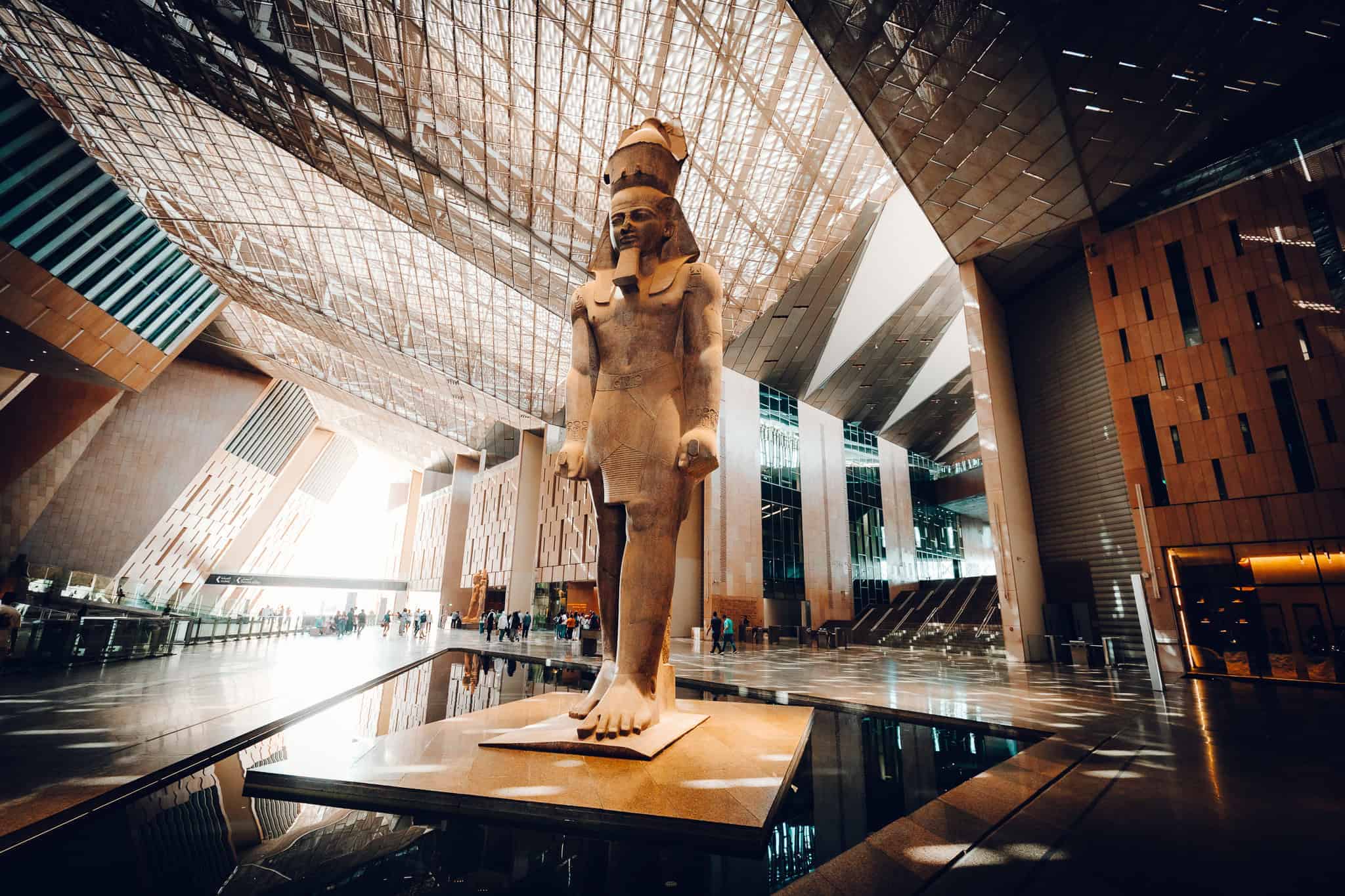
The Grand Egyptian Museum (GEM) is Egypt’s newest and most ambitious cultural project. It opened partially in 2024 and is located near the Pyramids of Giza. A pedestrian road is actually being built and will link both landmarks very soon.
The GEM is designed to house Egypt’s biggest and most complete collection of antiquities under one modern, stunning roof. The museum’s layout, architecture, and exhibitions are meant to tell the whole story of ancient Egypt chronologically, from prehistory to the Greco-Roman period, in a way that’s never been done before.
While the museum is not fully open (planned for October 2025), you can currently access the grand staircase and the main exhibition wing. Here are the best things to do at the GEM:
- The complete Tutankhamun collection will finally be displayed together for the first time, including many objects never shown to the public before. (still closed as of April 2025)
- The Grand Staircase, lined with colossal statues, is one of the museum’s most iconic spaces. It connects visitors from the entrance to views of the Pyramids and the main exhibition entrance.
- Thousands of artefacts from across Egypt have been carefully restored and moved here, promising a fresher, more interactive experience than the old museum.
Fun fact: The GEM is one of the largest archaeological museums in the world, covering nearly 500,000 square meters.
Tips for visiting: You can take an Uber from Giza after visiting the Pyramids. The Museum is a good place to get away from the afternoon sun and one of the best things to do in Cairo.
Where to Stay Nearby
- Marriott Mena House (Giza)
- Steigenberger Pyramids Cairo (Giza)
- Saray Pyramids & Museum View Hotel (Giza)
Islamic Cairo (Cairo city)

If you want to see a different side of Egypt that is unrelated to the pharaoh, start in Islamic Cairo, which has centuries of culture in every stone and street corner. The area grew during the Fatimid, Ayyubid, and Mamluk periods, and much of what you see today dates back to the 10th and 15th centuries. The best landmarks to visit in Islamic Cairo are:
- The Citadel of Saladin and the stunning Mosque of Muhammad Ali offer incredible panoramic views over the city.
- The Sultan Hassan Mosque and the Al-Rifa’i Mosque, standing side by side, are two of the most beautiful Islamic buildings in the world, each with soaring domes and exquisite details.
- Khan el-Khalili Bazaar is a must for wandering, shopping, or just soaking in the atmosphere.
Tips for visiting: Dress modestly (covering shoulders and knees) when visiting mosques, and bring a scarf if you’re a woman.
The Hanging Church & Coptic Area (Cairo city)
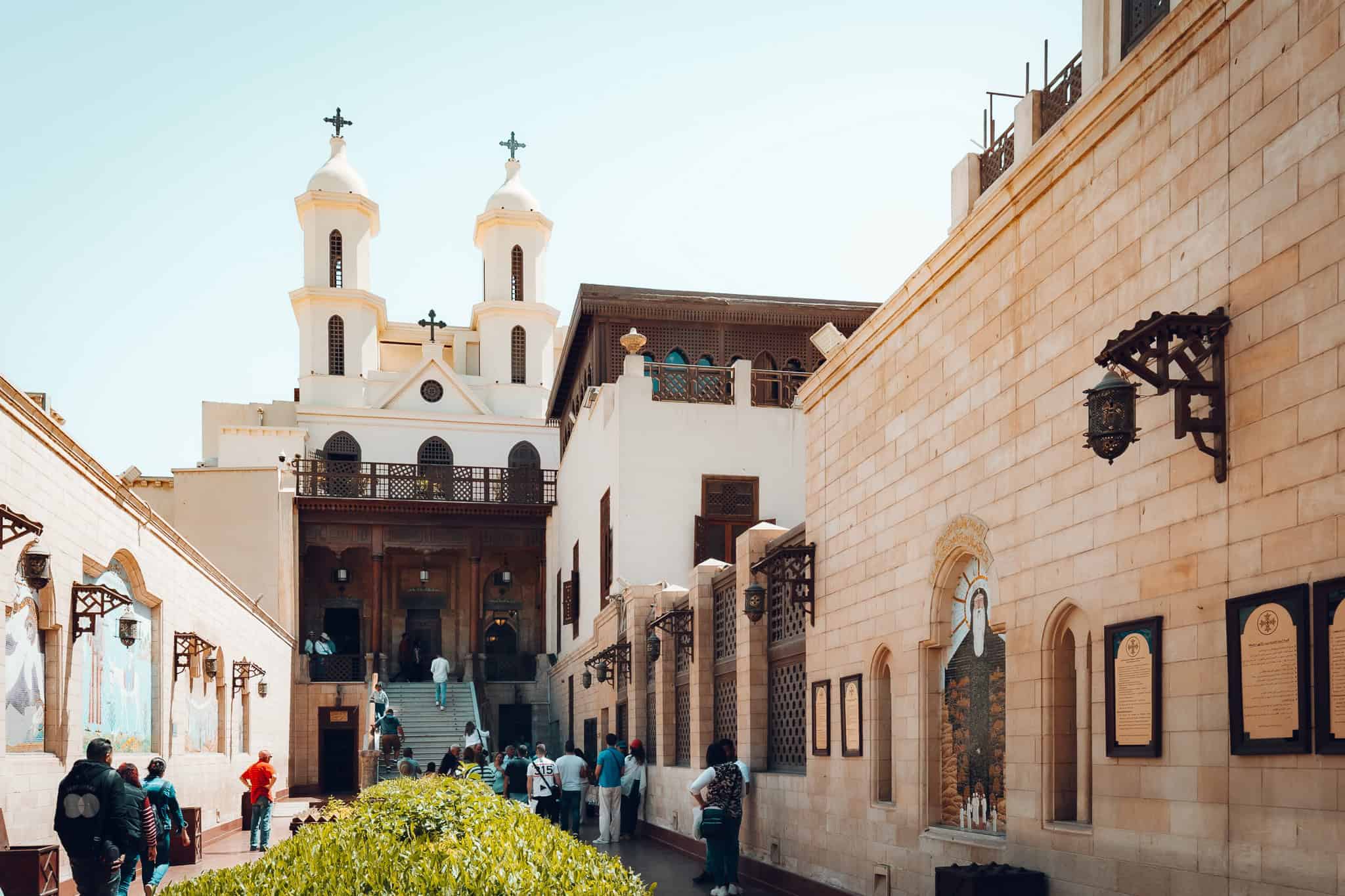
Tucked away in the winding alleys of Old Cairo, Coptic Cairo feels like stepping into a completely different side of the city. It’s quiet, older, and filled with layers of history you don’t often hear about on the usual Egypt itineraries, which makes it one of the best things to do in Cairo.
At the heart of it all is the Hanging Church, one of Egypt’s oldest and most important Christian sites.
The Hanging Church (officially called Saint Virgin Mary’s Coptic Orthodox Church) was built over a gatehouse of the Roman fortress of Babylon, and gets its nickname because it quite literally “hangs” above the ancient walls. Dating back to at least the 3rd century AD, this church has been a key part of Egypt’s Christian community for nearly two thousand years.
The wooden ceiling inside is shaped like a ship’s hull, a beautiful detail that makes the church feel peaceful and welcoming. Don’t miss the 13 graceful pillars inside, said to represent Jesus and his twelve apostles. One dark pillar stands out to symbolise Judas.
Nearby, you can also visit other gems like the Coptic Museum, the Church of St. Sergius and Bacchus (believed to be a place where the Holy Family stayed during their flight into Egypt), and Ben Ezra Synagogue, all packed within a short walking distance.
Tips to visit: Wear modest clothing when visiting churches; covering shoulders and knees is a good rule of thumb. Early morning visits are best if you want the atmosphere to be quieter and calmer. It’s easy to reach Coptic Cairo by taxi or even the Cairo Metro (Mar Girgis station drops you right by the heart of it).
Guided Tours: Coptic Area & Churches
Guided tour: Islamic & Coptic Cairo
The Egyptian Museum (Cairo city)

Before the new Grand Egyptian Museum entirely takes over, the Egyptian Museum in Tahrir Square remains one of the classic must-visit sites. It’s a bit chaotic, with old wooden cases, faded labels, and a slightly dusty vibe, but that’s honestly part of its charm.
Visiting this famous landmark feels like stepping into a time capsule of 19th-century archaeology.
This museum has been the home of Egypt’s most famous treasures for decades, including the breathtaking collection from Tutankhamun’s tomb, royal mummies, colossal statues, jewelry, and everyday items from ancient life.
My favourite (and unexpected) part of the museum has to be Tutankhamun’s treasures room, where you can see the iconic gold funerary mask and 2 of his sarcophagi.
Fun fact: When the museum opened in 1902, it was the first building in the world built specifically to be a museum of archaeology.
Saqqara (Cairo Region)

If the Pyramids of Giza are Egypt’s headline act, the story really begins in Saqqara. This vast necropolis, located about 30 kilometres south of Cairo, is home to the very first pyramid ever built (the Step Pyramid of Djoser) and an entire landscape of ancient tombs and ruins that feel much more “lost in time” than the more polished sites near Giza.
Saqqara served as the main burial ground for Memphis, the ancient capital of Egypt. Its history spans over 5,000 years, and archaeologists still make significant discoveries today. If you love exploring places that still hold secrets, Saqqara is a must-visit:
- The Step Pyramid of Djoser, built around 2700 BC, is the centrepiece. Designed by the legendary architect Imhotep, it’s considered the world’s first large-scale stone monument.
- The nearby Pyramid of Unas is less famous, but inside, the walls are carved with the Pyramid Texts, the oldest known religious inscriptions in the world.
- Dozens of tombs, like the Tomb of Kagemni and the Tomb of Mereruka, are open to visitors. Their detailed daily-life scenes of farmers, dancers, and craftsmen offer a vivid snapshot of ancient Egyptian society.
Fun fact: Saqqara is still giving up its secrets. In the last few years, archaeologists have uncovered ancient mummification workshops and tombs.
Tips to visit: Saqqara is much bigger than it looks at first. If you can, hire a local guide who knows the best tombs to visit based on what’s open (it changes often). Bring water, a hat, and comfortable shoes to walk on sandy, uneven ground. And try to visit early in the morning or late afternoon when the light makes the desert colours even more beautiful and the heat of the direct sun is gone.
Guided Tours: Including Giza
Guides tour: Excluding Giza
Dahshur (Cairo Region)

If you want to get a real sense of how ancient Egyptians perfected the art of pyramid building, Dahshur is the place to see it. Quieter and less visited than Giza, this site feels wonderfully off-the-beaten-path; and yet it’s home to some of the most important pyramids in Egypt’s story.
Dahshur is famous for two pyramids built by Pharaoh Sneferu, the father of Khufu (the builder of the Great Pyramid). You can actually trace ancient architectural experiments here, mistakes and all, which makes visiting feel a bit like stepping into a giant open-air history lesson without the crowds.
The Bent Pyramid is the standout. It starts rising at a steep angle but then suddenly curves inward near the top. No, it wasn’t intentional. Architects at the time likely realised midway through construction that the original angle would make it unstable. The result is unique, and you can even go inside if you’re up for a climb through tight passageways.
Nearby, the Red Pyramid is considered the first successful attempt at a “true” smooth-sided pyramid. It’s less famous than the ones at Giza, but no less impressive, and the best part is that you can often have it almost to yourself.
Tips to visit: Dahshur pairs really well with a trip to Saqqara since they’re so close to one another. It makes a perfect day trip outside of Cairo, too!
Guided Tours: Including Giza
Guided tour: Excluding Giza
Memphis (Cairo Region)

Before Cairo, before even Thebes (modern Luxor), Memphis was Egypt’s first true capital and the beating heart of the ancient kingdom. Founded around 3100 BC by the legendary King Menes, it was once a sprawling, powerful city, though today what remains is more of an open-air museum.
The massive statue of Ramses II, lying on its back in a covered pavilion, is the real showstopper. Even without his legs (they broke off), the craftsmanship and scale are jaw-dropping. You’ll also see a giant alabaster Sphinx and scattered statues, stelae, and fragments from what was once a vibrant city of temples and palaces.
Fun fact: Ancient Memphis was so legendary that the Greeks associated it with their mythology, believing a daughter of a Greek king founded it.
Tips to visit: The Memphis site is small and doesn’t take long (maybe 30 to 45 minutes) but it’s worth the stop if you’re already exploring Saqqara and Dahshur.
Guided Tours: Including Giza
Guided tour: Excluding Giza
Monastery of St. Simon the Tanner (Cairo city)

Hidden in Cairo’s cliffs at the edge of the Mokattam Hills, the Monastery of St. Simon the Tanner is one of the city’s most surprising sights. Also known as the Cave Church, it’s the largest church in the Middle East by capacity, with room for over 20,000 people, and it’s carved directly into the rock.
The monastery is named after St. Simon, a 10th-century Coptic saint said to have miraculously moved the Mokattam Mountain through prayer. The story remains an important part of Cairo’s Christian heritage.
Tips to visit: The monastery is located in Garbage City, a neighbourhood run by the Zabbaleen, Cairo’s informal garbage collectors. It’s best to visit with a guide who knows the area.
Where to Stay
- Cairo Inn (Cairo)
- Steigenberger Hotel El Tahrir (Cairo)
- The Nile Ritz-Carlton (Cairo)
Fort Qaitbay (Alexandria)

Standing proudly at the edge of the Mediterranean, Fort Qaitbay is Alexandria’s historic guardian. Built in 1477 by Sultan Al-Ashraf Sayf al-Din Qaitbay, the fortress was meant to defend Egypt’s northern coast against invading forces.
What really makes it special is its location since it sits right where the legendary Lighthouse of Alexandria, one of the Seven Wonders of the Ancient World, once stood.
The fort is beautifully designed, with thick limestone walls, corner towers, and inner courtyards. Even though the original lighthouse was destroyed by earthquakes long before the fort was built, many of its stones were reused in the fortress walls.
Tips to visit: Fort Qaitbay is best visited in the late afternoon, when the sunlight turns the stone walls golden and the sea breeze cools the air. It’s easy to pair with a walk along Alexandria’s Corniche, and if you have time, grab fresh seafood at one of the nearby restaurants by the harbour.
Where to Stay in Alexandria
Guided Tours from Alexandria
Guided Tours from Cairo
Karnak Temple (Luxor)

If there’s one place in Egypt that truly captures the scale and ambition of the ancient world, it’s Karnak. This sprawling temple complex wasn’t built by just one pharaoh; it grew over 2,000 years, with each ruler adding their own touches, halls, and monuments. The result is one of the most impressive open-air museums you’ll ever walk through.
Karnak is actually a vast mix of temples, sanctuaries, pylons, and obelisks, centred around the main Temple of Amun-Re. At its height, it was the most important religious site in Egypt, dedicated to the Theban triad of gods: Amun, Mut, and Khonsu.
What’s amazing to see today:
- The Hypostyle Hall is the star of the show. Imagine walking through a forest of 134 massive stone columns, some reaching 21 meters high, all covered in old hieroglyphs. The way the light filters through the broken roof is a heaven for photographers!
- The Sacred Lake, where priests once purified themselves before ceremonies, still glistens under the sun. It is a calm spot if you need a quick break (there is a shop where you can get a drink or an ice-cream)
- The Obelisks of Hatshepsut and Thutmose I stand proudly at the heart of the temple.
Fun fact: Karnak was actually connected to Luxor Temple (a few kilometres away) by an avenue lined with hundreds of sphinx statues. Parts of this avenue have been restored, and you can still walk along it today if you want to imagine the grand processions that once passed by (note: it is 3 km without any shade, so be prepared!)
Tips to visit: Karnak opens early, and if you can, aim to arrive right when the gates open. Later in the day, the heat and tour groups hit hard (although around lunch time, it gets quiet). Also, the site is huge; much bigger than it looks on a map, so wear comfortable shoes and bring water. If you’re into sound and light shows, Karnak hosts one in the evenings, but personally, I think the temple feels most powerful in the natural light of early morning or late afternoon.
Luxor Temple (Luxor)

Right in the heart of the modern city, Luxor Temple pops out with its ancient columns and giant statues rising out of the middle of daily life. It’s one of the most beautiful temples in Egypt and one of the best attractions in Luxor.
The massive, seated statues of Ramses II guarding the entrance are just breathtaking, especially as the last rays of sun catch their faces. As you enter the site, you’ll come across the colonnade, whose double row of towering columns is stunning at any time of day and perfect for photos.
Tips to visit: Many will tell you to visit at night, but to me, the best time to go is just before sunset. This way, you’ll catch the golden evening light, and then watch the temple slowly transform under the glow of soft spotlights as night falls.
The Valley of the Kings (Luxor, west bank)
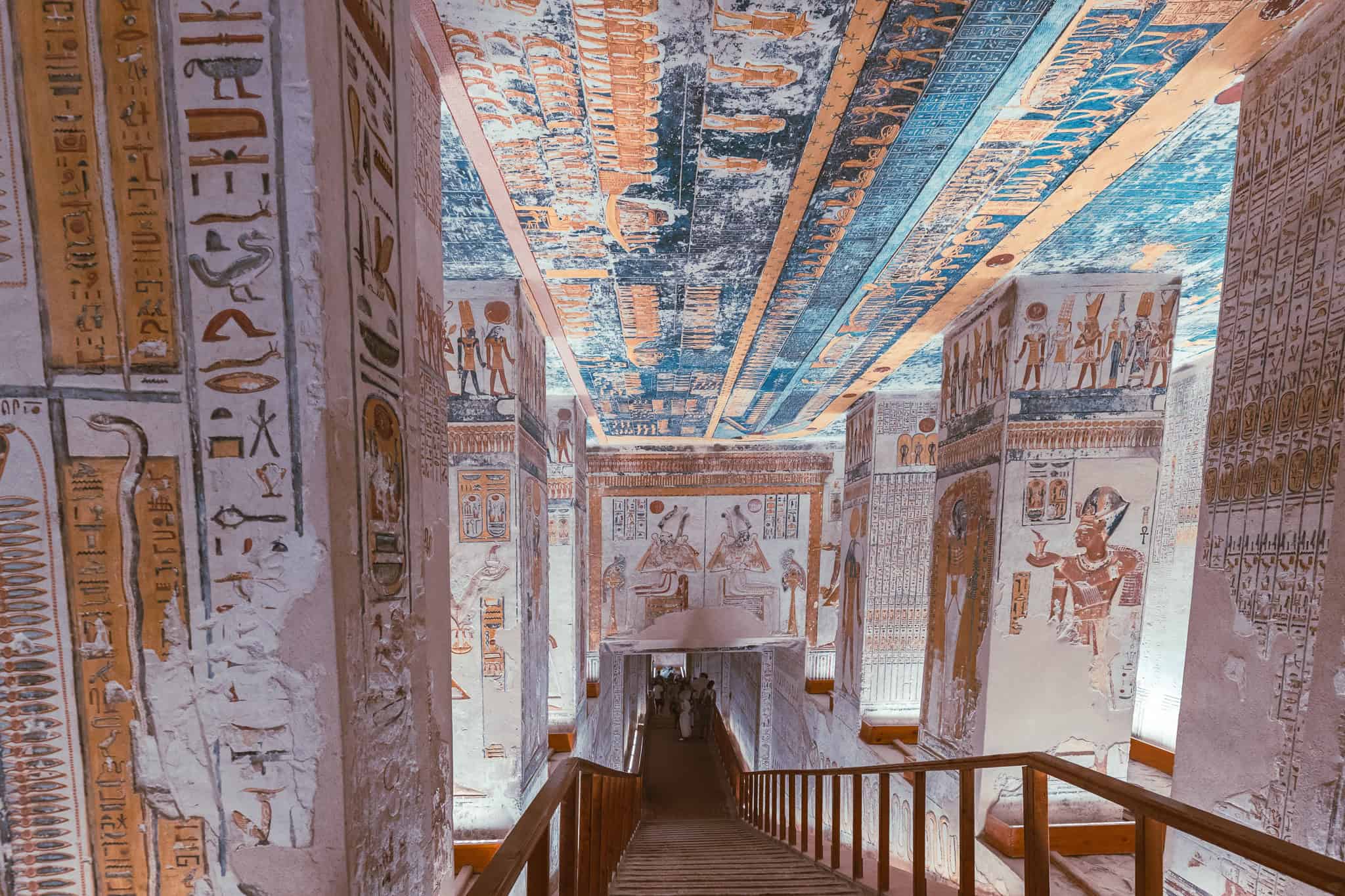
Tucked into the arid cliffs on the west bank of Luxor, the Valley of the Kings might be one of the most famous burial grounds in the world.
For nearly 500 years, this hidden valley served as the final resting place for the pharaohs of the New Kingdom, including big names like Tutankhamun, Ramses II, and Seti I. If you’re even a little curious about ancient Egypt, this place is a must-visit.
Over 60 tombs have been discovered here, but only about a dozen are open to visitors at any given time. With your basic entry ticket, you’re allowed to visit three tombs of your choice from a rotating selection of around 11 open ones. It’s a good idea to check the list at the entrance, as the lineup can change depending on ongoing conservation work.
Each tomb has its own unique character: some are small and intimate, others stretch deep into the mountainside with corridors covered in vivid hieroglyphs and starscapes. Though, something they all share is the incredible art displayed on the tomb’s walls; even after thousands of years, the colours and details are still astonishingly vibrant.
Add-ons to consider: There are a few notable tombs that require an extra ticket.
- Tutankhamun’s Tomb: I definitely think this one is worth it. Even though it’s smaller and simpler compared to others, seeing Tutankhamun’s actual mummy resting inside his tomb feels surreal, especially if you saw his sarcophagus at the Old Egyptian Museum.
- Seti I’s Tomb: I visited this one, too. It’s one of the largest and most beautifully decorated tombs in the valley, with massive halls, intricate carvings, and stunning colours. That said, the price is steep (around €40 per person), and while it’s impressive to see, I don’t think it justifies the cost unless you’re a hardcore Egyptology fan.
- Ramses V & VI’s Tomb: If you’re going to choose any extra, make it this one. The tomb is jaw-droppingly beautiful, especially the ceiling covered in astronomical scenes. It’s one of the most impressive interiors in the entire valley and, for me, an absolute must-see.
Fun fact: Despite all the grandeur, many of these tombs were looted in ancient times. What we see today is only a fraction of the treasures they once held. When visiting the Valley of the kings, you’ll only see the tomb empty with maybe a stone sarcophagus or two. Every treasure left behind by thieves is exposed in museums in Egypt and around the world. Click here to read our guide to the things you should know before visiting the Valley of the Kings.
- From Hurghada: Luxor Valley of the Kings & Tutankhamun Tomb Trip
- From Luxor: Valley of the Kings and Hatshepsut Temple Day Tour
- From Luxor: Valley of the Kings and Queens Guided Tour with Lunch
- From Luxor: Valley of The Kings and Hatshepsut Temple Day Trip
- From Luxor: Shared Full-Day Tour to Luxor West and East Banks
The Colossi of Memnon (Luxor, west bank)

Standing tall and weathered on the west bank of Luxor, the Colossi of Memnon were originally built to stand in front of Pharaoh Amenhotep III’s mortuary temple, which was one of the grandest temples of its time.
Sadly, the temple itself was mostly destroyed by floods and earthquakes over the centuries, but the statues somehow survived, still keeping their silent watch over the desert.
Though, restoration work in recent years has uncovered even more ruins of the original temple around the statues, giving a better sense of the massive complex that once stood here.
Each colossus is about 18 meters tall and made from single blocks of sandstone transported from quarries near Cairo. They both represent Amenhotep III seated on his throne, hands resting on his knees, gazing eternally eastward toward the Nile.
Tips to visit: The Colossi are free to visit and easy to stop by on your way back from the Valley of the Kings or other west bank sites. You won’t need more than 15 minutes here, but it’s absolutely worth a quick stop.
Valley of the Queens (Luxor, west bank)

Tucked away not far from the Valley of the Kings, the Valley of the Queens is one of those places that doesn’t always get as much attention; and that’s a shame, because it’s absolutely worth visiting. This was the burial ground for the wives, daughters, and sons of the pharaohs during the New Kingdom period, offering a quieter, more intimate glimpse into ancient Egyptian royal life.
There are around 90 tombs discovered here, but only a few are open to the public at a time. The real star of the valley is undoubtedly the Tomb of Queen Nefertari, the beloved wife of Ramses II. Her tomb is considered one of the most beautiful ever found in Egypt due to its vivid and detailed paintings. It was so elaborately decorated that it’s often called “the Sistine Chapel of Ancient Egypt.”
Unfortunately, the Tomb of Queen Nefertari is currently closed to the public, but there are other sites you can visit.
Temple of Hatshepsut (Luxor, west bank)

Built dramatically against the cliffs at Deir el-Bahari, this mortuary temple looks like it was carved straight out of the mountainside. It’s one of the most striking architectural achievements of ancient Egypt, and the story behind it is just as fascinating.
Hatshepsut wasn’t your typical pharaoh. She was one of the few female rulers of ancient Egypt and had to present herself as a king, often depicted wearing a false beard and traditional male regalia. Her temple is both a bold political statement and a place of worship, built to honour her reign and the god Amun.
The temple’s reliefs tell incredible stories, including Hatshepsut’s divine birth and her famous expedition to the land of Punt, basically one of the earliest recorded trade missions. Look closely and you’ll see evidence of later vandalism. After her death, her stepson (and successor) tried to erase her memory, chipping away at her images throughout the temple.
Tips to visit: Get there early in the morning when the sun lights up the cliffs and the temple feels almost empty. It’s best combined with a visit to the Valley of the Kings since they’re very close to each other. Also, wear good shoes. There’s a bit of walking involved between the parking area and the temple entrance (but the view as you approach is worth every step).
Medinat Habu (Luxor, West Bank)

Often overshadowed by the Valley of the Kings and Karnak, Medinat Habu is one of Luxor’s most impressive, and surprisingly quiet, ancient sites. This was the mortuary temple of Ramses III, and it’s incredibly well-preserved.
The outer walls, towering and thick, look almost like a fortress, and inside, the columns, courtyards, and massive pylons are still covered in vivid carvings and colours. The reliefs here are some of the best you’ll see in Egypt, vividly depicting battles, religious ceremonies, and offerings to the gods.
Tips to visit: Medinet Habu is close to the Valley of the Kings, but fewer people visit. Don’t rush; it’s smaller than Karnak but packed with fascinating details.
Abu Simbel (Aswan region)

Abu Simbel isn’t just a landmark; it’s an experience that sticks with you long after you’ve left. Located near the Sudanese border, these two massive rock temples, built by Ramses II, are in the middle of nowhere; and that’s precisely part of their magic.
The temples were originally carved straight into the cliffs around 1264 BC to show off Egypt’s power and intimidate neighboring Nubia. Thousands of years later, in the 1960s, they were famously moved piece by piece to higher ground to save them from the rising waters of Lake Nasser. Honestly, the relocation story alone is worth the visit; it’s one of the greatest feats of modern archaeology.
To really appreciate what you’re looking at, I highly recommend reading “Empress of the Nile” before you go. It tells the incredible story of Christiane Desroches-Noblecourt, the archaeologist who led the international effort to save Abu Simbel; a gripping read that will make standing there feel even more powerful.
Things you will see in Abu Simbel
- The four colossal statues of Ramses II guarding the entrance to the main temple are even bigger and more detailed than photos suggest; they absolutely dominate the landscape.
- Inside, the hypostyle halls are decorated with vivid scenes of Ramses’ military victories, and deep inside the sanctuary, you’ll find statues of four gods, perfectly lit by the sun twice a year in a phenomenon that still amazes scientists and travelers alike.
- Right next to the main temple is a smaller one dedicated to Queen Nefertari (his favourite wife), which is just as beautifully carved and full of life.
Fun fact: Twice a year, on February 22 and October 22, the morning sun shines straight through the temple, illuminating the statues inside. It was completely deliberate since October 22 was King Ramses II’s birthday and February 22 was the date of his coronation as king of Egypt.
Tips to visit: Abu Simbel is about a 3-hour drive from Aswan, so most travellers either take an early morning tour or a short flight. Either way, it’s worth the journey despite the cost. Here is our practical to visiting Abu Simbel from Aswan (do not miss it!)
Philae Temple (Aswan)

Sitting gracefully on an island in the Nile, Philae Temple feels like a scene out of a dream. Dedicated to the goddess Isis, it’s a very beautiful and peaceful temple you’ll get to visit in Egypt.
Philae was an important religious centre for centuries, even into the early Christian era. In fact, even after Egypt officially converted to Christianity, worship continued at Philae for a surprisingly long time. It was one of the very last places in the ancient world where the old gods were still honoured.
Like Abu Simbel, the temple complex was relocated in the 1960s to save it from the rising waters of Lake Nasser. Stone by stone, it was moved from its original spot to nearby Agilkia Island, where it stands today almost exactly as it did before.
The main temple of Isis is stunning, with detailed carvings, grand pylons, and quiet courtyards. Though, right by the water’s edge are the columns of Trajan’s Kiosk, sometimes called Pharaoh’s Bed, another place to visit.
Tips to visit: To reach the temple, you’ll need to take a small motorboat from the south of Aswan. Here is a full article I wrote about how to visit to Philae Temple. If you’re interested, the complex also hosts a Sound and Light Show in the evenings, a different but pretty magical way to experience it.
The Unfinished Obelisk (Aswan)

At first glance, the Unfinished Obelisk might not seem as glamorous as Egypt’s temples and tombs, but trust me, it’s fascinating once you realise what you’re actually looking at. This massive stone lies in an ancient granite quarry in Aswan, giving a rare, behind-the-scenes peek into how Egypt’s colossal monuments were created.
If it had been completed, the Unfinished Obelisk would have been the largest one ever built, around 42 meters long and weighing nearly 1,200 tons. But somewhere during the carving process, a crack appeared in the rock, and the whole project was abandoned. Today, it still lies exactly where it was left thousands of years ago, half-attached to the bedrock.
You can walk around the quarry and spot the tool marks left by ancient workers. If you are visiting on your own, don’t be surprised if you get approached by the security guards. One of them took me to a spot that is not allowed to visitors (and of course asked for a backsheesh…), but it was a highlight to see underneath the obelisk where stones were used to carve it out of the stone.
Fun fact: Most of the granite used for the pyramids and temples across Egypt came from these very quarries in Aswan. The pinkish hue of Aswan granite is easy to recognise once you know how to look for it.
Tips to visit: The site is a quick visit, about 20–30 minutes, and it’s an easy add-on if you are staying in Aswan. Take a taxi there and back, as the walk is quite long from the Aswan promenade and crosses a local area without a pedestrian path.
Old Cataract Hotel (Aswan)

Perched on a pink granite cliff overlooking the Nile, the Old Cataract Hotel is where colonial elegance meets Egyptian legend. Built in 1899 by Thomas Cook to host European travellers exploring Upper Egypt, this grand Victorian palace has welcomed the likes of Winston Churchill, Agatha Christie, and Howard Carter.
In fact, Christie wrote parts of Death on the Nile here, and the 1978 film adaptation was shot on-site.
The hotel underwent a major renovation between 2008 and 2011, restoring its historic charm while adding modern comforts. It now features two distinct wings: the historic Palace Wing, with its Moorish arches and antique furnishings, and the Nile Wing, offering contemporary luxury with panoramic river views.
Fun fact: The hotel’s name comes from its location near the first cataract of the Nile, a series of rapids that once marked the southern boundary of ancient Egypt.
Tips to visit: The hotel welcomes visitors for tea or dinner even if you’re not staying overnight. Dress smartly, and try to arrive before sunset to enjoy the golden light over the river. The entry is about €20 per person, but the cost will be deducted from your first cocktail. (Yes, cocktails here are more than €20… up to you if you think it’s worth it. I didn’t, so I just enjoyed the view of the hotel from an evening Nile cruise!)
Temple of Kom Ombo (between Luxor and Aswan)

Right on the banks of the Nile, Kom Ombo is one of Egypt’s most unique temples because it’s a double temple, dedicated to two gods: Sobek, the crocodile god, and Horus, the falcon-headed god.
Everything here is duplicated: twin entrances, twin halls and twin sanctuaries, symbolising the balance between good and evil.
Built during the Ptolemaic period (around 180–47 BC), Kom Ombo isn’t as ancient as Karnak or Luxor Temple, but the carvings are sharp and incredibly detailed. Some of the best preserved reliefs here show ancient surgical tools, which makes Kom Ombo fascinating not just religiously, but medically too.
Fun fact: Ancient Egyptians believed that worshipping Sobek could protect them from the crocodiles that once filled the Nile. Today, crocodiles are rare this far north (due to the Aswan Dam built in the 1960’s).
Tips to visit: Kom Ombo is a popular stop on Nile cruises between Aswan and Luxor. Try visiting late in the afternoon for softer light and fewer crowds. The temple isn’t huge, so you’ll only need about an hour to explore fully, but leave a little extra time for the Crocodile Museum afterwards.
Temple of Edfu (between Luxor and Aswan)
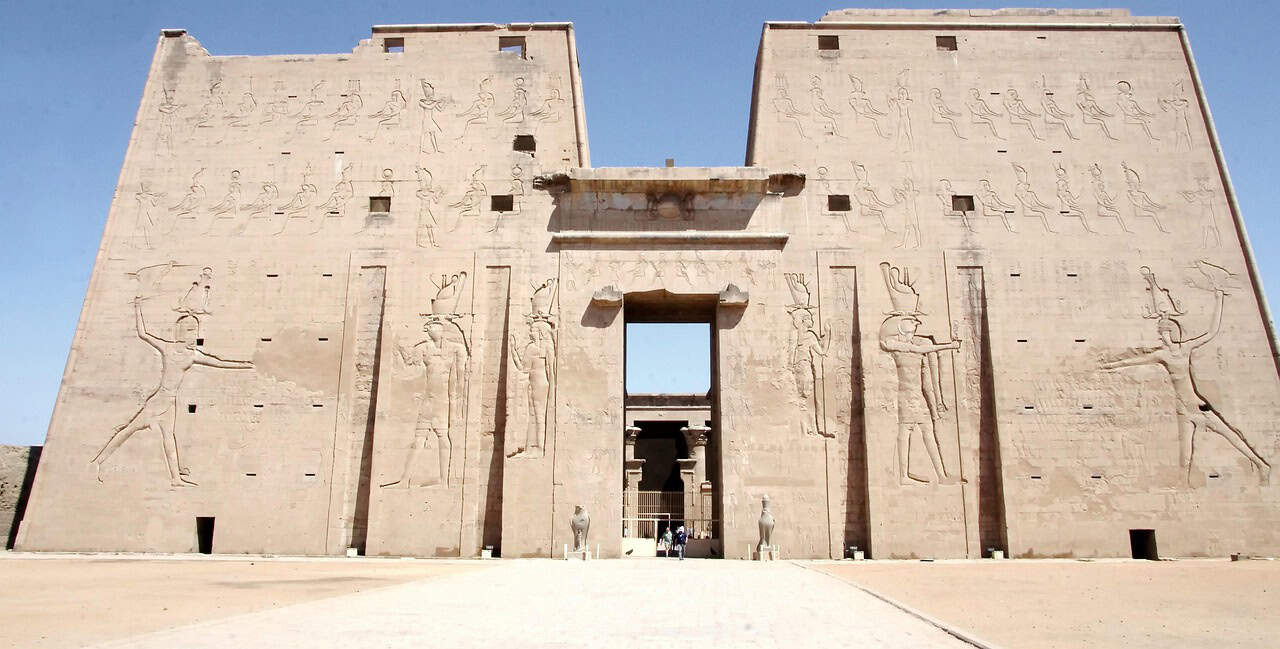
If you want to step into a landmark in Egypt that still feels almost complete, Edfu is the place. Dedicated to Horus, the falcon god, the Temple of Edfu is one of the best-preserved in all of Egypt, thanks to being buried under sand and silt for centuries until it was excavated in the 19th century.
Built during the Ptolemaic period (around 237–57 BC), Edfu’s massive entrance pylons, towering columns, and vivid reliefs show a blend of ancient Egyptian style with some Greek influences. Don’t miss the grand entrance, flanked by two giant statues of Horus in falcon form or the huge hypostyle hall, filled with rows of massive columns carved with intricate hieroglyphs.
Tips to visit: Like Kom Ombo, most travellers visit Edfu during a Nile cruise. These two temples tend to be skipped by the tours by road or train as they are a bit out of the way between Aswan and Luxor.
Siwa Oasis (Western Desert)

Deep in Egypt’s Western Desert, close to the Libyan border, Siwa Oasis feels like a world apart. Surrounded by palm groves and endless dunes, Siwa is also known for its salt lakes and natural springs such as Cleopatra’s Pool, which offers refreshing swims in the middle of the desert.
The oasis remained isolated for centuries, and even today, it retains its own language, traditions, and architecture, with mud-brick houses and old fortified villages crumbling beautifully into the desert. When visiting, don’t miss the ruins of the ancient Shali Fortress or the Temple of the Oracle of Amun (where Alexander the Great is said to have been declared the son of a god).
Fun fact: Siwa’s dates and olives are famous across Egypt; and sampling them fresh here is a must.
Tips to visit: Getting to Siwa takes effort. It’s about an 8 to 10-hour drive from Cairo. Once you arrive, rent a bike to explore the oasis at your own pace, and plan for at least two or three days to really soak in the magic.
Other (not so) famous landmarks in Egypt
White Canyon and Colored Canyon (Sinai)
In the heart of Sinai’s desert, the White Canyon and Colored Canyon offer two completely different but equally stunning hiking experiences.
The White Canyon is a narrow, winding passage through white limestone, often so bright it feels almost otherworldly. It’s a relatively easy walk, ideal for those who want dramatic desert scenery without a tough climb.
Nearby, the Colored Canyon is a maze of sandstone walls streaked with reds, yellows, and purples; like nature’s own art gallery. The paths are tighter and more adventurous, with some scrambling over rocks.
Tips to visit: Both canyons are typically visited from Dahab or Nuweiba with a 4×4 tour. Bring water, good shoes, and go early before the midday heat. A guide is highly recommended to navigate safely.
Ras Mohammed National Park (Sinai)
At the southern tip of the Sinai Peninsula, Ras Mohammed is Egypt’s first and most famous national park and it’s paradise if you love snorkelling or diving. Crystal-clear waters, colourful coral reefs, and an explosion of marine life make it one of the best underwater spots in the world.
Mount Sinai
Sacred to multiple religions, Mount Sinai is believed to be where Moses received the Ten Commandments. The climb to the summit takes about two to three hours, and many people hike at night to catch the sunrise.
Blue Hole (Dahab)
Just north of Dahab, the Blue Hole is a world-famous dive site known for its stunning depth and vivid reef walls. It’s legendary among divers, but even if you’re not diving, snorkelling around the rim is incredible, with endless schools of fish and bright corals close to the surface..
St. Catherine’s Monastery
At the foot of Mount Sinai, St. Catherine’s Monastery is one of the oldest working Christian monasteries in the world. Built in the 6th century, it is home to ancient icons, mosaics, and what is believed to be the biblical Burning Bush.
Mustafa Mosque (Sharm El Sheikh)
In a city best known for beaches and diving, the Mustafa Mosque stands out as a beautiful piece of architecture and culture. Located in the heart of Sharm el-Sheikh, it’s a striking modern mosque with classic Islamic design: grand domes, intricate minarets, and detailed stonework that lights up beautifully at night.
While it’s not ancient, the mosque is a peaceful place to step away from the tourist crowds and experience a bit of Egypt’s spiritual side.
Tips to visit: Non-Muslim visitors are welcome to admire the exterior, but entry inside is typically reserved for prayer times.
Suez Canal
The Suez Canal might not be ancient, but it’s definitely one of Egypt’s modern landmarks. Stretching 193 kilometres, it connects the Mediterranean Sea to the Red Sea and remains one of the world’s busiest and most strategic waterways. You can visit the Canal Zone from cities like Ismailia or Port Said. If you’re lucky, you might catch the surreal sight of massive cargo ships.
Exploring the landmarks in Egypt is like stepping back in time. From the Pyramids of Giza to the Philae Temple and the incredible tombs of the Valley of the Kings, these historic sites are more than just stone and sand; they’re living stories etched into the landscape. I love visiting the country because these places surprised and amazed me more than I expected. Mainly because I visited incredibly beautiful places I had never even heard of!
If you’re planning your adventure and wondering how to fit it all in, I recommend starting with the best things to do in Cairo to get a taste of the city’s ancient and modern sides. From there, a classic Nile cruise can connect you with the temples of Luxor and Aswan, while a trip to the Sinai Peninsula brings you face-to-face with Egypt’s natural wonders.
For a truly immersive experience, consider joining a guided trip like the 8-day guided tour around Egypt with Intrepid [coming soon], where you can explore Egypt’s top landmarks with the benefit of local knowledge and stress-free travel.

ARE YOU ON PINTEREST?
What about saving this post to your Pinterest board?
Click on the photo to save this blog post for later. We are also on the platform and we love pinning great travel tips. Follow Tales From The Lens’ boards to see our latest pins.
Don’t be shy, come say hi!
Please note │ This blog post may also include affiliate links to hostels or products we recommend, which means if you buy something following a link on this page, we’ll get a small commission. This will be of no extra cost to you but will help us continue running this blog. Thank you for your support.

About the Author
Jen is the Funder, Author & Photographer behind Talesfromthelens.comJen has lived for the past 15 years across Oceania and Ireland while also travelling in Latin America, North America, and Europe. She has visited more than 65 countries and set foot on every continent in the world! She is a coffee nerd, passionate about photography, wildlife, and outdoor activities.
For more info, check out the About page.